
ImmoMulti — direct buyer of multi-unit buildings on the North Shore — often meets owners who spent thirty years building an income-property portfolio and discover, too late, the size of the tax bill that will strike at death. The estate freeze is one of the best-known planning strategies to address it: it consists of locking in the current value of your buildings — and the latent capital gains tax attached to it — in your name, while transferring future growth to your children, often through a holding company and a family trust. This article explains the principle, indicates when to consider it, and stresses one golden rule: nothing is set up without a tax specialist and a notary.
What does the estate-freeze principle consist of?
An estate freeze locks in the current value of an asset — here an income-property portfolio — so that its future growth is attributed to the next generation, without immediately triggering capital gains tax on that growth. The owner keeps control and the value already accumulated; the children capture the future appreciation.
The estate freeze rests on a simple idea. Today, your income properties are worth, say, a given amount. Tomorrow, if they keep appreciating, they will be worth more — and it is precisely that growth that will one day be heavily taxed. The freeze "takes a snapshot" of today's value and locks it in your name, while all subsequent appreciation is directed toward your children or a trust.
In practice, the growth shares of a company that holds the buildings are converted into fixed-value preferred shares, and new common shares — the ones that will grow in value — are issued to the next generation. As one tax firm explains, the operation "converts ordinary growth-focused shares into preferred shares with a fixed value, essentially creating a snapshot of the current value while allowing all future appreciation to go to new ordinary shares held by children or a family trust."
Sources: Miller Thomson — Estate freeze; Fiszman Tax Law — Understanding estate-freeze transactions.
Why does tax hit so hard at the death of a property owner?
At your death, the Income Tax Act deems that you disposed of all your property immediately before you died, at fair market value (s. 70(5)). For a rental property, this triggers a capital gain (FMV minus cost), of which 50% is taxable on the final return — unless a spousal rollover applies.

Canada has no "estate tax" as such. What strikes is the deemed disposition rule. According to the Canada Revenue Agency, when a person dies, the law generally considers that they disposed of all their property immediately before death — even though there is no actual sale. Capital property such as an income building is deemed to have been sold at its fair market value on the date of death.
The consequence is direct: the capital gain (fair market value at death, minus acquisition cost) must be reported, and a portion — 50% under the applicable inclusion rate — becomes taxable on the deceased's final return. For a portfolio of plexes bought decades ago and heavily appreciated, the bill can be considerable. Recapture of previously claimed depreciation (CCA) must also be accounted for.
One major exception exists: the spousal rollover. According to Éducaloi, property left to a spouse (or to a qualifying spousal trust) can be transferred at its adjusted cost base rather than fair market value, which defers the capital gain until the spouse sells the property or dies in turn. The property must vest indefeasibly in the spouse within 36 months of the death. The freeze, by contrast, targets the next generation.
Sources: Canada Revenue Agency — Capital gains for a deceased person; Éducaloi — Planning your estate.
How is a freeze actually carried out: holding company and trust
The estate freeze of a real estate portfolio almost always runs through a holding company. The owner exchanges their growth shares for fixed-value preferred shares. This exchange is most often done through a tax rollover — under section 85 or section 86 of the Income Tax Act — so as not to trigger immediate tax at the moment of the freeze itself.
According to Thomson Reuters, "where preferred shares have a fixed value, any subsequent increase in the value of the company's shares is attributed to the ordinary shareholders," which lets the author of the freeze retain control while deferring tax on immediate gains and transferring all subsequent growth to children. At the same time, the corporation issues new common shares to new shareholders of the author's choosing: children, family members, or a family trust.
Why add a family trust?
The discretionary family trust subscribes to the new common shares. It offers two key advantages: flexibility — you do not have to decide today which child receives which building or in what proportion — and control, since you can act as a trustee. It can also facilitate income splitting (subject to the tax on split income rules) and the multiplication of the capital gains exemption in certain structures. In return, the trust is subject to the 21-year rule, which deems a disposition of its property at intervals — something to plan for.
| Element | Before the freeze | After the freeze |
|---|---|---|
| Value locked in your name | Growth shares (variable value) | Fixed-value preferred shares |
| Future appreciation | Belongs to you (taxed at your death) | Attributed to children / trust |
| Control of the company | You | You (control shares / trustee) |
| Latent tax on accumulated gain | Not frozen, grows with value | Locked at the freeze-day level |
Source: Thomson Reuters — Estate-freezing techniques (ITA sections 85 and 86).
When should you consider an estate freeze for your real estate portfolio?
A freeze is considered when the portfolio has significant value and strong growth potential, when the owner wants to pass it to the next generation and keep control during their lifetime. The ideal timing is often a period when the value is low, so as to lock in a smaller latent tax.

A freeze is not a one-size-fits-all solution. It makes sense when several conditions come together:
- A portfolio with value and good growth potential: the larger the expected future appreciation, the greater the interest in transferring it to the next generation.
- A genuine intention to transfer: you want to leave your income properties to your children rather than sell them.
- A desire to keep control: the freeze lets you transfer future value without giving up the reins during your lifetime.
- Good timing: freezing when the value is temporarily low — for example after a market correction — locks in a smaller latent tax.
To validate with your tax specialist before any freeze
- The current fair market value of the portfolio (supported by an appraisal)
- The latent capital gain and the recapture of CCA already claimed
- The choice of vehicle: holding company, trust, or both
- The applicable rollover (s. 85 or 86) and the impact of attribution rules
- The 21-year rule if a trust holds the new shares
"A freeze has the objective of deferring payment of capital gains tax on the growth of a family business or investment portfolio."
— Sun Life, Estate freeze — a practical guideSource: Sun Life — Estate freeze, a practical guide (PDF).
What are the limits, costs and pitfalls of an estate freeze?
A freeze comes with trade-offs that must be weighed coolly. First, by locking in your value, you give up future growth: if your buildings keep appreciating, it is the next generation that benefits, not you. Conversely, if the value falls after the freeze, your fixed-value shares do not decline — but you no longer benefit from a possible rebound either. Some owners plan mechanisms for a "thaw" (refreeze) to reopen the structure if circumstances change.
Next, the administrative complexity and costs are real and ongoing: incorporating and maintaining a holding company, creating a trust, separate annual tax filings, tax-specialist and notary fees. A poorly designed freeze can also trigger attribution rules or immediate tax — the exact opposite of the intended effect.
Never improvise an estate freeze
A freeze touches the Income Tax Act, corporate law and trust law. A mistake can be very costly. Have it structured and documented by a tax specialist and a notary who know your situation. This article is informational; it does not replace professional advice.
The concrete steps of an estate freeze, from first call to signing
An estate freeze generally unfolds in six to eight steps: appraising the fair market value of the portfolio, choosing the structure (holding company and trust), incorporating or reorganizing the company, exchanging shares through a tax rollover (section 85 or 86), issuing the new common shares to the trust, then filing the tax elections and corporate documents. The process rarely takes less than a few weeks and involves a tax specialist, an accountant and a notary.

Many owners picture an estate freeze as a single signing at the notary's office. In reality, it is a coordinated sequence of legal and tax steps, each of which must fall into place correctly for the tax deferral to hold up under an audit. Here is the typical flow, adapted to an income-property portfolio held by an individual or already inside a company.
Step 1 — Establish the fair market value of the portfolio
Every freeze begins with a reliable snapshot of value. You generally have each building appraised by an accredited appraiser, because this fair market value determines the value of the fixed-value preferred shares you will keep. An appraisal that is too low can be challenged by the Canada Revenue Agency and trigger reassessments; one that is too high needlessly locks in a larger latent tax. This is the foundation of the whole operation.
Step 2 — Quantify the latent capital gain and CCA recapture
Before freezing anything, you calculate the latent capital gain (fair market value minus adjusted cost base) and the recapture of depreciation (CCA) already claimed on the buildings. These figures tell you whether the freeze makes sense and when to do it. Recall that, for an individual, capital gains realized up to the annual $250,000 threshold remain included at 50%, while corporations and most trusts have their gains included at 66.67% as of January 1, 2026.
Source: Department of Finance Canada — Deferral in implementation of the capital gains inclusion rate change; Revenu Québec — Harmonization of the inclusion rate (January 1, 2026).
Step 3 — Choose and build the structure
You then decide on the vehicle: a holding company alone, a holding company combined with a discretionary family trust, or the reorganization of an existing company. If the buildings are held personally, they are often first transferred to a company through a section 85 rollover, which allows the tax to be deferred provided the joint election (form T2057) is filed with the receiving company. If the buildings are already in a company, the freeze is instead done through a reorganization of the share capital (section 86).
Source: Canada Revenue Agency — IC76-19, Transfer of Property to a Corporation under Section 85.
Step 4 — Exchange your growth shares for frozen shares
This is the heart of the operation: you exchange your growth common shares for fixed-value preferred shares, whose redemption value equals the fair market value set in Step 1. These frozen shares often carry a voting right that leaves you in control. From that point on, your share of value is capped: it will no longer rise.
Step 5 — Issue the new common shares to the next generation
The company then issues new common shares, at a low value initially, subscribed by the family trust (or directly by the children). These are the shares that will now capture all the future growth of the portfolio. Because the starting value is minimal, subscribing to them costs almost nothing and does not trigger significant immediate tax.
Step 6 — Document, file the elections and maintain the structure
Finally, you document everything: resolutions, registers, shareholder agreements, the trust deed, and above all the tax elections (T2057 for section 85) within the deadlines. Once the freeze is in place, it must be maintained: corporate bookkeeping, T2 returns, an annual T3 trust return, and monitoring of the 21-year rule. A freeze is not a one-time event: it is a living structure.
| Step | Who is involved | Key deliverable |
|---|---|---|
| 1. FMV appraisal | Accredited appraiser | Value report of the buildings |
| 2. Latent gain calc. | Tax specialist / accountant | Estimate of the frozen tax |
| 3. Structure | Tax specialist / lawyer | Reorganization plan |
| 4. Share exchange | Lawyer / notary | Fixed-value preferred shares |
| 5. New shares | Lawyer + trust | Common shares to the next generation |
| 6. Elections and follow-up | Accountant / tax specialist | Annual T2057, T2, T3 |
Each of these steps involves technical choices that depend on your situation. That is why a freeze is prepared with a team — never alone, and never at the last minute.
How much does an estate freeze cost and how do you assess whether it is worth it?
An estate freeze involves setup costs (tax-specialist, lawyer and notary fees, building appraisals, drafting the trust deed) and then recurring costs (corporate accounting, T2 and T3 returns, maintaining the trust). These costs are justified when the latent capital gain and expected future growth are significant; for a very small portfolio, simpler strategies are often enough.

The real question is not "how much does it cost" in absolute terms, but "how much does it cost relative to the tax it defers". A freeze that costs a few thousand dollars to set up and a few hundred a year to maintain can be trivial against a latent capital gain of several hundred thousand dollars on a plex portfolio. Conversely, on a single small, lightly appreciated building, the structure may weigh more than the tax benefit.
Setup costs
- Building appraisals by an accredited appraiser — essential to set the value of the frozen shares.
- Tax-specialist and lawyer fees to design the structure and draft the reorganization and agreements.
- Drafting the trust deed and incorporating the holding company (legal and government fees).
- Notary fees for property transfers, where applicable, and any transfer duties.
Recurring costs
- Annual accounting for the company and filing of the T2 return.
- T3 trust return each year, with the enhanced disclosure obligations.
- Monitoring the 21-year rule and planning to avoid the deemed disposition within the trust.
A simple test before going further
- Does the portfolio have a large latent capital gain (not just a high value)?
- Is the expected future growth significant and over a long enough horizon?
- Do you really want to pass it on rather than sell during your lifetime?
- Does the tax benefit clearly exceed the setup and maintenance costs?
If you answer "yes" to all four, the freeze deserves serious analysis. If you hesitate, a simple calculation of your latent tax on a sale often helps decide between freeze, sale and other avenues.
Estate freeze and the capital gains exemption: how they interact
An ordinary rental building does not qualify for the lifetime capital gains exemption, which is reserved for qualified small business corporation shares (QSBC) and qualified farm or fishing property. In some structures, a freeze can help "multiply" access to this $1,250,000 exemption among several beneficiaries of a trust — but only if the shares qualify as QSBC, which is not automatic for rental real estate.
Many owners hear about the lifetime capital gains exemption and hope to apply it to the sale of their plex. That is rarely possible directly: the exemption targets qualified small business corporation shares (QSBC) as well as qualified farm and fishing property, not the sale of a rental building held personally. The ceiling for this exemption has been raised to $1,250,000.
Source: Canada Revenue Agency — Capital gains deduction (line 25400).
The freeze's indirect role
Where a freeze can play a role is in structuring the ownership so that shares may eventually qualify as QSBC, and so that several beneficiaries of a family trust can each claim the exemption — an effect sometimes called "multiplying the exemption". Be careful: the passive rental nature of the buildings often complicates qualification as QSBC, because a company whose assets consist mainly of rental property may not be a small business corporation. This is highly technical ground.
| Situation | Exemption available? | Note |
|---|---|---|
| Sale of a plex held personally | No | Not a QSBC |
| Shares of a purely rental company | Generally no | Passive assets, hard to qualify |
| Shares of a qualifying active company (QSBC) | Possible | Up to $1,250,000 per person |
| Trust with several beneficiaries | Possible (multiplication) | Only if the shares qualify |
Do not assume eligibility for the exemption
Qualifying a real estate company as a small business corporation is complex and depends on the asset mix, level of activity and many criteria. Never build a freeze on the assumption that the exemption will apply without a detailed analysis by a tax specialist.
The 21-year deemed disposition: the hidden trap of trusts
A personal trust is deemed to have disposed of its property at fair market value on the 21st anniversary of its creation, and every 21 years thereafter. This "21-year rule" prevents tax from being deferred indefinitely inside a trust. In an estate freeze, it must be planned for in advance — often by distributing the shares to the beneficiaries before the deadline, by rollover, to avoid an unexpected tax.
An estate freeze often places the new common shares — the ones capturing growth — inside a family trust. This trust offers flexibility, but it comes with a relentless deadline: the 21-year rule. Under federal legislative proposals, a personal trust is deemed to have disposed of its capital property at fair market value on the 21st anniversary of its creation, and on every 21st anniversary thereafter.
Source: Department of Finance Canada — Explanatory notes (21-year rule for trusts).
Why the rule exists
Without it, a trust could hold frozen shares indefinitely and defer the tax on growth forever. The 21-year rule periodically "resets" the clock by deeming a notional sale, which triggers tax on gains accumulated within the trust if no planning is done.
How it is managed in practice
The classic workaround is to distribute the shares to the beneficiaries (often adult children) before the 21st anniversary, through a rollover that transfers the property at cost, thereby deferring the gain until they actually sell. There are also anti-avoidance rules preventing you from circumventing the 21-year rule by transferring property to another trust: the new trust then "inherits" the anniversary of the old one.
Put it on the calendar from the moment the trust is created
- Record the exact date the trust was settled and the 21st anniversary.
- Plan the distribution or rollover to beneficiaries several years ahead.
- Anticipate the anti-avoidance rules on transfers between trusts.
- Re-validate the planning with your tax specialist well before the deadline.
"The 21-year rule is designed to prevent the indefinite deferral of tax on gains accumulated through a personal trust."
— Based on the explanatory notes of the Department of Finance CanadaA worked example: a plex portfolio frozen at the right time
Take a plex portfolio held for twenty years. Without a freeze, the deemed disposition at death would tax the entire gain accumulated up to death. With a freeze done today, only the gain up to the freeze date stays attached to your frozen shares; all future appreciation is carried by the children or the trust. Here is how the figures compare, purely for illustration.

The following examples are illustrative: they show the mechanics, not your situation. The actual amounts depend on your adjusted cost base, the CCA claimed, your tax rate and the rules in force at the time of disposition. Consult a tax specialist for your exact figures.
The "without a freeze" scenario
Suppose a portfolio whose value goes from $1M today to $1.6M in fifteen years, at the owner's death. The deemed disposition (s. 70(5)) would tax the full gain accumulated up to death, calculated on the difference between fair market value at death and the original adjusted cost base — not forgetting the CCA recapture. All fifteen years of growth are added to the final bill.
The "with a freeze today" scenario
By freezing today at $1M, your fixed-value preferred shares stay frozen at that value. At your death, only the gain up to the freeze date remains attached to these shares. The $600,000 of growth over the following fifteen years is carried by the common shares held by the trust or the children — it no longer inflates your final return.
| Item | Without a freeze | With a freeze today |
|---|---|---|
| Value frozen in your name | $1.6M (at death) | $1.0M (at the freeze) |
| Future growth (15 years) | In your estate | With the next generation / trust |
| Gain taxed on your final return | On the whole value | On the frozen value only |
| Control during your lifetime | Yes | Yes (control shares) |
This gap illustrates the core of the freeze: it is not a disappearance of tax, but a transfer of future growth out of your taxable estate. The stronger the expected growth and the longer the horizon, the more pronounced the effect — hence the importance of timing.
Alternatives to an estate freeze for a property owner
A freeze is not the only path. Depending on your situation, a tax specialist may propose: the spousal rollover (deferring the gain until the spouse's death), gradual gifting or selling to the children, life insurance to fund the tax at death, holding in a company without a freeze, or simply selling during your lifetime to crystallize the value and simplify the estate.

Before taking on the costs of an estate freeze, it is worth comparing the other estate-planning tools. Each meets a different objective — deferring the tax, funding the tax, or eliminating it by selling — and several can be combined.
The spousal rollover
Property left to a spouse (or to a qualifying spousal trust) can be transferred at its adjusted cost base rather than fair market value, which defers the gain until the spouse sells or dies. The property must vest indefeasibly in them within 36 months of death. It is often the first line of defence, but it merely pushes the deadline back one generation.
Life insurance to fund the tax
Rather than reducing the tax, some owners choose to fund it: a life insurance policy pays out, at death, a capital sum meant to cover the tax bill, sparing the estate from having to sell a building in a hurry. This approach combines well with a freeze or with the spousal rollover.
Gradual gifting or selling
You can also transfer the buildings to the children gradually, by gift or sale, spreading the realization of the gain over several years. Be careful: an inter vivos gift of a building generally triggers a disposition at fair market value, therefore an immediate gain — it is not a tax-free shortcut.
Selling during your lifetime
Finally, the simplest solution is sometimes to sell. Crystallizing the value during your lifetime gives you liquidity, fixes the tax once and for all, and radically simplifies your estate. For many North Shore owners approaching retirement, it is the most peaceful option — especially when managing a portfolio becomes a burden.
| Strategy | Effect on tax | Keeps control? |
|---|---|---|
| Estate freeze | Defers tax on future growth | Yes |
| Spousal rollover | Defers to the spouse's death | Partial |
| Life insurance | Funds the tax (does not reduce it) | Yes |
| Gift / sale to children | Realizes the gain (often immediate) | No |
| Sale during your lifetime | Crystallizes the tax now | No (but liquidity) |
Source: Éducaloi — Planning your estate: strategies for reducing or postponing taxes.
What it changes for a plex portfolio on the North Shore
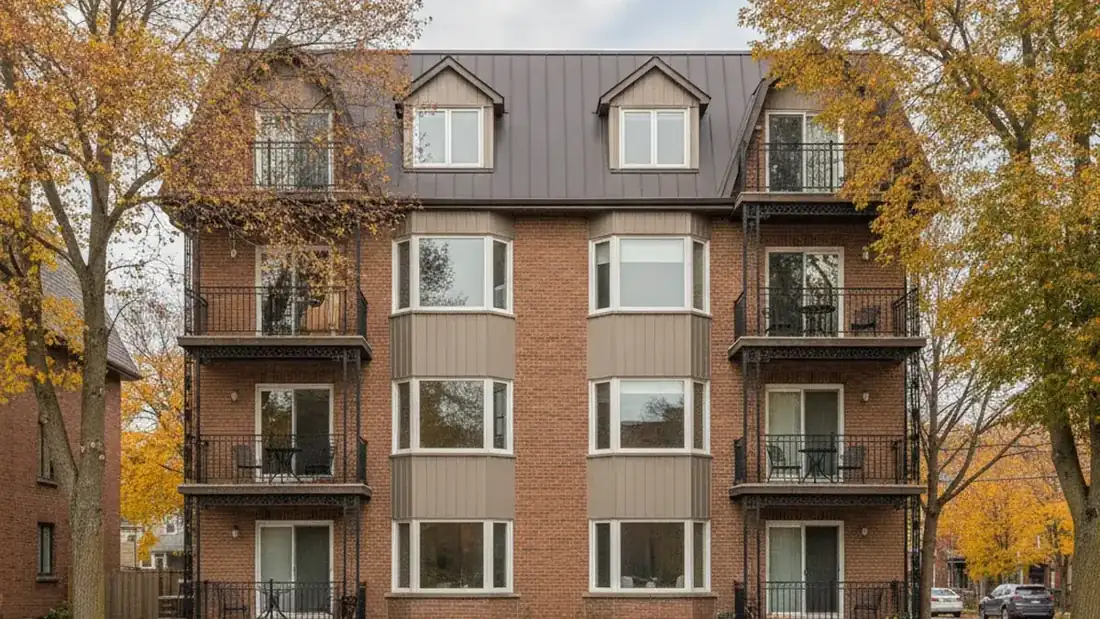
On the North Shore of Montréal — Terrebonne, Mascouche, Blainville, Boisbriand, Saint-Jérôme, Saint-Eustache, Deux-Montagnes, Mirabel — many owners hold one or more plexes bought twenty or thirty years ago, whose value has climbed sharply. For these portfolios, the question of the latent capital gain at death is far from theoretical: the deemed disposition could force an estate to sell a building simply to pay the tax.
The estate freeze is one possible answer, but the cost of the structure must be weighed against the value of the portfolio. For a single small plex, a tax specialist might conclude that simpler strategies suffice; for a portfolio of several multi-unit buildings, the case for a freeze grows. Before any decision, it is useful to quantify your latent gain and compare transfer and sale scenarios.
ImmoMulti offers neither tax advice nor a freeze service — that is the role of your tax specialist and your notary. However, if you conclude that selling your building during your lifetime is the best route (for example to crystallize value, simplify your estate or free up your capital), we can make you a direct offer. To understand the tax at stake on a sale, see our guide on capital gains when selling your plex and our article on CCA recapture.
ImmoMulti: direct buyer of multi-unit buildings on the North Shore
If your planning leads you to consider selling one or more income properties, we buy directly, with no broker and no commission, in full confidentiality. Get a proposal within 48 hours.
To explore other planning and sale avenues, see also our guide to selling an inherited income property in Québec.