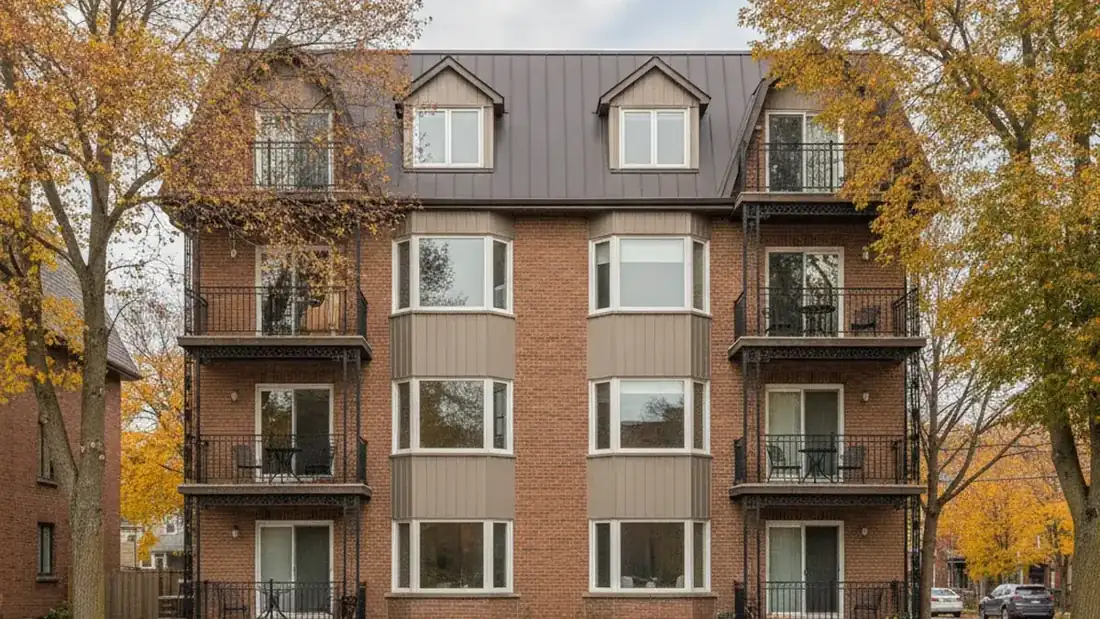
Real Estate Inheritance in Quebec Taxes, Capital Gains & Estate 2026
Inheriting a building or home in Quebec? Contrary to popular belief, a real estate estate transfer is not tax-free. This comprehensive guide demystifies every applicable tax and the strategies to protect your inheritance.
No inheritance tax
In Canada — but indirect taxes exist
50% taxable
Of capital gain at death
37–53%
Combined marginal rate in Quebec
Estate Taxation in Quebec — The Basics
In Quebec, there is no estate tax as such. However, the transfer of real estate as part of an estate carries important tax implications that every heir should understand.
The central mechanism is the deemed disposition: at death, the deceased is deemed to have sold all their assets at fair market value. It is the estate (not the heir directly) that must pay the taxes before distributing the assets.
💡
The liquidator's roleThe estate liquidator is responsible for filing the deceased's tax returns, calculating the taxes owing, and obtaining a clearance certificate authorizing the distribution of assets. A certificate for partial distribution can be requested to speed up the process.
The 4 Taxes That May Apply in a Real Estate Estate
Four taxes may apply when a property is transferred as part of an estate.
01 — The largest bill
Capital Gains Tax
The biggest charge in a real estate estate. All properties other than the principal residence are affected: income properties, cottages, land, commercial properties.
Calculation: Fair market value at death − original acquisition cost = capital gain. Half of that amount is added to the taxable income on the deceased's final return.
02 — Often overlooked
GST and QST on the Transfer
If the property transferred is a commercial or income property registered for GST/QST, the estate may need to collect and remit GST (5%) and QST (9.975%).
Exception: If the heir is themselves registered for GST/QST, the estate is not required to collect these taxes. Verify registration status before the transfer.
03 — Depends on family relationship
Land Transfer Tax (Welcome Tax)
The land transfer tax (welcome tax) applies when title changes hands. In an estate, significant exemptions exist.
Exempt: Direct-line transfers (parent→child, grandparent→grandchild) and transfers between spouses.
Not exempt: Siblings, nieces, nephews. On a $600,000 property, the bill can exceed $8,000.
04 — Estate obligation
Unpaid Property Taxes
Unpaid property taxes owed by the deceased must be settled by the estate before distributing assets. The heir who keeps the property assumes responsibility for property taxes from the transfer date onward.
Concrete Example — Capital Gains Tax Calculation
6-plex purchased 20 years ago — Current value $850,000
Original acquisition cost$350,000
Fair market value at death$850,000
Total capital gain$500,000
Taxable portion (50%)$250,000
Combined marginal rate (Quebec)~37% to 53%
Estimated tax bill$90,000 – $130,000
✅
Principal residence exemptionThe deceased's principal residence is generally exempt from capital gains tax thanks to the principal residence exemption. This exemption does not apply to income properties.
Special Considerations for Income Properties in an Estate
Rental income and tax returns
All rental income generated between January 1 and the date of death must be reported on the deceased's final return. If the estate continues to collect rent during the settlement period, that income must be reported on the estate's income return (a separate tax entity).
Impact of a real estate portfolio
A portfolio of several buildings significantly increases the estate's tax bill.
An owner holding multiple properties exposes their estate to a substantial tax bill. Without planning, heirs could find themselves in a situation where liquid assets are insufficient to pay the tax — forcing a rushed sale of certain assets.
⚠️
Avoid a forced saleIf you inherit a property you do not wish to keep, a quick sale to a direct buyer can avoid the delays and costs of a traditional listing while resolving the situation quickly.
GST/QST registration
If the income property was registered for GST/QST purposes, the liquidator must ensure that the obligations related to these taxes are met: filing returns for the period up to the date of death and managing the transition of the registration to the heirs.
Frequently Asked Questions — Real Estate Inheritance Quebec
No, Canada does not impose a direct inheritance tax. However, the deemed disposition at death can trigger capital gains tax on the deceased's final return. It is the estate that pays, not the heir directly — but the assets transferred may be significantly reduced.
No. The deceased's principal residence is generally exempt from capital gains tax thanks to the principal residence exemption. This exemption does not apply to income properties, cottages, land, or commercial properties.
It depends on the family relationship. Direct-line transfers (parent→child, grandparent→grandchild) and transfers between spouses are exempt. Transfers between siblings, nieces, nephews, or friends are subject to the full tax. A supplementary duty of up to $200 may still apply even when an exemption exists.
Capital gain = fair market value at death − original acquisition cost. Half of that gain (50% inclusion rate) is added to the taxable income on the deceased's final return and taxed at combined marginal rates (federal + provincial), which can reach 37% to 53% in Quebec.
Yes, in certain cases. A property transferred to a surviving spouse can be transferred at adjusted cost base (without triggering an immediate capital gain). The gain is then deferred until the spouse subsequently disposes of the property. Similar rules may apply to trusts and advanced estate planning — consult a tax specialist.
Capital gains tax is part of the deceased's final return. For a death between January 1 and October 31, the return must be filed by April 30 of the following year (or June 15 if the deceased or their spouse was carrying on a business). For a death in November or December, the deadline is 6 months after the date of death. The liquidator must ensure that the tax is paid before distributing assets to the heirs.
If the estate's liquid assets are insufficient to pay the tax, heirs may be forced to sell certain real estate assets. A quick sale to a direct buyer can avoid the delays and costs of a traditional listing while meeting tax deadlines.
Potentially yes for commercial or income properties registered for GST/QST. If the heir is themselves registered for GST/QST, the estate is not required to collect these taxes. Verify this status before the transfer to avoid a tax surprise.
Strongly recommended. An income property estate involves tax returns (GST/QST, capital gains tax), title transfers, obligations to tenants, and potentially negotiations with tax authorities. A notary, tax specialist, and accountant are key players to involve quickly.
The estate assumes the debts attached to the property, including the outstanding mortgage balance. Heirs can take over the loan, refinance, or sell the property to settle the obligations. Confirm the procedure with the liquidator and notary.
This guide is provided for informational purposes only and does not constitute legal or tax advice. Consult a notary, tax specialist, or accountant for advice tailored to your personal situation. Last updated: June 2026.