
ImmoMulti — direct buyer of income properties on the North Shore — guides plex owners through every step of a sale. And one item comes up again and again at inspection: balconies, galleries and guardrails. A guardrail that is too low, balusters that are too widely spaced or a rotted wood structure are not merely cosmetic annoyances — they are matters of safety, of Construction Code compliance and of civil liability. A failing balcony can injure a tenant, delay a transaction and expose the owner to a lawsuit. Here are the current standards, your obligations and the concrete effect on the value of your income property.
What guardrail height does the Construction Code require?
Under the Québec Construction Code (Building chapter, subsection 9.8.8), a guardrail must be at least 900 mm high when the surface it protects is 1,800 mm or less above the adjacent level, and at least 1,070 mm above 1,800 mm. A guardrail becomes mandatory as soon as a walking surface exceeds 600 mm above the ground.
The rule is simple in principle but often misapplied on older plex buildings. The Régie du bâtiment du Québec (RBQ) administers the Construction Code, which adopts the requirements of the National Building Code adapted for Québec. For a residential balcony or gallery, guardrail height is measured from the walking surface to the top of the handrail.
Concretely: a floor balcony less than 1,800 mm above ground may have a 900 mm guardrail, but as soon as the potential fall exceeds 1,800 mm — as is the case for most second- and third-floor galleries of a triplex — the guardrail must reach 1,070 mm. Many older buildings show 36-inch (914 mm) guardrails where 42 inches (1,067 mm) would now be required.
The key benchmarks
- Guardrail required from 600 mm in height;
- 900 mm minimum if the surface is 1,800 mm or less above ground;
- 1,070 mm minimum above 1,800 mm of fall height;
- Resistance to a minimum load set out in the Code (guardrail firmly anchored).
Source: Régie du bâtiment du Québec — Construction Code, Building chapter (subsection 9.8.8, guardrails). Always check the version in force; a municipality may impose stricter requirements.
Baluster spacing: why the 100 mm rule matters

Height is not everything: baluster spacing is a crucial safety element, especially in a multi-unit building where children move around. The Construction Code requires that no element, support or opening located between 140 mm and 900 mm above the protected surface facilitate climbing — the "no-climb" rule intended to keep a young child from climbing over the guardrail.
In practice, the openings of a residential guardrail must not allow a 100 mm spherical object to pass through. This limit prevents a child from getting their head stuck or slipping entirely through. Old guardrails with horizontal or widely spaced balusters are especially problematic and are routinely flagged when a plex is inspected.
The guardrail must also be solidly built and anchored: the RBQ points out that it must resist minimum horizontal and vertical loads set out in the Code. A guardrail that moves, comes loose or has rusted fasteners no longer does its job, regardless of its height.
| Requirement | Standard (residential) |
|---|---|
| Guardrail required from | 600 mm above adjacent ground |
| Height (surface ≤ 1,800 mm) | 900 mm minimum |
| Height (surface > 1,800 mm) | 1,070 mm minimum |
| No-climb zone | No foothold between 140 and 900 mm |
| Maximum opening | Does not allow a 100 mm object to pass |
Source: RBQ — Structural resistance of guardrails. Dimensions are given for reference; refer to the current regulatory text.
Who is liable if a balcony collapses or someone falls?
Article 1467 of the Civil Code of Québec makes the owner liable for injury caused by the ruin, even partial, of their immovable, whether it results from a lack of maintenance or a defect of construction. The collapse of a balcony or gallery is considered ruin of the immovable.
This is the most consequential point for a plex owner. The Civil Code imposes a duty of maintenance: if a balcony gives way, if a rotted guardrail fails or if a defective step causes a fall, the owner's liability can be engaged. To establish that liability, a victim must show that the owner held the immovable at the time of the accident, that there was ruin (total or partial) resulting from a defect or lack of maintenance, and a causal link with the injury.
"The owner of an immovable, without prejudice to his liability as custodian, is bound to make reparation for injury caused by its ruin, even partial, where this has resulted from a lack of maintenance or a defect of construction."
Article 1467, Civil Code of QuébecIn other words, an owner cannot simply ignore an aging balcony. A missing guardrail on a staircase, rotted decking or a rusted anchor amounts to an insufficiently signalled danger that can trigger liability. This is also why adequate civil liability insurance and documented maintenance are essential for any income-property owner.
Caution
This article sets out the broad principles. Every accident or dispute is specific: consult a lawyer to assess your situation and your insurance coverage before any incident or claim.
Source: Civil Code of Québec, art. 1467 (LégisQuébec).
Façade inspection and municipal oversight: what applies (or not) to your plex

Since 2013, the Building chapter of the Safety Code in Québec has imposed a precise obligation: owners of buildings with at least one façade of 5 or more above-ground storeys must have those façades verified by an architect or engineer, obtain a report confirming the absence of a dangerous condition, and renew that verification every 5 years. The rule is aimed in particular at preventing falling material — including pieces of concrete balcony or guardrail.
The majority of duplexes, triplexes and quadruplexes on the North Shore fall below this 5-storey threshold and are therefore not subject to this mandatory façade inspection. But note: this in no way relieves the owner of the duty of safe maintenance. Cities have by-laws on building sanitation and safety that require all parts of a building — balconies, guardrails, staircases, walls — to be kept in good condition at all times.
A city like Montréal specifically regulates balconies, staircases and other projecting elements and can intervene on a complaint. On the North Shore — Terrebonne, Mascouche, Blainville, Boisbriand, Saint-Jérôme, Saint-Eustache, Deux-Montagnes — planning departments can require an unsafe balcony to be brought up to code and impose a permit for any rebuild. Always confirm the requirements with your municipality.
Sources: RBQ — Inspection of façades of 5 storeys and more · City of Montréal — Balconies, staircases and other projecting elements.
How to spot a risky balcony or gallery on your plex
Before listing a plex, a careful look at the balconies avoids nasty surprises at inspection. Here are the most common warning signs on North Shore income properties:
- Rotted, split or soft wood in the beams, decking or posts;
- A guardrail that moves, comes loose or whose screws and anchors are rusted;
- Balusters spaced too far apart (over 100 mm) or horizontal balusters that make climbing easy;
- A guardrail that is too low versus current standards (36 in. instead of 42 in.);
- Crumbling concrete with exposed, rusted rebar on concrete balconies;
- Reverse slope that retains water and speeds up deterioration;
- Abnormal vibration or deflection of the balcony under weight.
A building inspector or an engineer can confirm whether a balcony needs a simple repair or a full rebuild. Documenting the condition and any work done strengthens your position at the time of sale and limits the risk of a latent defect.
What impact does a non-compliant guardrail have on the sale of a plex?

A non-compliant balcony or guardrail has a direct effect on a transaction. In a traditional sale, the pre-purchase inspection will systematically flag it. The buyer may then request a price reduction, demand corrective work before closing, or even walk away if the scope of repairs worries them. A mortgage lender or insurer may also impose conditions tied to the condition of the structure.
Worse still: a known but undisclosed defect can turn into a latent (hidden) defect, exposing the seller to a claim after the sale. That is why transparency is your best protection. Two strategies are available to an income-property owner:
- Repair before the sale: replacing a non-compliant guardrail or rebuilding a balcony can unlock a transaction and reassure the buyer, provided you obtain the required permits;
- Sell transparently to a direct buyer: selling the property "as is" to a specialized buyer such as ImmoMulti avoids fronting the cost of the work and managing back-and-forth inspections.
In both cases, knowing the true condition of your balconies and guardrails lets you negotiate from a position of strength rather than face a last-minute discovery. A multi-unit building whose exterior elements are sound and compliant sells faster and at a better price.
Anatomy of a plex balcony: understanding each part and its weakness
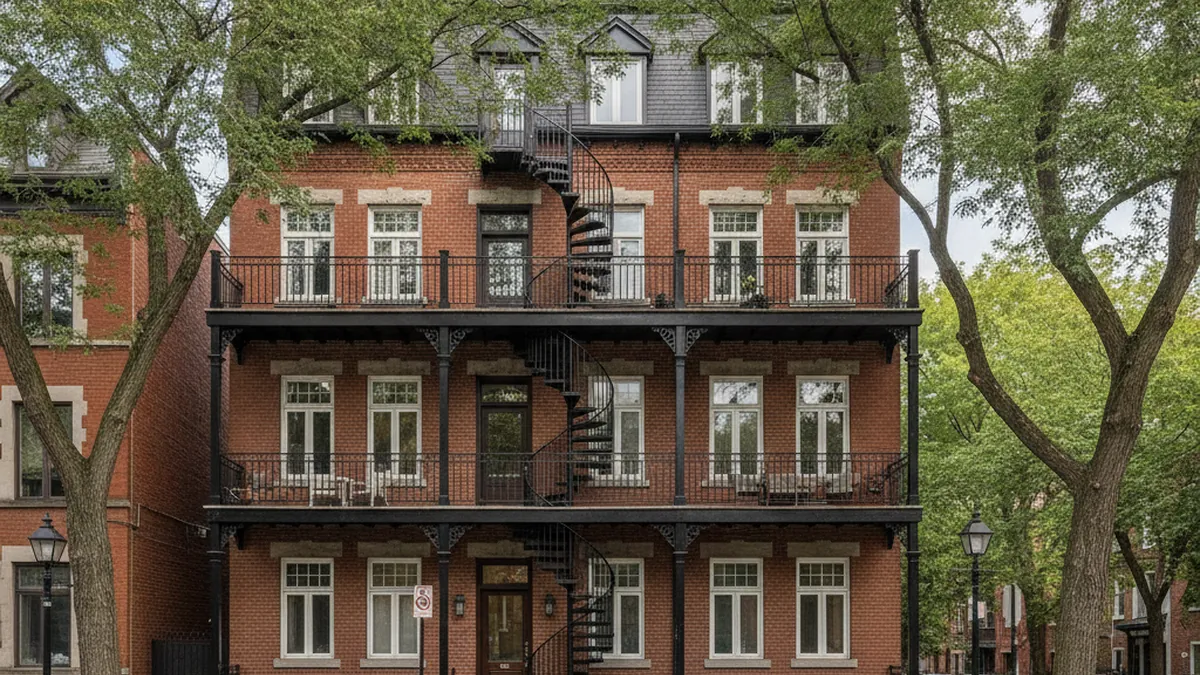
Before judging whether a balcony is safe, you have to know what it is made of. On a typical plex on the North Shore — a duplex, triplex or quadruplex built between the 1950s and the 1990s — an exterior gallery is an assembly of several components, each aging at its own pace and each capable of becoming the weak link. An owner-seller who understands this anatomy spots problems well before the inspector does and negotiates from a solid position.
The load-bearing structural components
The load-bearing structure is what keeps the balcony from falling. It includes the joists (the horizontal beams that support the decking), the ledger beam anchored to the building wall, the posts that carry the load down to the ground, and the anchors — bolts, metal brackets, plates — that tie it all together. On a floor balcony, the most critical element is often the connection between the ledger and the wall: a rusted or poorly sealed anchor lets water in, rots the framing behind the cladding and can cause a sudden detachment. This is exactly the kind of hidden failure that article 1467 of the Civil Code refers to when it speaks of the "ruin" of the immovable.
The decking and walking surface
The decking is the surface you walk on: treated wood planks, concrete slabs, composite panels or membrane over plywood. It is the most visible part and the first to deteriorate under freeze-thaw, standing water and de-icing salts. Decking that deflects, "sounds hollow" or has lifting planks often betrays a deeper problem in the joists. A reverse drainage slope — one that retains water toward the wall instead of shedding it — accelerates rot and is a major red flag before selling a multi-unit building.
The guardrail and handrail
The guardrail is the safety element in the strict sense: it is what prevents a fall. It is made up of the posts (vertical uprights), the balusters or infill (glass, perforated sheet, mesh), the top handrail and the fasteners anchoring it to the decking or structure. It is also the component most often non-compliant on older plexes: insufficient height, over-spaced balusters, rusted fasteners. A guardrail may look solid to the eye yet give way under a lateral push if its anchors are corroded.
| Component | Role | Typical failure | Risk level |
|---|---|---|---|
| Ledger / wall anchors | Hold the balcony to the building | Corrosion, infiltration, detachment | High (possible ruin) |
| Joists | Support the decking | Rot, deflection, cracks | High |
| Posts | Carry the load to the ground | Rot at the base, misalignment | Medium to high |
| Decking | Walking surface | Soft wood, reverse slope, lifting | Medium |
| Guardrail | Prevent falls | Too low, spaced balusters, loose anchor | High (safety) |
| Handrail | Grip for circulation | Non-compliant height, weak fastening | Medium |
This reading grid is the basis of a plex inspection: each component is checked individually, but their safety depends on the whole. A perfectly compliant guardrail fixed to rotted decking offers no real protection. That is why a building inspector always assesses a balcony as a system, from the attachment wall to the handrail.
Source: Régie du bâtiment du Québec — Building chapter of the Construction Code. Component description for explanatory purposes; have a specific case assessed by a professional.
Wood, concrete, steel or aluminum: which material to rebuild a guardrail

When it comes time to replace a guardrail or rebuild a gallery before selling a plex, the choice of material affects cost, future maintenance, lifespan and buyer appeal all at once. No material is "the best" in absolute terms: the right choice depends on the building's style, the budget and the holding horizon. Here are the four main families found on North Shore income properties.
Treated wood and cedar
Wood remains the most common material on older Québec plexes. It is cheap to buy, easy to work with and blends well with the character of brick triplexes. Its Achilles heel: maintenance. A wood guardrail needs staining or painting every few years, and wood in contact with water eventually rots. It is a sensible choice for an owner who wants to repair cheaply before a quick sale, less so for one seeking to eliminate long-term maintenance.
Concrete
Concrete balconies — poured or precast — equip many plexes from the 1960s to 1980s. Robust and non-combustible, they nonetheless suffer from concrete spalling: when water reaches the steel rebar, it rusts, swells and cracks the concrete apart (the "delamination" phenomenon). Exposed, rusted rebar on a concrete balcony is a serious warning that warrants an engineer's opinion before listing.
Galvanized steel and aluminum
Aluminum and galvanized steel dominate the new-guardrail market. Aluminum does not rust, requires almost no maintenance and comes in baluster, glass or perforated-sheet models that easily meet the 100 mm rule. Galvanized steel, heavier and stiffer, suits long spans. Their upfront cost is higher than wood, but the absence of maintenance and the "new and compliant" look reassure the buyer of a multi-unit building.
| Material | Indicative lifespan | Maintenance | Main strength | Weakness |
|---|---|---|---|---|
| Treated wood | 15-25 years | High (stain every 2-4 yrs) | Cost, character | Rot, upkeep |
| Cedar | 20-30 years | Medium to high | Natural resistance | Price, greying |
| Concrete | 40-60 years | Low | Robust, non-combustible | Spalling, rusted rebar |
| Galvanized steel | 25-40 years | Low to medium | Stiffness, spans | Weight, corrosion if coating pierced |
| Aluminum | 30-50 years | Very low | No rust, compliant | Upfront cost |
The lifespans above are indicative and vary with exposure, quality of installation and upkeep. For an owner selling "turnkey," a compliant aluminum guardrail is often the best peace-of-mind-to-price ratio; for one selling "as is," it may be more profitable to redo nothing and adjust the price accordingly.
To remember before choosing
- Quick sale on a small budget: repair in wood, get the permit, document;
- Eliminate maintenance: compliant aluminum with balusters or glass;
- Spalled concrete balcony: engineer's opinion before any decision;
- "As is" sale: cost out the work and adjust the price rather than fronting the expense.
Structural resistance: the loads a guardrail must withstand
Height and baluster spacing are useless if the guardrail gives way under pressure. The Québec Construction Code therefore requires that every guardrail resist minimum loads applied at any point and in any direction. For a plex owner, understanding these requirements helps distinguish a guardrail that is merely "old" from one that is genuinely dangerous.
The regulatory loads on the handrail
According to the requirements set out by the Régie du bâtiment du Québec, a residential guardrail must resist a minimum concentrated load of about 1.7 kN (roughly 173 kg) applied at any point on the handrail, as well as a distributed horizontal load of about 0.7 kN per linear metre. These values correspond to subsection 9.8.8 for Part 9 buildings and article 4.1.5.15 for Part 3 buildings. In concrete terms, a compliant guardrail must withstand, without dangerous deflection, the push of a group of adults leaning on it or the impact of a person tripping.
"A guardrail must be able to resist the minimum prescribed loads, both a concentrated load and a distributed load applied at any point and in every direction."
Régie du bâtiment du Québec — Structural resistance of guardrailsA guardrail that moves when pushed, whose posts pivot in their anchors or whose screws are rusted no longer meets these loads, even if its height is correct. This point is often misunderstood: a guardrail's compliance is judged not only with a tape measure but also by its actual solidity.
The loads on the decking itself
The decking of a residential balcony must also support a minimum live load set out in the Code, to which Québec adds the snow load — far from negligible on the North Shore, where winter accumulation can exceed several hundred kilograms on a gallery. A balcony designed to the standards of its era can be weakened by rot to the point of no longer carrying these loads. That is why a balcony that vibrates, deflects or "works" under weight should be assessed before winter and before listing.
| Load | Indicative requirement (residential) |
|---|---|
| Concentrated load on the handrail | 1.7 kN (~173 kg) at any point |
| Distributed horizontal load | 0.7 kN/m linear |
| Live load on the decking | Per the Code (Part 4 / 9.4) |
| Snow load | Per the locality (North Shore) |
Sources: RBQ — Structural resistance of guardrails · NRC — Québec Construction Code, Chapter I Building (NBC 2015 amended). Indicative values; the calculation for a specific case is an engineer's task.
Acquired rights, code compliance and the triggers that bring them into play
"My plex was built in the 1970s — are my 36-inch guardrails illegal?" This is one of the most frequent questions from owner-sellers. The answer rests on a single principle: acquired rights. A balcony built in compliance with the standards in force when it was built generally does not have to be rebuilt to the current Code, as long as no major work touches it and it remains safe.
What acquired rights protect
Acquired rights protect the existing configuration: a 914 mm (36 in.) guardrail installed in compliance with the rules of its era may remain in place without the law requiring it to be raised to 1,070 mm. But this protection has strict limits. It does not extend to an element that has become dangerous: the duty of maintenance imposed by article 1467 of the Civil Code and by municipal by-laws remains in full, regardless of the year of construction. An "acquired-right" guardrail that is rotted, loose or wobbly must be repaired or replaced.
The triggers that bring the current code into play
Certain events cause the acquired right to lapse and trigger the application of the current Code. Knowing them avoids nasty surprises at the time of the work:
- Complete rebuild of a balcony or gallery: the new structure must meet current height, spacing and resistance standards;
- Replacement of the guardrail: a new guardrail must be compliant, even if the old one benefited from acquired rights;
- A structural change (new joists, new anchors, enlargement) requiring a permit;
- A dangerous condition observed by the municipality, which can order compliance regardless of acquired rights;
- A change of use or major transformation of the building.
The "we'll just fix one part" trap
Replacing a section of guardrail or rebuilding half a gallery may, depending on the municipality, be considered work that triggers full compliance of the affected portion. Before undertaking a partial repair, confirm with the planning department whether the acquired right is kept or lost.
For an owner preparing to sell a plex, the nuance is strategic: an "acquired-right" guardrail is disclosed as is to the buyer, whereas a guardrail you choose to rebuild must be brought up to current standards, permit in hand. Documenting the year of construction and past renovations strengthens the seller's position.
Source: RBQ — Compliance according to the year of construction. Acquired rights are assessed case by case; consult your municipality.
North Shore and Montréal by-laws: what applies to your plex
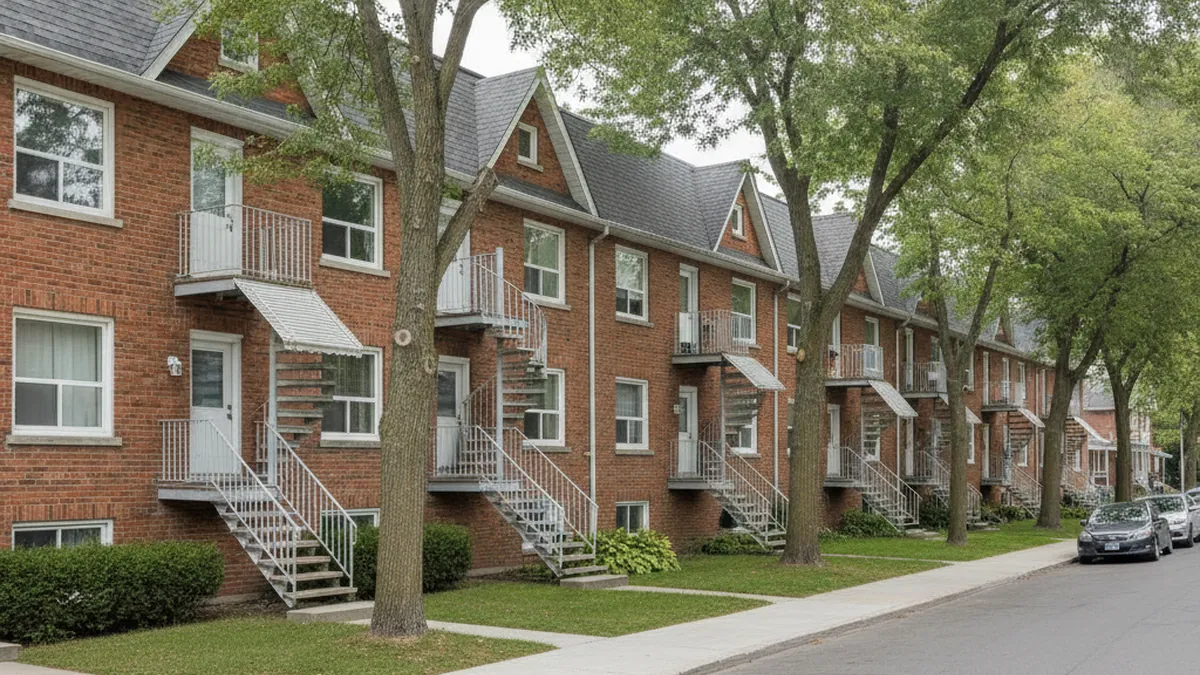
Beyond the provincial Construction Code, every city has its own occupancy and maintenance by-laws, along with sanitation and building-safety rules. These municipal by-laws often impose more concrete and more immediate obligations than the Code itself, because they let a municipal inspector intervene directly on a complaint. For a plex owner on the North Shore, it is essential to know that these two regulatory layers stack on top of each other.
Montréal: the occupancy and maintenance by-law
The City of Montréal adopted a By-law concerning the occupancy and maintenance of buildings (23-016), in force since October 24, 2023, which replaces the former by-law 07-034. It requires that all parts of a building — including balconies, terraces, staircases, cornices and gutters — be kept in good condition and free of danger. A balcony or guardrail deemed dangerous can be the subject of a correction notice, and even an intervention at the owner's expense if it is not remedied.
The North Shore: comparable by-laws city by city
The North Shore municipalities — Terrebonne, Mascouche, Repentigny, Blainville, Boisbriand, Sainte-Thérèse, Saint-Jérôme, Saint-Eustache, Deux-Montagnes, Rosemère — have construction and safety by-laws that, while not identical, pursue the same objectives: keeping buildings in good condition, a mandatory permit for rebuilding a balcony or staircase, and compliance with the current Code for any new structure. Thresholds, deadlines and permit fees vary from one city to another, which is why you should verify directly with the relevant planning department.
| Level | What it governs | Who enforces |
|---|---|---|
| Construction Code (provincial) | Design standards: guardrail height, spacing, loads | RBQ / municipality via permit |
| Safety Code (provincial) | Safe maintenance; façade inspection for 5+ storeys | RBQ |
| Municipal maintenance by-law | Good condition, sanitation, danger, correction notice | City (municipal inspector) |
| Municipal construction by-law | Permit for rebuild, zoning, setbacks | City (planning department) |
This regulatory architecture explains why two neighbouring plexes can be treated differently: one within Montréal's territory subject to by-law 23-016, the other in a North Shore city with its own framework. In every case, the duty of safe maintenance and the liability of article 1467 remain constant.
Sources: City of Montréal — Occupancy and maintenance of buildings (by-law 23-016) · City of Montréal — Balconies, staircases and projecting elements. Confirm the applicable by-law with your North Shore municipality.
Step-by-step balcony rebuild procedure and indicative budget
An owner who decides to rebuild a balcony or guardrail before selling a plex benefits from an orderly approach. An improvised rebuild, without a permit or documentation, can backfire on the seller at inspection time. Here are the typical steps of a rebuild project on a North Shore income property.
Step 1 — Professional diagnosis
First, have the balcony assessed by a building inspector or, for a concrete structure or a structural failure, by an engineer. The diagnosis establishes whether a simple repair (replacing a guardrail, a few planks) or a full rebuild (joists, anchors, posts) is needed. This report becomes a valuable piece of the sale file.
Step 2 — Municipal permit
Rebuilding or structurally modifying a balcony generally requires a permit. File the application with the planning department along with plans and a description of the work. The permit ensures the structure will comply with the current Code and protects the seller: a balcony rebuilt without a permit may be demanded "to be demolished and redone" by a wary buyer.
Step 3 — Choosing the contractor and material
Use a contractor holding a valid RBQ licence and request several quotes. The choice of material (wood, aluminum, concrete) is made according to budget and sale horizon, as seen above. Require detailed quotes distinguishing labour, materials and debris disposal.
Step 4 — Work, inspection and documentation
During the work, keep photos, invoices and the permit. At the end, a municipal inspection may be required to close the permit. This complete file — report, permit, invoices, contractor's warranty — reassures the buyer and sharply limits the risk of a latent-defect claim.
| Type of work | Typical scope | Indicative cost range |
|---|---|---|
| Guardrail replacement (aluminum) | One gallery section | A few thousand dollars |
| Decking rebuild | Planks + partial joists | Several thousand dollars |
| Full rebuild of a wood gallery | Structure, decking, guardrail, posts | Five figures depending on size |
| Repair of a spalled concrete balcony | Rebar treatment, patching or rebuild | Variable — engineer's opinion required |
The ranges above are deliberately general: the real cost depends on the size of the balcony, access, material and the condition of the underlying structure. Always request firm quotes. To gauge the scale of a renovation budget before deciding between "repair" and "sell as is," the ImmoMulti renovation calculator gives a first order of magnitude.
Ten common mistakes plex owners make with their balconies
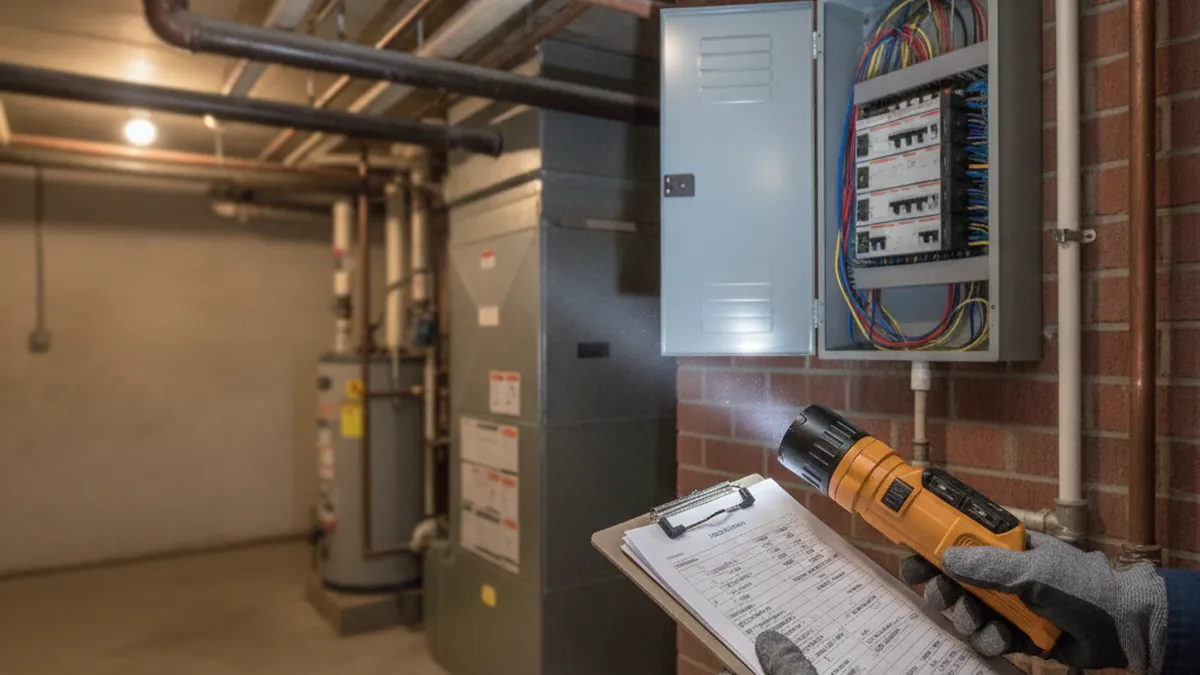
After guiding many owners of multi-unit buildings, the same mistakes come up again and again around balconies and guardrails. Avoiding them protects your liability and preserves the value of your plex at sale.
- Ignoring the wall anchors. Owners look at the decking and balusters but rarely at the connection to the building — yet that is where the most dangerous detachments happen.
- Painting over rot. A fresh coat of paint hides soft wood. The inspector will detect it with an awl, and the seller loses credibility.
- Believing acquired rights waive maintenance. The acquired right protects the configuration, never an element that has become dangerous.
- Rebuilding a guardrail without a permit. Unpermitted work may have to be redone and fuels the buyer's doubts.
- Reusing old rusted anchors during a partial rebuild, which compromises the solidity of the new work.
- Installing horizontal balusters that make climbing easy for a child, breaching the no-climb zone.
- Neglecting the drainage slope of the decking, letting water pool toward the wall and accelerate rot.
- Underestimating the snow load on a weakened gallery, especially in late winter on the North Shore.
- Failing to document the work. Without invoices or permits, it is impossible to reassure the buyer or defend against a claim.
- Hiding a known defect. An undisclosed defect can turn into a latent defect, exposing the seller to liability after the sale.
The owner-seller's golden rule
- Inspect the balcony as a system, from wall to guardrail;
- Document every repair with photos, invoices and permits;
- Honestly disclose the true condition rather than concealing it;
- Cost out the work to choose between "repair" and "sell as is."
Season-by-season preventive maintenance of a balcony
The best way to avoid a costly rebuild and a price cut when selling a plex remains preventive maintenance. A balcony tracked year after year ages slowly and stays compliant; a neglected balcony deteriorates abruptly and becomes a liability. Here is a maintenance calendar suited to the North Shore climate.
Spring — the post-winter inspection
At thaw, inspect each gallery: look for swollen or split wood, fasteners lifted by frost, standing water, rust on the anchors and spalled concrete. Spring is the best time to spot damage caused by the freeze-thaw cycle and snow removal.
Summer — repairs and treatment
The warm, dry season is ideal for staining or painting wood, tightening fasteners, replacing planks and carrying out permitted work. Test a guardrail by pushing it firmly: any abnormal play signals an anchor to redo.
Fall — preparing for winter
Before the first snow, clear drains and drainage slopes, check that nothing retains water, and make sure the structure is sound before it takes on the snow load. A balcony weakened in the fall becomes a real risk in February.
Winter — vigilance
In winter, avoid piling shovelled snow on a weakened gallery and use de-icers compatible with the material (some salts attack concrete and aluminum). Watch for any sign of deflection under the load.
| Season | Priority | Key action |
|---|---|---|
| Spring | Diagnosis | Full post-freeze-thaw inspection |
| Summer | Repair | Staining, tightening, permitted work |
| Fall | Prevention | Drainage, check before snow |
| Winter | Vigilance | Snow management, suitable de-icers |
A maintenance log kept up to date is not just good practice: it is a selling point. It shows the buyer that the multi-unit building has been tracked and reduces the perceived risk on the condition of the balconies.
Building the sale file for a plex with sound balconies
At the time of sale, the condition of the balconies and guardrails becomes a measurable argument. A well-assembled sale file turns a source of worry into a mark of seriousness. Here is what a plex owner gains by gathering before putting the building on the market — or before soliciting an offer from a direct buyer.
- Recent inspection or engineer's report on the condition of the galleries;
- Permits and certificates for the rebuild work carried out;
- Invoices and warranties from the contractor (RBQ licence);
- Dated photos before and after the work;
- Seasonal maintenance log;
- Honest seller's declaration on "acquired-right" elements and the known condition.
Two paths are then available to the owner. The first: invest in the rebuild, obtain the permits, then sell on the traditional market with a spotless file. The second: sell the property "as is" to a specialized buyer such as ImmoMulti, without fronting the cost of the work or managing back-and-forth inspections, simply adjusting the price to reflect the condition of the balconies. In both cases, transparency and documentation are the seller's best protection against a later claim.
The winning reflex before selling
- Know the true condition of each balcony before the buyer does;
- Document to negotiate from a position of strength;
- Choose knowingly between rebuild and "as is" sale;
- Disclose honestly to rule out the risk of a latent defect.
Informational content · Does not constitute legal or tax advice. Consult the Régie du bâtiment du Québec, your municipality and a lawyer for your specific situation.

