Signing a lease feels routine — until a poorly completed section turns against you at the Administrative Housing Tribunal. This guide helps you read a Quebec TAL lease section by section, from A to G, spot the required disclosures, and know exactly what the landlord must fill in before a tenant signs. At ImmoMulti, a direct buyer of multi-unit properties on the North Shore, we read dozens of leases a month — here is the methodical read every plex owner should master.
Why is the TAL lease a mandatory form in Quebec?
Since September 1, 1996, every residential lease in Quebec must be entered into using the mandatory form of the Administrative Housing Tribunal (TAL), the former Régie du logement. The landlord must give the tenant a copy of the lease within 10 days of entering into it.
In Quebec, a landlord cannot draft their own residential lease however they please. The lease must be concluded on the mandatory TAL form, a uniform document that protects both lessor and tenant by framing which clauses are allowed. The form is sold in bookstores, in convenience stores, and is also available online on the Tribunal's website. A verbal lease remains legal, but the landlord must still provide the mandatory disclosures in writing — which in practice means filling out the form anyway.
The logic of the form is simple: each section covers one aspect of the contract. Read carefully, it tells you exactly what you undertake to provide and what the tenant undertakes to pay. Completed carelessly, it creates costly grey zones. That is why reading it section by section is not a formality but a verification.
Source: Administrative Housing Tribunal — The mandatory lease.
What does each section contain, from A to G?
The lease is structured in sections: A (identifying the parties), B (description and intended use of the dwelling), C (term), D (rent and payment), E (services, accessories and dependencies), F (lowest rent of the previous 12 months and the article 1955 disclosure for a new dwelling), G (restrictions, building by-laws and signatures).
Here is the ordered read of the form. The exact wording may vary slightly between TAL editions, but the logic of the sections stays the same. Always read in order: each section assumes the previous one is consistent.
| Section | What it contains | What the landlord fills in |
|---|---|---|
| A — Parties | Identity of the lessor (landlord) and of the tenant(s). | Full names, mailing address, exact contact details. |
| B — Dwelling | Precise address of the dwelling, unit number, its intended (residential) use. | Exact description of the dwelling (floor, number of rooms if requested). |
| C — Term | Start and end dates, term of the lease (fixed or indeterminate). | Exact dates; a 12-month lease renews automatically. |
| D — Rent | Rent amount, terms and place of payment, instalments. | Monthly rent, due date, accepted payment method. |
| E — Services and accessories | What is included: parking, heating, electricity, appliances, dependencies. | Check precisely what is provided and at whose expense. |
| F — Prior rent | Lowest rent paid in the previous 12 months; article 1955 disclosure (new dwelling / under 5 years). | State the prior rent or check the section F disclosure if the dwelling qualifies. |
| G — Restrictions and signatures | Additional clauses, reference to building by-laws, standard notices, parties' signatures. | Permitted clauses, reference to the by-laws given, signature and date. |
Section D (rent) and section E (services): the most scrutinized
In section D, the rent entered must be the real rent: this figure becomes the reference for any future rent-fixing or review request. In section E, you specify the services and accessories included. A classic error is forgetting to mention that a parking space or a shed is included — which can later be read in the tenant's favour. Detail what is provided; anything not written down can be used against you.
Section F: the prior rent and the article 1955 disclosure
Section F deserves special attention. The landlord must state the lowest rent paid over the previous 12 months. This lets the new tenant know whether they can have their rent fixed by the TAL. For a new, restored, or recently first-rented dwelling (under five years), the landlord may check the article 1955 disclosure of the Civil Code, which removes this right to contest during that period. We break this exact point down in our guide on setting the rent on a first lease and section F.
Which disclosures are required in a TAL lease?
The TAL form already includes the disclosures required by law: the notice on the lowest rent of the previous 12 months, the rules on lease renewal and modification, and the tenant's rights. The landlord must complete these fields accurately and give the corresponding notice if section F is left blank.
The advantage of the mandatory form is that it already contains, in fine print, the disclosures the law requires. But they only serve their purpose if the corresponding fields are properly completed:
- The notice on the lowest rent of the previous 12 months (section F). If left blank, the landlord must provide the separate notice issued by the TAL, otherwise the tenant has an extended period to contest their rent.
- The rules on renewal and modification. A 12-month lease renews automatically; a landlord wishing to change a condition (rent, term) must respect the statutory notice periods.
- The tenant's rights, including the right to remain in the dwelling and the ban on certain clauses (see below).
Watch out for prohibited clauses
Even written and signed, a prohibited clause is void: security deposit, mandatory post-dated cheques, abusive penalties, or a waiver of the tenant's rights. Our guide on banned security deposits and rent advances details what a landlord cannot require, even in good faith.
Which annexes and documents should you attach?
Depending on the situation, the landlord attaches: the building by-laws (given before signing so they form part of the lease), the renewal or modification annex at renewal, and the notice on the lowest rent of the previous 12 months if section F is left blank. An inventory of the premises can also be attached.
The lease does not stand alone. Several documents attach to it, and chronological order matters:
- The building by-laws — Under article 1897 of the Civil Code of Quebec, they form part of the lease if given to the tenant before it is entered into. Given afterward, they are not binding. Reference them in section G and hand them over together with the lease.
- The renewal or modification annex — At renewal, the TAL provides a model notice to propose a change (rent, term) within the legal deadlines.
- The notice on the lowest rent — Mandatory to give a new tenant when section F is left blank.
- The inventory of the premises and meter readings — Optional, but very useful to document the dwelling's condition at the start and end of the lease.
The building by-laws govern noise, use of common areas and, often, pets. On that last point, read our guide on the pet clause in a lease to draft a valid restriction.
Sources: TAL — Building by-laws and Éducaloi — Dwelling leases.
What are the common landlord mistakes at signing?
The most common mistakes: not giving the copy of the lease within 10 days, forgetting to complete section F or the rent notice, handing over the building by-laws after signing, vaguely describing the included services (section E), and inserting prohibited clauses that are void anyway.
Most TAL disputes come not from bad faith but from sloppy sections. Here are the traps to avoid:
- Giving the lease late — The landlord has 10 days to give the tenant a copy. A delay weakens your position.
- Leaving section F blank without the notice — This opens an extended period for the tenant to contest the rent.
- Handing over the by-laws too late — Given after signing, they do not apply.
- Describing section E vaguely — Any unmentioned accessory may be deemed included or become a source of conflict.
- Adding a prohibited clause — It does not protect you and can hurt your credibility before the Tribunal.
A clean lease file is worth money
- Each section matches the reality of the dwelling
- Section F and the rent history are documented
- The building by-laws were given before signing
- A signed copy is filed for every dwelling
These checks aren't just for day-to-day operations: they count double at transaction time. In-place leases and their content directly affect the value of an income property — a careful buyer will read every lease section by section, as we do. To go further, see how the lease assignment rules since Law 31 change your obligations as a landlord.
ImmoMulti: direct buyer of multi-unit properties on the North Shore
Selling a plex with leases in good order? We can make you a direct offer, with no broker or commission, after carefully reading your lease file. Get a proposal within 48 hours.
Section A in detail: how to identify the parties correctly
Section A of the lease names the lessor (landlord) and the tenant(s). A plex owner must enter each party's exact legal name, a valid mailing address, and — when several tenants sign — understand that they are, in principle, jointly and severally liable for the rent and the lease obligations.
Section A looks trivial: two or three lines of names and addresses. Yet it determines whom you can act against in case of non-payment, damage or a sudden departure. An imprecise identity or a missing mailing address can delay — or even sink — an application to the Administrative Housing Tribunal. Fill it in like a contract, because that is exactly what it is.

The legal name, the mailing address and the mandatary
Enter each tenant's full legal name as it appears on identification, not a nickname. On the lessor's side, if the building is owned by a corporation or a trust, it is the exact name of the legal entity that appears as lessor, not your personal name. Always add a mailing address where the tenant can reach you in writing: this is where notices of modification, demand letters and TAL documents are validly sent. A landlord who manages remotely or through a third party also indicates the mandatary authorized to receive notices, which avoids disputes over whether a delivery was valid.
Co-tenancy, sub-tenants and joint liability
When several people sign the same lease as co-tenants, they are generally jointly and severally liable: you can claim the full rent from any one of them, regardless of who actually lives in the dwelling. That is a safety net for the landlord — provided every adult occupant is actually named in section A. Conversely, a person who lives in the dwelling without being on the lease (a partner, an "informal" roommate) is not your tenant: you have no direct contractual link with them, which complicates any recourse. Before signing, ask yourself: "Who will live here, and is each of those adults named on this lease?"
| Situation in section A | What the landlord enters | Why it matters |
|---|---|---|
| A single tenant | Full legal name + mailing address | One point of contact for all notices |
| Couple or roommates | All adults as co-tenants | Joint liability for the rent |
| Owner = corporation or trust | Exact name of the entity + mandatary | Validity of notices and recourse |
| Management by a third party | Contact details of the mandated manager | Valid receipt of documents |
In a plex, this rigour multiplies by the number of dwellings. A lease file where every section A is complete, with legible names and up-to-date addresses, is worth far more — to you and to a future buyer — than a stack of forms filled in haphazardly.
Sections B and C: describing the dwelling and setting the right term
Section B describes the rented dwelling (precise address, unit number, residential use) and section C sets the term of the lease. A fixed-term 12-month lease renews automatically on the same conditions; a landlord who wants to change a condition must send a notice within the deadlines set by law.
Sections B and C read together: the first says what, the second says for how long. Buyers and notaries check these two first, because a mistake here changes the very nature of the commitment.

Section B: a description that must match reality
In section B, enter the exact civic address and the unit number (for example "apt. 2" or "rear unit"), and confirm the residential use. This precision counts: if your plex has one dwelling in the basement and another upstairs, each lease must unambiguously designate which one is rented. A vague description opens the door to misunderstandings about common areas, the entrance used, or access to the yard. Residential use also excludes commercial use: a tenant cannot turn the dwelling into a business without your consent, and short-term touristic use is regulated separately.
Section C: fixed term, indeterminate term and renewal
Section C sets the start and end dates. The most common form in Quebec is the 12-month lease, from July 1 to June 30, which renews automatically on the same conditions if no one ends it within the deadlines. A lease can also be for less than 12 months, more than 12 months, or of indeterminate term — each form has its own notice deadlines. The key point for the landlord: renewal is the rule, ending the lease is the exception that requires a proper notice.
| Lease term (section C) | Renewal | Modification notice deadline (landlord) |
|---|---|---|
| 12 months or more (fixed term) | Automatic, same conditions | 3 to 6 months before the end |
| Less than 12 months (fixed term) | Automatic, same conditions | 1 to 2 months before the end |
| Indeterminate term | Continues with no term | 1 to 2 months before the change |
Source: TAL — Modification of a condition of the lease.
These deadlines are not details: a notice sent too early or too late can be void, forcing the landlord to wait another year to adjust the rent entered in section D. More on that below.
Section D in depth: entering the right rent and the right terms
Section D sets the rent amount, its due date, and the place and method of payment. The rent entered must be the real rent, because it becomes the reference for any future rent-fixing request. The landlord cannot require post-dated cheques or a security deposit.
If one section deserves to be completed to the dollar, it is section D. It is the figure that follows the dwelling from one lease to the next, the base for the annual increase, and the number every buyer adds up to value your plex. A sloppy section D is paid for over a long time.

The amount, the due date and the instalments
Enter the real monthly rent, the date it is due (most often the first of the month) and the number of instalments. Rent is payable monthly unless a different written agreement applies. Specify the place and method of payment accepted: Interac transfer, deposit, cheque, etc. You may accept e-transfer, but you cannot impose a payment method that would force the tenant to disclose banking information or provide a series of post-dated cheques — those requirements are prohibited.
A worked example: why the "asking" rent isn't always the "real" rent
Suppose a 4½ for which you ask $1,200 a month from the new tenant. The former tenant paid $1,050. In section D you enter $1,200 — the agreed rent. But in section F, you must declare that the lowest rent of the previous 12 months was $1,050. The new tenant therefore sees the $150 gap and knows they could, within the deadlines, have their rent fixed by the TAL. If you skip section F, you deprive the tenant of this information — and open an extended period for them to contest. The "real" rent (section D) and the history (section F) are an inseparable pair.
Three reflexes for a solid section D
- The amount entered = the rent actually agreed, with no convenient rounding
- The due date and payment method are clear
- Section D matches the history declared in section F
To understand how this rent evolves from one year to the next, see our guide on the new 2026 TAL rent calculation method, which explains the criteria used to adjust the section D amount at renewal.
Section E decoded: services, accessories and dependencies
Section E specifies what is included in the rent: heating, electricity, hot water, parking, a shed, appliances, laundry, snow removal. Everything provided must be checked or described; an unmentioned accessory can be deemed included and turn against the landlord.
Section E is the most often mis-completed field — and the one that generates the most small day-to-day disputes. A tenant who thought parking was included, a landlord who thought heating was the tenant's responsibility: most of these conflicts start with an empty box. The golden rule: anything not written down can be read in the tenant's favour.

Who pays for heating and electricity?
In a plex, how energy costs are split completely changes the profitability calculation. A "heated and lit" dwelling (heating and electricity included in the rent) normally commands a higher rent but transfers the risk of rate increases to the landlord. A dwelling where the tenant pays their own bill must clearly state in section E that these costs are the tenant's responsibility. Also specify who is responsible for hot water, the water heater and, where applicable, air conditioning. This clarity prevents a tenant from stopping heating in winter because "it isn't paid for," with the risk of frozen pipes that entails.
Parking, shed, appliances and services
Detail each accessory: parking space (numbered if possible), shed or storage space, access to shared laundry, appliances provided (stove, refrigerator, dishwasher), and services such as snow removal or landscaping. If an appliance is provided "as is" with no obligation to replace it, it is best to say so. The table below illustrates a clear split.
| Item (section E) | Included in the rent | Tenant's responsibility |
|---|---|---|
| Heating | Check if provided | State if the tenant's charge |
| Electricity / hot water | Check if provided | Account in the tenant's name |
| Parking | 1 space, number specified | None or at extra cost |
| Appliances | Stove, refrigerator provided | Tenant's own appliances |
| Snow removal / upkeep | Handled by the landlord | Handled by the tenant |
A field tip: reread section E of every lease before winter and before a sale. That is often where the "verbal agreements" hide — the ones written nowhere that complicate a transaction.
Special cases: verbal lease, subletting, assignment and co-tenancy
A verbal lease is legal but still requires the mandatory disclosures to be given in writing. Subletting and lease assignment follow precise rules since Law 31. A new dwelling, or one under five years old, benefits from the article 1955 disclosure, which removes the right to have the rent fixed.
Reading section by section covers the standard case. But a plex owner regularly runs into situations that spill outside the form. Here is how to read them.

The verbal lease and the occupant without a written lease
A verbal lease is still valid in Quebec, but it puts the landlord in a weak position: in a dispute, it becomes hard to prove the agreed rent or the included services. The law requires the landlord to give the tenant, within 10 days, a written statement of the mandatory disclosures, including the notice on the lowest rent of the previous 12 months. In practice, that statement amounts to filling in the form. An occupant without a lease — someone who lives in the dwelling without being a party to the contract — does not have the same status as a tenant, which complicates any recourse; hence the importance of naming every occupant in section A.
Subletting, lease assignment and a new dwelling
Subletting and lease assignment let the tenant transfer their occupancy right temporarily or permanently. Since Law 31 came into force, the rules governing assignment have changed: the landlord keeps a right to refuse for a serious reason, but the terms have evolved. We break down these changes in our guide on lease assignment since Law 31. Finally, for a new, restored, or recently first-rented dwelling (under five years), the article 1955 disclosure (section F) removes the tenant's right to have their rent fixed during that period — a crucial point explained in our guide on the first lease and section F.
- Verbal lease — Legal, but give the written statement of mandatory disclosures within 10 days.
- Subletting — The tenant remains responsible to you; you cannot refuse without a serious reason.
- Lease assignment — Permanent transfer governed by Law 31; record it in the file.
- Dwelling under 5 years — Check the section F disclosure (article 1955) if the dwelling qualifies.
- Co-tenancy — All adults in section A for joint liability.
Section G: additional clauses, by-laws and signatures
Section G groups the additional restrictions and clauses, the reference to the building by-laws, the standard notices and the signatures. The landlord may add valid rules (no smoking, pets, subletting), but any abusive or prohibited clause is void there, even signed.
Section G is the freest part of the form — and therefore the riskiest. It is where the landlord personalizes the lease, but also where they make the most mistakes by entering clauses that do not hold up before the Tribunal. Read carefully, section G protects; misused, it gives a false sense of security.

Valid clauses and void clauses
You may add reasonable restrictions: non-smoking dwelling, pet rules, no commercial use, noise rules. These clauses are valid if they are neither abusive nor contrary to the law. However, some clauses are void even when written and signed: a security deposit, a requirement to provide post-dated cheques, an automatic penalty for leaving, or a waiver of the tenant's rights. Entering them does not protect you — on the contrary, it can hurt your credibility if a dispute arises. For a common clause like pets, read our guide on the pet clause in a lease, and for advances, our guide on the banned security deposit.
The building by-laws and the signatures
Section G is also where you reference the building by-laws. Remember the article 1897 rule: the by-laws form part of the lease only if they were given before signing. Mention them in section G and hand them over together with the lease. Finally, section G carries the signatures of the parties and the date. A missing signature, a wrong date, or a copy not given within 10 days weakens the document. Verify that every tenant named in section A has actually signed in section G.
Clauses never to enter
Security deposit, mandatory post-dated cheques, waiver of rights, automatic departure penalty, automatic mid-lease rent increase: these clauses are void. Adding them to section G creates no valid obligation for the tenant.
Signing a lease: the step-by-step procedure
To sign a lease properly: hand over the building by-laws before signing, complete each section from A to G with accurate information, fill in section F, have each tenant sign, then give a copy to the tenant within 10 days and file your own.
Once you understand each section, signing becomes a safe routine. Here is the procedure we recommend to every plex owner, in order.
| Step | Action | Section / document |
|---|---|---|
| 1 | Hand over the building by-laws | Before signing (art. 1897) |
| 2 | Identify all the parties | Section A |
| 3 | Describe the dwelling and set the term | Sections B and C |
| 4 | Enter the rent and its terms | Section D |
| 5 | Check the services and accessories | Section E |
| 6 | Declare the prior rent / article 1955 | Section F |
| 7 | Add valid clauses and have signed | Section G |
| 8 | Give a copy to the tenant | Within 10 days |
Two steps concentrate most mistakes: step 1 (by-laws handed over too late) and step 8 (the copy not given within the 10-day deadline). Get into the habit of dating the delivery of the by-laws and keeping proof that the lease was given — a confirmation email is often enough. An inventory of the premises signed at the start and end of the lease, although optional, usefully completes the file and protects you in case of damage. For reading leases at purchase or sale time, our guide on due diligence and the documents to gather follows this same verification logic.
Renewing or modifying the lease: which notices and deadlines?
A lease renews automatically on the same conditions. To change a condition — the rent, the term, a service — the landlord must send a written notice: 3 to 6 months before the end for a lease of 12 months or more, 1 to 2 months for a shorter or indeterminate lease. The tenant has one month to respond.
Reading the lease section by section is not just for signing day: the same rigour applies every year, when the renewal period arrives. That is when the landlord adjusts the rent entered in section D — but only if they respect the mechanics of the notices.

Renewal: silence means renewal
In Quebec, lease renewal is automatic: at term, the lease renews on the same conditions if neither party acts within the deadlines. The tenant benefits from the right to remain in the dwelling, a strong right that the landlord cannot bypass with a simple non-renewal clause. To change anything, you must go through a notice of modification.
The modification notice and the tenant's response
The modification notice states the new proposed condition: the new rent, a different term, or a change of service. Once the notice is received, the tenant has one month to accept it, refuse it, or leave the dwelling. If they do not respond within that one-month period, they are deemed to accept the renewal with the requested changes, including the rent increase. If they refuse, it is up to the landlord, within the month following the refusal, to apply to the TAL to have the rent fixed — not up to the tenant to contest.
| Step | Who acts | Deadline |
|---|---|---|
| Modification notice (lease 12 months +) | Landlord | 3 to 6 months before the end |
| Modification notice (short / indeterminate lease) | Landlord | 1 to 2 months before |
| Response to the notice | Tenant | 1 month after receipt |
| Application to fix the rent at the TAL | Landlord | 1 month after the tenant's refusal |
Source: TAL — Modification of a condition of the lease and Éducaloi — Dwelling leases.
A notice out of time is void
A modification notice sent too early or too late has no effect: the lease then renews on the same conditions and you must wait another year to adjust the rent. Carefully note the end date of every lease in your plex and prepare your notices in advance.
Reading the leases before selling a plex: the check that protects your price
Before selling a plex, each lease must be read section by section to verify that the document matches reality. In-place leases, rents and clauses directly affect the value of an income property, because a buyer capitalizes the net income; a clean lease file supports the price.
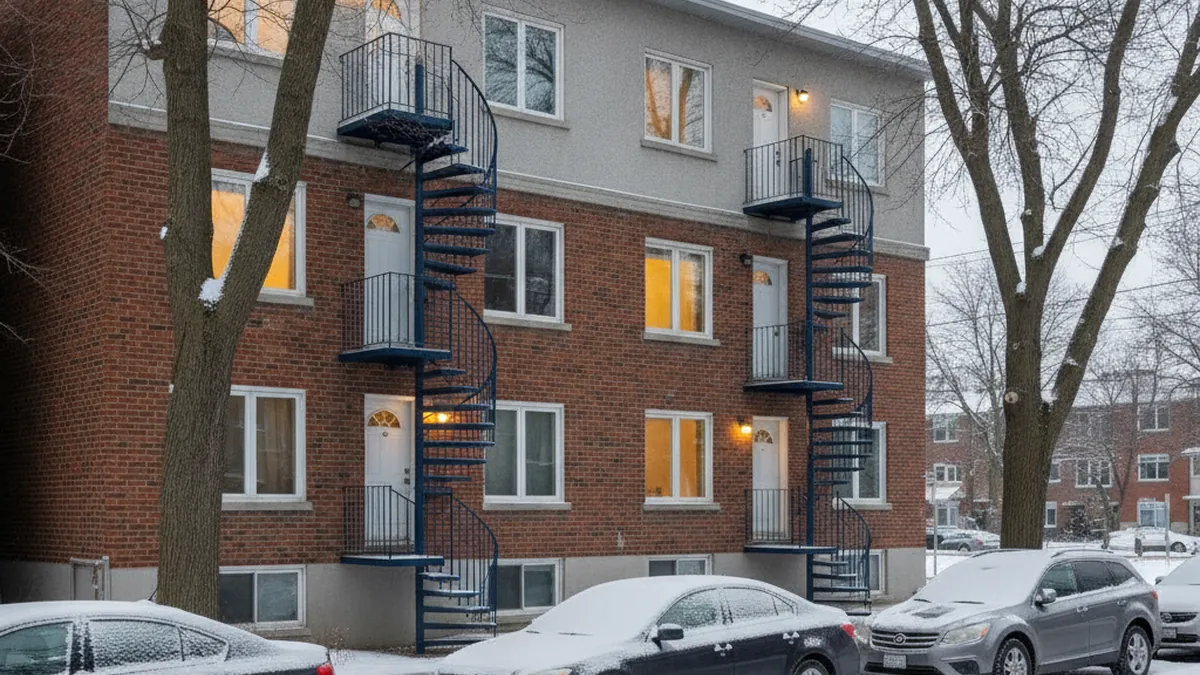
This is where methodical reading literally pays off. When we assess a plex on the North Shore, we do not just look at the building's condition: we read every lease as a contract that will follow the property. A clear lease file reassures the buyer and supports your price; a murky file worries them and justifies a discount.
Why leases set the value of an income property
An income property sells first on its net income. The buyer adds up the real rents (section D), subtracts expenses, then capitalizes that income at the market capitalization rate (cap rate). Below-market rents, costly included services that go unbilled, or leases impossible to verify reduce the perceived net income — and therefore the price. Conversely, clear leases, documented section F disclosures and consistent histories let the buyer pay with confidence. To understand this link, see our cap rate calculator and our analysis of why a plex isn't selling.
| Section checked | What the buyer verifies | Risk if inconsistent |
|---|---|---|
| A — Parties | Actual tenants vs named on the lease | Occupant with no contractual link |
| B — Dwelling | Rented unit vs reality | Dispute over spaces |
| D — Rent | Declared vs collected rent | Overstated net income |
| E — Services | Included costs not billed | Hidden expenses |
| F — History | Prior rent and article 1955 | Rent contestation |
| G — Clauses | Valid vs prohibited clauses | Void clauses |
"A complete, consistent lease file reads in a few minutes and translates into confidence at the negotiating table. A murky file, on the other hand, translates into questions — and every question becomes an argument to lower the price."
ImmoMulti Team, direct buyer of multi-unit properties on the North ShoreBefore putting your plex on the market, prepare a file where every dwelling has its signed lease, its annexes and its rent history. To go further, see our guide on selling a plex with active leases. The section-by-section read you apply at signing is exactly the one your buyer will perform: better that it works in your favour.