
For investors in multiplex/income properties on the North Shore, ImmoMulti presents the most powerful financing lever of 2026: the CMHC MLI Select program, also known as APH Select. This mortgage loan insurance program enables a loan-to-value ratio (LTV) of up to 95%, amortization of up to 50 years, and insured rates often 0.5% to 1.5% lower than conventional financing — in exchange for measurable commitments in affordability, energy efficiency, and accessibility. The entry threshold is 50 points in this scoring system. For a property of five units or more on the North Shore — Laval, Terrebonne, Repentigny, Blainville, Saint-Jérôme — the combination of sustained population growth and strong rental demand makes this financing particularly relevant. Here is a complete guide, updated for 2026, including changes that came into effect on November 28, 2025.
Quick answer
MLI Select (APH Select) is CMHC's points-based multi-unit mortgage insurance program. Projects earning 50+ points on affordability, energy efficiency, or accessibility can access up to 95% LTV and up to 50-year amortization — with insured rates typically 0.5%–1.5% below conventional financing. A CMHC-approved commercial mortgage broker must submit the application.
Important Disclaimer
This article is strictly informational in nature and does not constitute financial, mortgage, or tax advice. CMHC parameters (point tiers, premiums, ratios) change regularly: an important program update came into effect on November 28, 2025, with a transition period. Always confirm current criteria directly with CMHC or a commercial mortgage broker before making a decision.
What is CMHC multi-unit financing and how does it work?
CMHC insures mortgage loans on residential properties of five or more units. Because the lender's risk is covered, it offers lower rates, a reduced down payment, and longer amortization than conventional financing.
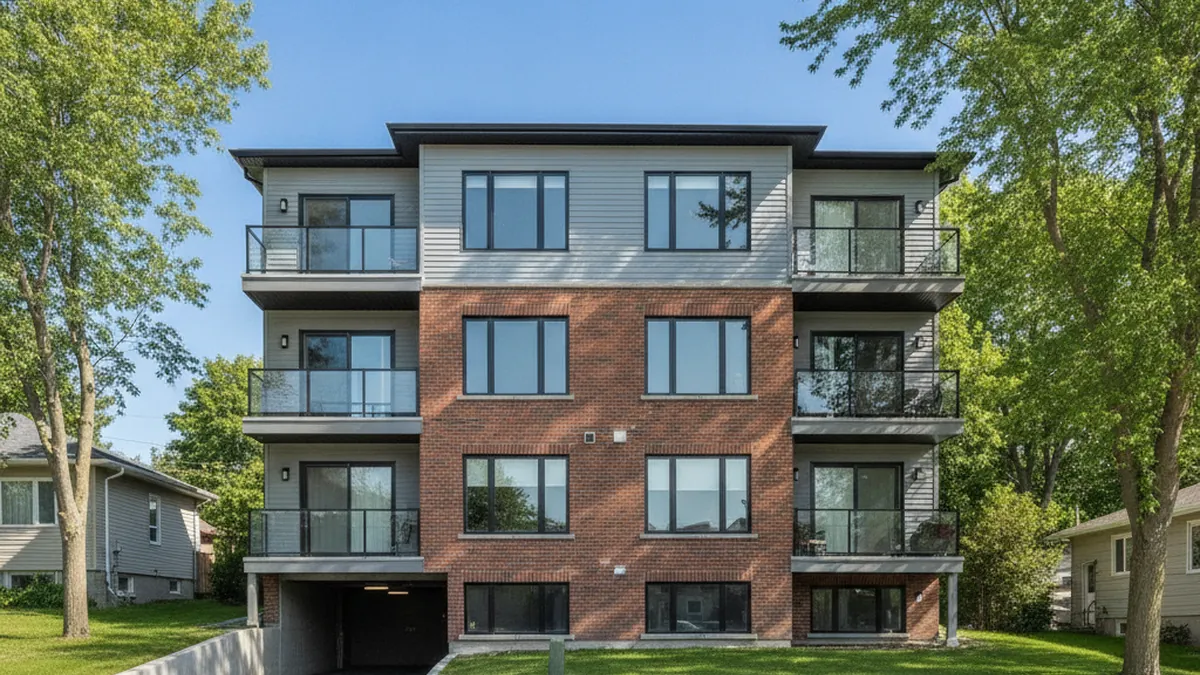
Canada Mortgage and Housing Corporation (CMHC) is a federal Crown corporation that insures mortgage loans. For a residential property of five units or more, a lender (bank, credit union, commercial lender) can obtain CMHC insurance covering the risk of default. Since the lender is protected, it agrees to lend on much more favourable terms than conventional financing: lower interest rates, reduced down payment, and longer amortization.
Two major families of multi-unit products at CMHC should be distinguished. On one hand, the standard product (sometimes called MLI Standard), which applies to conventional rental income properties. On the other, MLI Select / APH Select, an enhanced product reserved for projects that commit to meeting social and environmental criteria. It is this second, more generous product that has captured investors' attention in recent years. To visualize the gap between options, our financing comparison tool can help you put the scenarios side by side.
What is the difference between MLI Select and APH Select?
There is no difference. MLI Select is the English name (Multi-Unit Insurance Select) and APH Select is the French name (Assurance prêt hypothécaire Select) for the same CMHC program launched in 2022.
MLI Select (Multi-Unit Insurance Select) and APH Select refer to exactly the same CMHC program; they are simply the English and French names for it. Launched in 2022, the program was designed to channel insured financing toward more affordable, more energy-efficient, and more accessible properties.
The principle is simple: instead of offering fixed terms, CMHC awards points based on the commitments made by the developer. The more points a project accumulates, the more advantageous the financing terms become. The program applies to new construction as well as the purchase or refinancing of existing properties, making it a versatile tool throughout the full life cycle of an income property.
Eligible property types include standard rental properties, seniors' residences, supportive housing, and certain rooming houses. To quickly estimate how many points your project could reach, you can use our APH Select points estimator.
How does the MLI Select points system work — affordability, energy, and accessibility?
Projects earn points in up to three pillars: affordability (below-market rents committed for 10+ years), energy efficiency (exceeding NECB reference code), and accessibility (universal design per CSA B651:23). The minimum entry threshold is 50 points; tiers at 70 and 100 unlock better terms.
The core of the program rests on three pillars. A project can accumulate points in just one of these categories or by combining several. The minimum entry threshold to access benefits is 50 points.
1. Affordability
This is generally the most accessible and most commonly used path. Points are awarded when the developer commits to keeping rents below a certain threshold (often defined relative to the regional median income or median market rent) for a proportion of units, for a set commitment period (typically 10 years or more). The higher the proportion of affordable units and the longer the commitment, the more points are earned.
2. Energy Efficiency
Points are awarded to projects that reduce their energy consumption and greenhouse gas emissions below reference code thresholds. For new construction, this typically means performance exceeding the National Energy Code for Buildings (NECB) by roughly 15% to 40%. For an existing property, the improvement is measured against pre-renovation consumption. Note: energy modelling requirements and reference codes are in transition. Certain attestation documents based on older standards are only available until September 30, 2026; exact thresholds must be confirmed with CMHC.
3. Accessibility
This category rewards universal design. To earn accessibility points, the building must first be "visitable," meaning it meets basic universal design criteria under CSA B651:23: sufficiently wide corridors, adequate landings at entrances, no steps at access doors, etc. Additional points are awarded for a proportion of units that are fully accessible to persons with reduced mobility. Accessibility is not merely a regulatory formality: it broadens the pool of potential tenants (families, seniors, persons with reduced mobility) and contributes to the project's long-term sustainability, which aligns with the program's social objectives.
It is essential to understand that these three pillars are not siloed. A single project can, for example, aim for 30 points in affordability, 25 points in energy efficiency, and 15 points in accessibility to clear the 70-point tier. This cumulative logic is what makes the program both flexible and strategic: the goal is to build the most cost-effective "blend" of points given your market, property type, and tolerance for long-term commitments.
Key takeaway on points
A project can combine all three pillars to reach higher tiers. For example, a property targeting a strong affordability commitment while exceeding the energy code can more easily clear the 70 or even 100-point threshold. That combination unlocks the best terms.
What benefits do the three MLI Select point tiers (50, 70, and 100) unlock?
50 points: up to 95% LTV (new construction), up to 40-year amortization. 70 points: up to 95% LTV, up to 45 years. 100 points: up to 95% LTV, up to 50 years and maximum premium reduction. Higher tiers also increasingly offset the amortization surcharges introduced in 2025.
CMHC structures benefits around three tiers: 50, 70, and 100 points. The table below summarizes the terms generally associated with each. These figures serve as reference points: they may be adjusted by CMHC and vary depending on whether the property is new or existing. Always validate the current numbers.
| Point Tier | Max. Loan-to-Value (LTV) | Max. Amortization | Indicative Premium |
|---|---|---|---|
| 50 points (entry threshold) | Up to 95% (new construction) / 85% (existing) | Up to 40 years | Base premium reduction |
| 70 points | Up to 95% | Up to 45 years | Additional reduction |
| 100 points | Up to 95% | Up to 50 years | Maximum reduction |
At the 100-point tier, certain projects may also access limited recourse terms, a notable advantage for developers. The debt coverage ratio (DCR) required remains relatively low, which helps projects qualify even with tight margins. To test how these parameters affect the profitability of a purchase, see our offer calculator.
What are the concrete benefits of the MLI Select program for an investor?
Key benefits: down payment as low as 5%, amortization up to 50 years (improving cash flow and DCR), lower insurance premiums at higher point tiers, and insured interest rates 0.5%–1.5% below conventional — freeing capital to build a portfolio faster.

Why are so many investors now structuring their acquisitions around MLI Select? The benefits are tangible:
- Reduced down payment: with LTV potentially reaching 95%, the down payment can drop to roughly 5% of value, freeing capital for other projects.
- Extended amortization: amortization of up to 50 years significantly reduces the monthly payment and improves cash flow, a crucial factor for DCR qualification.
- Lower premiums: the more points earned, the lower the insurance premium, reducing the total cost of financing.
- Competitive rates: CMHC insurance reassures the lender, which generally offers rates lower than those on a conventional loan.
- Greater leverage: less capital tied up per project allows a portfolio to be built more quickly.
These advantages translate directly into returns. To understand how amortization and leverage affect the return on equity, our multiplex yield calculation guide details the method.
What are the eligibility criteria for a property under MLI Select financing?
Minimum 5 units (typically ~50+ for seniors' residences), residential purpose (non-residential portion capped ~30%), sustained affordability/energy/accessibility commitments, demonstrated borrower strength, and net income sufficient to meet the minimum debt coverage ratio (DCR).
Before targeting MLI Select, your project must clear a few baseline conditions:
- Minimum of five units (the threshold generally rises to around 50 units or beds for seniors' residences).
- Residential purpose: the non-residential portion of the property is capped (often around 30% of the floor area or loan value).
- Commitments maintained over time: affordability, energy efficiency, or accessibility commitments must be respected throughout the agreed period, failing which the benefits may be clawed back.
- Borrower strength: CMHC assesses net worth, experience, and management capacity. The level of scrutiny may vary depending on the number of points earned.
- Project viability: the property must generate sufficient net income to cover debt service according to the minimum DCR.
To quickly check whether a property's value holds up against its rents, the NOI (net operating income) calculator provides a useful first benchmark before going further.
What are the steps of the MLI Select application process?
Five steps: (1) define your points strategy, (2) assemble the financial file and energy/accessibility specs, (3) submit through a CMHC-approved lender, (4) CMHC review and insurance certificate issuance, (5) closing with commitments recorded. Allow several weeks to a few months for complex files.

An MLI Select application typically unfolds as follows:
- 1. Define the points strategy. First, determine which combination of affordability, energy efficiency, and accessibility enables the target tier (50, 70, or 100) to be reached.
- 2. Assemble the file. Financial statements, revenue and expense pro formas, plans, energy specifications, appraisals, and ownership documents are gathered.
- 3. Submit through an approved lender. The application must go through a CMHC-approved lender, often with the support of a commercial mortgage broker.
- 4. CMHC review. CMHC validates the points, LTV, amortization, and applicable premium, then issues an insurance certificate (often subject to conditions).
- 5. Closing and commitments. Financing is put in place and commitments (rents, energy performance, accessibility) are recorded and monitored over time.
Allow several weeks, or even a few months, for a complex file. A well-prepared file, with a clear points strategy from the outset, greatly accelerates processing.
A few practical tips to streamline the process: engage a commercial mortgage broker early who is well-versed in CMHC files, as they will anticipate missing documents and present the points strategy persuasively. Have your energy modelling done by a recognized firm, ideally at the design stage, to avoid having to modify plans later. Finally, rigorously document your affordability commitments: CMHC requires clear evidence of the target rents and commitment duration, and any ambiguity can delay certificate issuance or reduce points awarded.
What premiums and surcharges apply to the MLI Select program in 2025–2026?
CMHC raised premiums in 2025 and added surcharges per amortization tranche beyond 25 years — a 50-year amortization now costs more in premium. However, points-based reductions apply after surcharges, making the 70- and 100-point tiers even more advantageous. A November 28, 2025 program update is in effect with a transition until September 30, 2026.
The 2025–2026 context deserves particular attention. CMHC revised its premiums upward in 2025, partly to reflect its regulatory capital framework. Surcharges now apply to longer amortizations: there is a supplement per amortization tranche beyond 25 years. In practice, a 45- or 50-year amortization, while attractive for cash flow, results in a higher premium than before.
The good news, however, is that points-based premium reductions generally apply after these surcharges. The more points your project accumulates, the more the surcharge impact is mitigated. This is one of the reasons why targeting a higher tier (70 or 100 points) becomes even more relevant in 2026.
Furthermore, a program update came into effect on November 28, 2025, with a transition period allowing certain files to qualify under the old criteria until September 30, 2026. Energy thresholds and certain requirements have evolved. As these parameters change quickly, specific premium figures should never be considered final without verification with CMHC or a professional.
What common mistakes should be avoided in an MLI Select financing application?
Common pitfalls: overestimating points, underestimating the opportunity cost of affordability commitments, ignoring amortization surcharges, improvising energy modelling without a recognized firm, and underestimating CMHC review timelines.
- Overestimating your points. An overly optimistic estimate of affordability or energy performance can derail qualification for the target tier. Validate with an estimator, then with a professional.
- Overlooking the cost of commitments. Maintaining affordable rents for 10 years or more has a real opportunity cost; it must be weighed against the financing savings.
- Forgetting amortization surcharges. A 50-year amortization is not "free": the premium increases. Compare the scenarios.
- Improvising the energy file. Energy modelling requires specialized expertise and tight timelines, especially with the 2026 transition.
- Underestimating timelines. Factor CMHC's review time into your acquisition or construction schedule.
Why is the MLI Select program particularly relevant on the North Shore of Montréal?
The North Shore (Laval, Terrebonne, Repentigny, Blainville, Saint-Jérôme) combines sustained population growth, strong rental demand, and available land for new construction — creating ideal conditions for affordability and energy-efficiency points strategies under MLI Select.

The North Shore (Laval, Terrebonne, Repentigny, Mascouche, Blainville, Saint-Jérôme and surrounding areas) offers a particularly compelling environment for MLI Select. Sustained population growth, strong rental demand, and available land for new construction create a favourable context for projects targeting affordability and energy efficiency. For an investor, structuring an APH Select project in this market can combine strong appreciation potential with enhanced financing terms.
At ImmoMulti, we specialize in multiplex/income properties on the North Shore and support investors at every stage, from assessing points potential to structuring financing. If you would like to discuss a specific project, contact our team; we can guide you toward the right tools and the right financing partners.
Final reminder
CMHC rules change regularly and every project is unique. The information in this guide is provided for educational purposes only. Before structuring a financing, confirm current criteria, premiums, and ratios with CMHC or a commercial mortgage broker.

