
Quick answer
On the North Shore, approximately 6 out of 10 plex listings fail on the first attempt (ImmoMulti estimate). The 5 real causes are: (1) price disconnected from the market cap rate (5.0–6.2% in 2026), (2) buyer's financing refused after the offer, (3) problematic leases discovered in due diligence, (4) inspection results that reopen negotiation, (5) uncooperative tenants during showings. Selling directly to ImmoMulti bypasses all five.
Why is your plex not selling? ImmoMulti, a direct buyer of multi-unit properties on the North Shore, estimates, based on locally processed files, that approximately 6 out of 10 listed plex properties fail to close on their first listing in 2025-2026 — not because the market is bad, but because the causes of failure for an income property are fundamentally different from those of a residential home. A well-located plex in Terrebonne, Laval, or Repentigny that has been stagnating for 90 days almost always carries one of the five structural causes analyzed here: price poorly calibrated to the market cap rate (5.0% to 6.2% on the North Shore in 2026), buyer's financing refused after the offer, problematic leases discovered during due diligence, an inspection that reopens negotiation, or uncooperative tenants during showings. Understanding which one applies to your property allows you to correct course — or to choose an alternative like a direct sale with no financing condition.
This article does not cover preparation mistakes before listing your property — our guide to 9 costly mistakes to avoid already covers that ground in detail. Here, we analyze the structural causes that prevent an already actively listed plex from receiving offers, or that cause offers to fall through. These are distinct causes, often invisible to the seller, but well known to experienced buyers.
Why do so many plex listings on the North Shore fail on the first attempt?
The multi-unit market on the North Shore remains active in 2026 (vacancy below 2.4%), so stagnant listings point to a structural problem — not a slow market. The 5 causes identified here explain the vast majority of failures.
A plex or multi-unit property that does not sell after 90 days of listing on the North Shore is not necessarily a bad asset. It is often a sound asset whose listing is blocked by one or more of the 5 factors identified below. The distinction matters: an asset problem requires a price reduction; a listing problem requires a technical correction.
The multi-unit market on the North Shore in 2026 remains a seller's market overall, with vacancy rates below 2.4% according to available market data. Qualified buyers exist and are actively searching for income properties in Laval, Terrebonne, Repentigny, Blainville, and Saint-Jérôme. When a well-located plex stagnates, the cause is almost always structural, not cyclical.
Regarding disclosure obligations that apply to any property sale in Quebec, including reasons 3, 4, and 5 below, the OACIQ publishes detailed resources on seller obligations that apply equally to sales with and without a broker.
Reason 1: why does a price poorly calibrated to the cap rate prevent a plex from selling?
If your asking price implies a cap rate below 4.5% on the North Shore (market benchmark: 5.0–6.2% in 2026), a buyer's bank will finance a value 15–25% lower than your price. The buyer can't bridge the gap — the transaction collapses even when both parties agreed on price.

The first reason a plex does not sell on the North Shore is a listing price disconnected from the property's actual income. This is not an overpriced home in the residential sense — it is a price that implies a cap rate (TGA) too low to be financeable by an ordinary buyer.
Here is how it works: the cap rate of an income property is calculated by dividing the annual NOI by the sale price. On the North Shore in 2026, market cap rates range between 5.0% and 6.2% depending on the area. If your price implies a cap rate of 3.8%, the value your buyer's bank will recognize is calculated from actual income capitalized at the market cap rate — often 15 to 25% less than your asking price.
The problem of potential income vs. actual income
Some plex sellers calculate their price based on the rents they could theoretically achieve if current leases were at market rates. Buyers, however, finance the property based on actual collected income. A gap between these two figures creates a situation where the buyer wants the property but cannot finance it at the asking price.
Use our offer calculator to check whether your price aligns with current cap rates in your area on the North Shore.
How does the bank calculate the value of your plex differently than you do?
The bank uses the income approach: actual NOI ÷ market cap rate = bank value. On the North Shore in 2026, banks apply 5.0–6.2% cap rates. If your price implies 3.8%, the bank's value can be 20%+ lower — forcing the buyer to cover the gap or walk away.
The divergence between the seller's perceived value and the value recognized by the buyer's bank is one of the least visible but most frequent causes of failed transactions for multi-unit properties on the North Shore.
The income approach (bank method)
When a buyer applies for mortgage financing on a plex or income property, the bank commissions a certified appraiser. This appraiser primarily uses the income approach: they take actual gross income, deduct a normative vacancy rate and operating expenses, arrive at a net income, and capitalize it at the cap rate applicable to that area to obtain the property value.
If this value is lower than the price agreed between buyer and seller, the bank finances only a percentage of its own appraisal — not the purchase price. The buyer must then cover the gap with their own funds. If this gap exceeds their available down payment, the financing condition is not lifted and the transaction fails.
Concrete example — Terrebonne 2026
A triplex in Terrebonne is listed at $750,000. Actual annual gross income is $42,000. After expenses and normative vacancy, net income is $30,000. The bank applies a market cap rate of 5.5%: bank value = 30,000 / 0.055 = $545,000. The gap with the sale price is $205,000 — which the buyer cannot absorb. Transaction fails, even though both parties agreed on the price.
Reason 2: why is the buyer's financing refused after the offer?
Financing refusals on plexes often stem from insufficient down payment (5+ unit properties require 20%), or banks counting only 50–80% of rental income toward mortgage qualification. The buyer may have passed an initial pre-approval but still get refused after the offer is signed.

Even when the price is reasonable, a plex buyer's financing can be refused after signing a conditional offer. The reasons are varied and not all related to your property — but their impact on your listing is direct.
Insufficient down payment for an income property
For a 1-to-4-unit multi-family property, the buyer can occupy one of the units and obtain Canada Mortgage and Housing Corporation (CMHC) insured financing with as little as 5% down. For a property with 5 or more units, the rules change: minimum 20% down payment, different debt service calculation. Many buyers do not realize this distinction until after signing a conditional offer.
Debt service ratio and rental income
Banks factor rental income into the repayment capacity calculation, but not always at 100%. Under current rules, a bank may only count 50 to 80% of rental income toward mortgage qualification. A buyer who calculates their capacity using 100% of rents may be surprised by their bank's refusal, even if the property is profitable. See our guide to selling your income property quickly to identify the best-capitalized buyers.
Reason 3: how can problematic leases block the sale of your plex?
Buyers' notaries review all leases before lifting conditions. Rents 20%+ below market, active TAL files, disputed lease assignments, or tenants without a written lease can all trigger price reductions or buyer withdrawal. Resolving these issues before listing prevents surprises.

A serious buyer always has their notary review your plex leases before lifting the legal inspection condition. And this review sometimes reveals situations the seller considered minor, but that represent a real risk for the buyer.
The most common problematic leases on the North Shore:
- Rents significantly below market (more than 20% gap): rent increases permitted by the Rental Housing Tribunal (TAL) are slow and regulated, making a rapid move to market rates difficult.
- Lease assignment accepted without verification: an assigned lease may have modified conditions without the landlord having formalized the changes in writing.
- Active file at the Rental Housing Tribunal (TAL): an ongoing dispute with a tenant is a major red flag for any buyer, as they inherit the file.
- Difficult termination clause: some older leases include clauses that limit repossession, even for the landlord's own use or expansion.
- Occupants without a written lease: a frequent situation in older buildings on the North Shore, which complicates the sale as the rights and obligations of the parties become unclear.
Under the rules of the Chambre des notaires du Québec, the notary is obligated to verify the title and encumbrances of the property before completing the deed of sale — including leases, which constitute charges on the property.
Reason 4: what happens when the inspection reveals problems in a plex?
Major findings — cracked foundations, pyrite, outdated electrical panels, end-of-life roof, asbestos — almost always trigger renegotiation or buyer withdrawal. The preventive strategy: commission an inspection before listing, disclose known issues, and have quotes in hand.
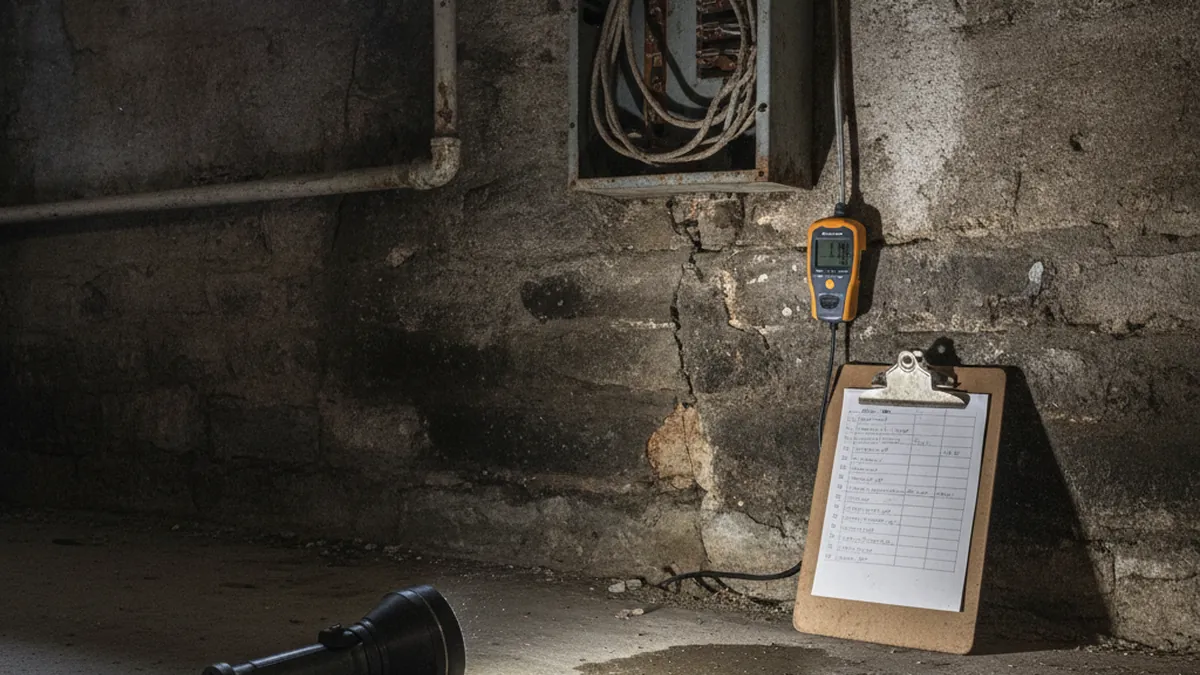
A building inspection on a plex or multi-unit property is almost always more comprehensive than on a single-family home. The inspector must cover all systems in all units, common areas, and mechanical spaces. And in older buildings on the North Shore — 60% of which were built before 1980 — there are almost always deficiencies.
The findings most likely to derail a plex sale
- Cracked foundations or water infiltration: especially in buildings constructed before newer peripheral drainage standards.
- Presence of pyrite under the slab: common in certain areas of the North Shore (Laval, Terrebonne), and catastrophic for financing as some banks refuse to finance a property with active pyrite.
- Outdated electrical system (aluminum wiring, Federal Pacific or Federal Pioneer panels): a common problem in plex buildings from the 1970s-1980s.
- End-of-life roof with no provision: if the roof needs replacing within 2 years and the seller did not inform the buyer, this leads to a price reduction request.
- Presence of asbestos in materials: in buildings constructed before 1980, asbestos may be present in cement-asbestos joints, vinyl flooring, and pipe insulation.
Each of these findings can trigger a renegotiation request, and if you cannot or will not respond, the buyer walks away. The preventive strategy is to get an inspection before listing, to disclose known issues in the seller's declaration — as we detail in our guide to mistakes to avoid when selling an income property.
"On the North Shore, I've seen well-advanced transactions collapse because of a surprise inspection. The solution is simple: know your property before selling it. An informed seller is never blindsided by their own building."
— ImmoMulti Team, multi-unit property investor, North Shore
Reason 5: how do uncooperative tenants cause a plex sale to fail?
Tenants can legally refuse repeated showings, ignore access requests, or keep their unit in poor condition for visits. On the North Shore, uncooperative tenants add 6–8 weeks to the sale timeline on average. Proactive communication from day one is the most effective solution.
Existing tenants in a plex do not share your interest in selling the property. Legally, they have the right to peaceful enjoyment of their unit. In practice, this means they can refuse repeated showings, insist on the full 24-hour notice being respected, or simply fail to keep their unit in a presentable state for viewings.
The concrete cost
A buyer who cannot freely visit all units cannot properly assess the condition of the property. In some cases, they will include a specific access condition in their offer — which extends the timeline. In extreme cases, they make no offer at all, preferring to wait for a vacant or partially vacant property.
On the North Shore, multi-unit transactions with uncooperative tenants take an average of 6 to 8 weeks longer than average — representing a real cost in time, carrying costs, and the risk of a qualified buyer redirecting to another property.
The solution lies in proactive communication with tenants from the start of the sale process: explaining the process, their rights, and what will (or will not) change for them. An informed and reassured tenant is generally less hostile than a tenant caught off guard by the arrival of strangers in their home. See also: negotiating a cash-for-keys agreement to free a unit before selling.
Table of 5 failure reasons: frequency, root cause, and impact on sale timeline
Here is a summary overview of the 5 reasons why a multi-unit property or plex does not sell on the North Shore, with estimated frequency observed in local transactions and impact on sale timeline.
| Reason | Estimated frequency | Impact on timeline | Typical solution |
|---|---|---|---|
| 1. Price/cap rate miscalibrated | ~35% of failed listings | Listing withdrawn after 90-120 days, relisted at reduced price (+60 to 90 days) | Recalibrate price to actual local market cap rate |
| 2. Buyer's financing refused | ~25% of aborted transactions | Transaction lost after 30-45 days of conditions, back to square one | Require proof of plex-specific mortgage pre-approval before accepting an offer |
| 3. Problematic leases | ~20% of due diligence reviews | Price reduction request or withdrawal, additional 30-60 day delay | Disclose tenancy situations at listing, resolve TAL files before listing |
| 4. Inspection / renegotiation | ~15% of conditional transactions | 2 to 4 week renegotiation, withdrawal risk if no agreement | Pre-listing preventive inspection, quotes in hand, complete seller's declaration |
| 5. Uncooperative tenants | ~5% of listings with tenants | +6 to 8 weeks on total sale timeline | Proactive communication with tenants from the start, strict respect of tenant rights |
How does the bank calculate the cap rate differently from the seller when valuing a plex?
Banks use the income approach on the actual rent roll — not your projected rents. If current leases average $1,050/month and the market is $1,450, the bank values on $1,050. On 8 units that gap can reduce the recognized value by $300,000–$500,000 vs. your asking price.
The divergence between the seller's appraisal and the bank's appraisal is the root cause of the first failure reason. Understanding this mechanism is essential for any plex or income property owner on the North Shore who is about to sell.
What the seller factors into their calculation
Most multi-unit sellers calculate their price starting from recent comparable sales in their area. They may add a premium for improvements made to the property. Some project the income the property could generate if all rents were at market rates — an approach that systematically overvalues the property in the bank's eyes.
What the bank factors into its calculation
The bank commissions a certified appraiser who uses the income approach: actual gross income collected (not potential), minus a normative vacancy rate of 5% to 8%, minus documented actual operating expenses. The result — the net operating income (NOI) — is then capitalized at the cap rate applicable to that area based on recent market data from APCIQ.
In 2026, cap rates applied by banks on the North Shore range between 5.0% and 6.2% depending on the area:
- Laval: 4.9% to 5.6% depending on location and property quality
- Blainville / Boisbriand: 4.8% to 5.4%
- Terrebonne / Mascouche: 5.3% to 6.0%
- Saint-Jérôme: 5.4% to 6.0%
- Mirabel / Saint-Eustache: 5.2% to 5.8%
If your price implies a cap rate below 4.5%, the probability that the buyer's bank will recognize your full price is very low — except for an extremely well-capitalized buyer who can absorb the gap without bank financing.
How to verify whether your price is bankable
Calculate your implied cap rate: (Actual annual net income ÷ Asking price) × 100 = cap rate %. If this result is below 5.0% on the North Shore, your price will be difficult for an ordinary buyer to finance. Our offer calculator performs this calculation automatically with current market data for your area.
How to bypass these obstacles by selling directly with no financing condition?
Sell directly to ImmoMulti — no financing condition (own internal valuation), no inspection condition, leases transferred as-is, firm offer in 48 hours, notary in 30 days. All 5 failure causes are bypassed in a single transaction.
The 5 reasons identified in this article share one thing in common: they are all tied to the traditional sale process, with its conditions, delays, third-party interveners, and withdrawal risks at every step. There is a way to bypass them entirely: sell directly to a buyer who does not depend on traditional bank financing and who does not impose inspection or lease review conditions.
This is precisely the ImmoMulti model. As a direct buyer of plex and multi-unit properties on the North Shore, we eliminate the 5 failure causes in a single transaction:
- No financing condition: we perform our own internal valuation, without going through the buyer's bank.
- No inspection condition: we inspect ourselves, without involving your tenant in a conditional inspection process.
- Leases transferred as-is: we buy your multi-unit property with leases in place, without asking you to modify them.
- Firm offer within 48 hours: no listing delay, no waiting for the market, no post-inspection renegotiation.
- Notary in 30 days: clear, predictable timeline, no surprises.
Before deciding, read our full comparison: broker vs. direct buyer to understand the nuances. And use our offer calculator to get an estimate based on current cap rates in your area — no commitment, in 2 minutes.
Informational content only. Does not constitute legal, tax, or financial advice. Market data (cap rates, timelines, frequencies) are estimates based on conditions observed on the North Shore of Montreal at the time of publication, . Consult a qualified professional for your personal situation.
Frequently asked questions — plex not selling


