
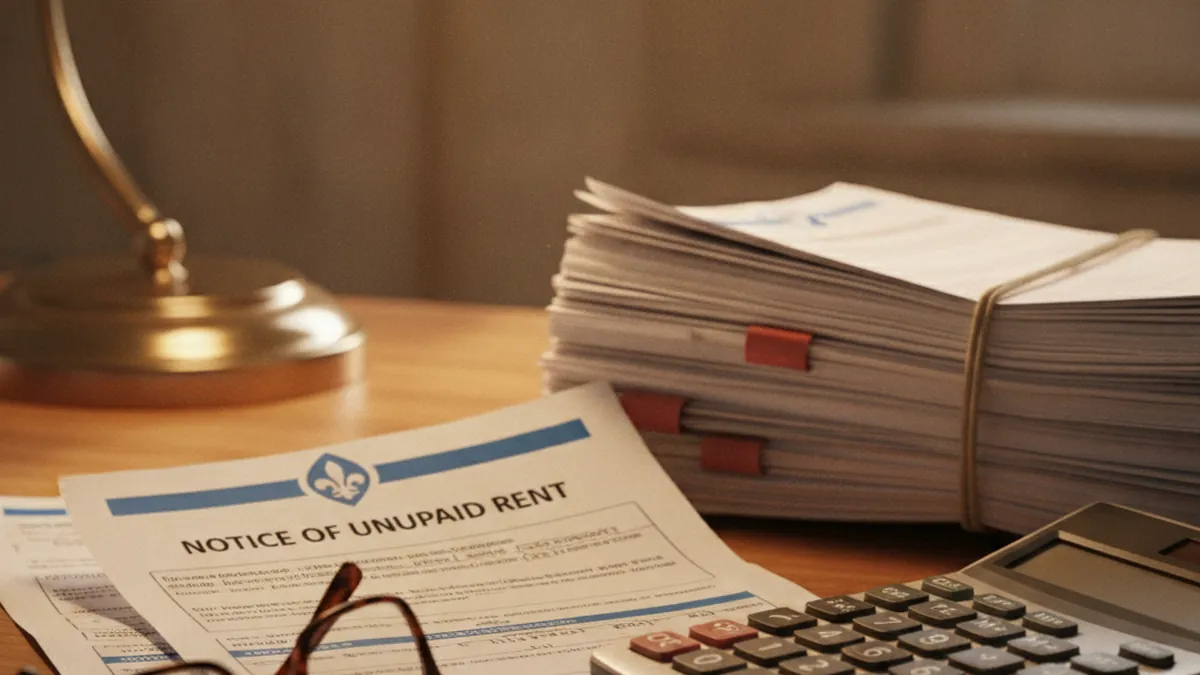
The demand letter for unpaid rent is the first written step in collection in Quebec: a formal letter that requires the tenant to pay the outstanding balance within a set deadline, failing which you will take action. Written well, it often settles the dispute without ever reaching the tribunal — and if the file goes further, it becomes a valuable piece of evidence. This guide for plex owners covers when to send the demand letter, what to include, what deadlines to respect, how to reach a payment agreement, and then how to move to an application with the Tribunal administratif du logement (TAT) if the tenant does not comply.
When should you send a demand letter for unpaid rent?
In Quebec, rent is payable on the first day of each term — usually the 1st of the month. As soon as a tenant is late, you are entitled to send a demand letter. In practice, many landlords wait a few days and try an informal reminder before sending the formal letter, but nothing requires you to.
You do, however, need to distinguish two thresholds. To claim payment, no minimum delay is required: the rent is due, period. But to ask the TAT to cancel the lease, the Civil Code of Quebec, as explained by Éducaloi, requires the tenant to be more than three weeks late, or that the delay cause serious harm. The demand letter serves precisely to document that delay and apply pressure before that threshold is reached.
The demand letter is not a mandatory formality to bring a non-payment case to the TAT, but it remains strongly advisable. It proves you put the tenant on notice, it starts the clock on damages, and very often it is enough to unlock payment.
What should an effective demand letter contain?
A good demand letter is factual, dated and unambiguous. The tone stays professional: this is not a threat, it is a formal legal notice. Here are the elements you must include.
- Identifying details: your contact information, the tenant's, and the exact address of the unit concerned.
- The words "DEMAND LETTER" clearly visible, usually as a heading.
- The exact amount owed, broken down month by month, with due dates and the total balance claimed.
- A clear deadline to pay (for example 10 days from receipt) and the accepted payment method.
- The consequences of default: filing a TAT application, cancelling the lease, claiming damages and costs.
- The date and your signature.
Avoid slipping in items not provided for in the lease (invented penalties, rent advances) or aggressive language. A sober, precise letter is more credible before an administrative judge. Éducaloi offers free demand-letter templates you can adapt to your situation.
Source: Éducaloi — How to Write a Formal Demand Letter and Failing to Pay Rent.
What deadline should you give, and how to send it?
The deadline must be reasonable. For rent, a 10-day deadline is common and generally considered sufficient. A very short deadline (48 hours, say) risks being seen as abusive; too long a deadline weakens your urgency. Set a precise cut-off date rather than a vague phrase.
The method of sending is crucial, because you may need to prove receipt. The table below compares the common options.
| Method of sending | Evidentiary weight | Keep in mind |
|---|---|---|
| Registered mail with acknowledgment of receipt | High | The most recommended; keep the acknowledgment and a copy of the letter. |
| Hand delivery with a witness | High | Have a proof of receipt signed or note the witness. |
| Medium | Convenient and fast, but receipt is more easily contested. | |
| Ordinary mail | Low | No proof of receipt; avoid using it alone. |
Whatever method you choose, keep a copy of the letter, the proof of sending and, if possible, the acknowledgment of receipt. These items are worth their weight in gold if the file reaches the TAT.
The payment agreement: the fastest route
Often, the demand letter opens the door to a conversation. A good-faith tenant who is temporarily short may offer to spread out repayment. This is frequently the fastest and least costly solution for everyone: you get your money back without the delays and costs of a legal remedy.
The golden rule: put the agreement in writing. State the total balance, the repayment schedule (dates and amounts of each instalment), the payment method, and a clause setting out what happens if it is not honoured. Have both parties sign it and keep a copy. A written agreement protects the tenant as much as the landlord, and it can be presented to the TAT if the tenant defaults.
Watch out for banned advances and deposits
In your agreement, you cannot require a security deposit or rent advances beyond the first term: these practices are banned in Quebec. Claim only the amounts actually owed. See our guide on banned security deposits and rent advances.
No response: moving to a TAT application
If the demand-letter deadline expires with no payment or agreement, the next step is filing an application with the Tribunal administratif du logement. There you can claim recovery of the rent owed and, depending on the extent of the delay, cancellation of the lease. The TAT generally prioritizes non-payment cases, but actual delays can stretch over several months.
This is where your demand letter shows its full value: together with the lease, the rent ledger and the proof of sending, it forms a solid part of your file. For the detailed procedure — form, fees, evidence and hearing — see our full guide on how to file a TAT application as a landlord. Important reminder: even with a favourable decision, only a bailiff can carry out an eviction — never you.
Source: Tribunal administratif du logement and Éducaloi — Housing.
Common collection mistakes to avoid
- Threatening instead of informing. An aggressive letter or intimidating language hurts your credibility and can backfire.
- Sending without proof. Email alone, with no acknowledgment, makes it hard to demonstrate receipt.
- Setting an unreasonable deadline. A few-hour deadline may be judged abusive; favour 10 days.
- Making a verbal agreement. Without a signed writing, an agreement is nearly impossible to enforce.
- Taking the law into your own hands. Changing locks or cutting services is illegal in Quebec, even for non-payment.
- Waiting too long. The more the debt piles up, the harder collection becomes; act early.

The demand-letter template, line by line
Many landlords stall on collection simply because they do not know how to structure the letter. In reality, an effective demand letter fits on a single page and always follows the same frame. Here is the detailed template, block by block, with what each section must accomplish. You can copy it and adapt it to your North Shore plex — the key is to be precise, dated and verifiable.

1. The header and contact details
In the top left, put your name and full address (the landlord or the owning company). Below it, the date of sending — this is what starts the deadline running. Then, to the right or underneath, the exact name of the tenant(s) and the address of the unit, apartment number included. If the lease is in the names of two jointly liable co-tenants, name them both: joint liability lets you claim the full balance from either one.
2. The words "DEMAND LETTER" and the subject line
Write "DEMAND LETTER" in capitals, in bold, clearly visible. That phrase is what turns a simple reminder into a formal legal notice. Add a clear subject line: "Subject: unpaid rent — unit located at [address]." A tenant who sees these words immediately understands that the next step is the tribunal.
3. The body: the facts, then the formal demand
The body is written in three moves. First the facts: "You are the tenant of the unit located at [address] under a lease beginning [date], at a monthly rent of [amount]." Then the statement of default: "To date, you have not paid the rent for the months of [list], for a total balance of [amount]." Finally the formal demand: "I hereby put you on formal notice to pay the sum of [amount] within 10 days of receiving this letter, failing which I will, without further notice, take the remedies provided by law, including an application to the Tribunal administratif du logement for recovery and cancellation of the lease, with a claim for interest, the additional indemnity and costs."
4. The closing, date and signature
End with a sober line ("Please govern yourself accordingly"), your handwritten signature and your payment details (accepted method, person to contact). Do not forget to keep the signed original and a dated copy: these are the documents you will file with the TAT.
The reflex that makes the difference
- Break down your unpaid rent month by month rather than as one lump sum: the itemization is more credible and simplifies the interest calculation.
- Date the letter on the actual day of sending, not a "round" date.
- Keep a neutral tone: "I hereby put you on formal notice" is enough; no need to threaten.
- Send a copy through a second channel (email in addition to registered mail) to multiply the traces.
Éducaloi offers free templates you can fill out in minutes. The classic mistake is to write a text that is too long, emotional or vindictive: an administrative judge gives more weight to a factual letter than to an indictment. Sobriety is a strength, not a weakness.
Source: Éducaloi — How to Write a Formal Demand Letter.

Calculating exactly what to claim
The amount you write in the demand letter — and then in your TAT application — must be exact and documented. An inflated or approximate balance weakens your file; an understated balance costs you money. Here is how to build it cleanly, using a concrete example of a North Shore triplex.
Start from a rent ledger
Open a simple table: one row per month, with the rent due, the amount actually received and the balance. This ledger does double duty — first in the demand letter, then as evidence at the hearing. Take a unit rented at $1,250 per month whose tenant has stopped paying:
| Month | Rent due | Received | Cumulative balance |
|---|---|---|---|
| April | $1,250 | $0 | $1,250 |
| May | $1,250 | $0 | $2,500 |
| June | $1,250 | $625 (partial payment) | $3,125 |
| July | $1,250 | $0 | $4,375 |
At the end of July, the principal balance is $4,375. That figure, itemized as above, is what must appear in your demand letter. Note: apply partial payments to the oldest rent first, unless the tenant states otherwise.
Interest and the additional indemnity
On the amounts owed, you can claim interest at the legal rate, set at 5% per year in Quebec, as well as the additional indemnity provided by the Civil Code. This indemnity corresponds to the gap between the interest rate applicable to debts owed to the State (set by Revenu Québec and revised each quarter) and the 5% legal rate. In practice, the TAT can order the tenant to pay, on top of the principal, this interest calculated from the date of each unpaid rent until full payment.
Do not get lost in manual calculations: in your TAT application, it is enough to claim "interest at the legal rate and the additional indemnity from the date of each due date." The Tribunal fixes the exact amount in its decision. You therefore do not have to quantify every dollar of interest in the demand letter — simply state that you will claim it.
Source: Civil Code of Quebec (arts. 1617 and 1619) and Barreau du Québec — Interest-rate tables.
What you can NOT add
Forget flat "late fees" ($25, $50 a day) invented in some leases: they have no effect if they do not comply with the law. Likewise, you cannot claim a rent advance or a security deposit, both banned in Quebec. Stick to the rent actually owed, the interest and the judicial costs.
The real shortfall exceeds the unpaid balance
For your own management decision, keep in mind that the cost of a tenant who stops paying is not limited to the rent owed. Add the months the unit stays blocked during the process, the filing fees, the time spent and, sometimes, damage found when the keys come back. On a triplex, a single unit in default for six months can represent several thousand dollars of lost income. It is often this overall figure, not the legal balance, that weighs in the balance when you assess whether to keep pursuing collection or consider an exit.
The TAT application, step by step
When the demand-letter deadline expires with no payment or agreement, you move to the formal application to the Tribunal administratif du logement. Here is the real path, from the form to the hearing, for a non-payment case.
Step 1 — Fill out the right form
The TAT offers a specific non-payment of rent application form. On it you state the parties, the address of the unit, the rent, the unpaid months, the balance claimed and your conclusions: recovery of the rent owed, cancellation of the lease (if the delay justifies it), interest, the additional indemnity and costs. The application can be filed online or at the counter.
Step 2 — Pay the filing fees
Fees apply on filing. In 2026, they are roughly $83 for most applications, and climb for the largest claims (up to $259 for a non-payment above $15,000). Recipients of a last-resort financial assistance program may be exempt on proof. These fees are part of what you can claim from the losing tenant.
Source: Tribunal administratif du logement — Required fees.
Step 3 — Non-payment cases are prioritized
Good news for landlords: non-payment cases are prioritized by the TAT. The Tribunal aims for a first hearing within a relatively short time — a matter of weeks — unlike other disputes that can drag on for a year or more. Careful, though: "priority" does not mean "instant." Between filing, notifying the tenant, the hearing and the decision, you should generally count several weeks, sometimes more depending on the district.
Source: TAT — Non-payment of rent application.
Step 4 — Prepare and present the evidence
At the hearing, present an organized file: the signed lease, the rent ledger, the demand letter and its proof of sending, and your exchanges with the tenant. A clear, chronological file is more convincing than a long story. This is where your demand letter shows its full value: it proves you acted in good faith and put the tenant on notice before turning to the Tribunal. For the detailed procedure, see our guide on how to file a TAT application as a landlord.

After the judgment: payment, enforcement and the bailiff
Getting a favourable decision is a step, not the end of the story. Between filing and money actually recovered, several scenarios are possible. Here is what happens once the application is filed.
The tenant can pay before judgment
This is a mechanism every landlord must know: in a lease-cancellation case for non-payment, the tenant can avoid cancellation of the lease by paying, before the judgment is rendered, the full rent owed, the interest and the costs. In other words, even if you seek cancellation, a tenant who clears their debt at the last minute keeps the unit. You then recover your money, but the lease continues. For many landlords, that is an acceptable result; for others, the relationship is broken and this outcome frustrates. In all cases, the law favours keeping the tenant in place.
Source: Éducaloi — Failing to Pay Rent and Civil Code of Quebec (art. 1883).
The recovery judgment
If the tenant does not pay, the TAT renders a decision ordering them to pay you the balance, the interest, the additional indemnity and the costs. This decision is an enforceable title: it has the same force as a court judgment. But a title does not fill your account on its own. If the tenant does not comply voluntarily, you will have to move to forced enforcement.
Forced enforcement goes through a bailiff
To enforce the judgment — seizure of property, garnishment of wages, or eviction if cancellation was ordered — you must retain a bailiff. Crucial reminder: you can never evict a tenant yourself. Changing the locks, removing the furniture or cutting the electricity is illegal in Quebec, even with a judgment in hand. Only the bailiff, armed with the judgment, can proceed. Wage garnishment is often the most effective way to recover a debt when the tenant is employed.

Collecting from a tenant who has already left
If the tenant has left the unit with a debt, cancellation no longer has an object, but the debt remains. You can claim the unpaid rent from the TAT (or, depending on the amount and context, from the Small Claims Division). You still have to locate the debtor and they must have seizable income — which is why acting early, before the person becomes untraceable, matters.
Special collection situations
The textbook scenario — one tenant, one rent, one delay — does not cover every situation. Here are the cases that come up most often for plex owners, and how to approach them.
Co-tenants and joint liability
When two people sign the same lease with a joint-liability clause, each is responsible for the entire rent, not just "their half." So address your demand letter to both, and claim the full amount from each. If one co-tenant has left and the other stays, you can pursue the one who can afford to pay — leaving them to recover from their former co-tenant. Joint liability is a powerful collection asset: do not leave it out of your leases.
Bounced cheque or refused payment
A payment that "comes back" (a bounced cheque, a refused withdrawal) is equivalent to non-payment: the rent is not paid. Document the bank notice, add the amount to the balance and proceed as with any delay. If the tenant piles up bounced cheques, that behaviour can feed an argument of frequent delays causing serious harm, another ground for cancellation provided by law.
Tenant on social assistance
A low-income tenant is still bound to pay their rent, and you keep all your remedies. In some cases, a mechanism to pay the rent directly to the landlord may exist through last-resort assistance. Inquire with the competent bodies rather than assuming: a payment agreement tailored to the tenant's budget is often more productive than a confrontation.
Frequent delays rather than one big default
Some tenants always pay, but systematically late. The Civil Code provides that frequent delays can justify cancellation of the lease if they cause serious harm to the landlord. You then have to document the ground chronologically: the dates of each late payment, the reminders, the impact on your cash flow. A demand letter that recalls the history of delays sets up this kind of file well.
Source: Civil Code of Quebec (art. 1971) and Éducaloi.
Occupant without a lease: a different regime
A person who occupies a unit without a lease (for example a former partner who stayed, or someone you never accepted as a tenant) does not necessarily fall under the same rules as your signing tenant. Before acting, clarify the occupant's status — the collection and eviction process can differ significantly.
Preventing unpaid rent on your North Shore plex
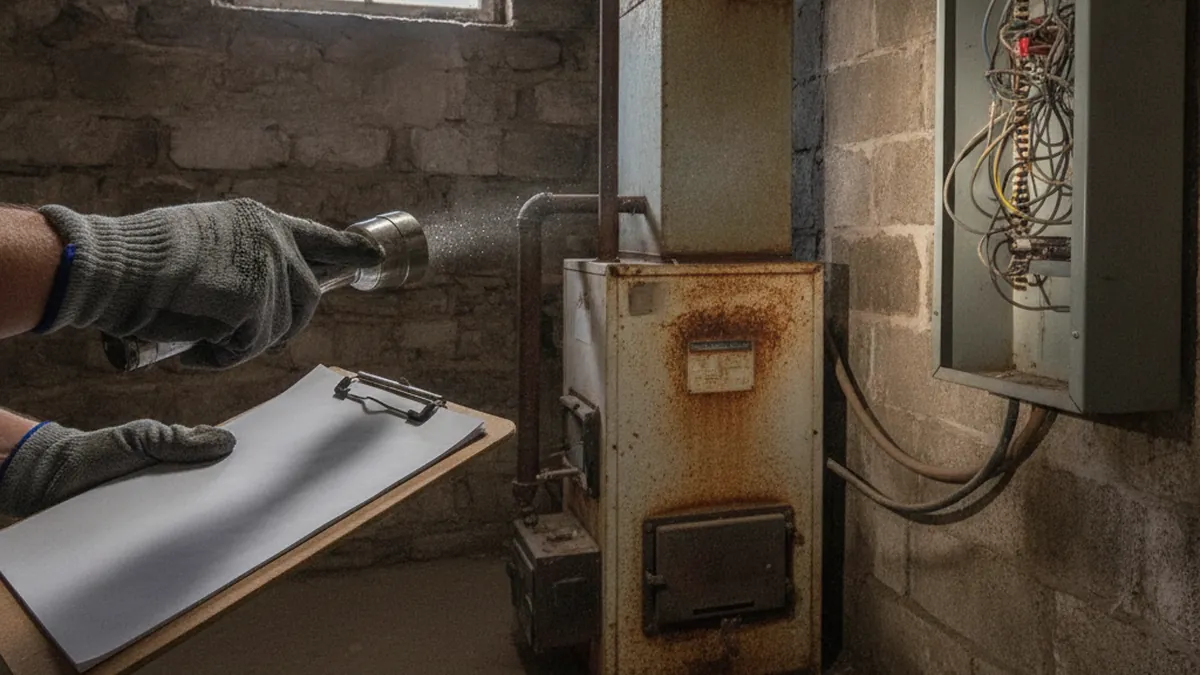
The best collection is the one you never have to do. On a multi-unit building, a few reflexes clearly reduce the risk of landing a tenant who stops paying. Prevention costs almost nothing; an unpaid balance can cost months of rent.
Screen rigorously before you sign
Advance screening is your first line of defence. Before renting, you can — with the applicant's consent — check their housing references, confirm their employment and review their credit file. A clean payment history is the best indicator of a future good payer. Be wary of rushed files ("I need the unit tomorrow"), cash payments with no explanation, and reluctance to provide references. On the North Shore, where rental demand is strong, take the time to choose: a unit empty for one more month costs far less than a problem tenant settled in for a year.
A clear lease, with no illegal clauses
Use the mandatory TAT lease and fill it out completely: rent, payment date, payment method, mandatory clauses. Do not slip in illegal clauses (advances, deposits, flat penalties): they have no effect and undermine your credibility if the file reaches the Tribunal. A joint-liability lease, when several adults occupy the unit, clearly strengthens your collection position.
Tight tracking of payments
Track your receipts like a business. As soon as a rent does not come in on the expected day, follow up immediately — a friendly reminder on the 2nd or 3rd of the month defuses many situations before they escalate. Pre-authorized payments, when the tenant agrees, reduce oversights. Keep an up-to-date ledger per unit: that document will become a valuable piece of evidence if an unpaid balance arises despite everything.
The "72-hour" rule
- Rent not received on the expected day: note it and send a courteous reminder.
- Still nothing after a few days: call to understand the situation.
- No payment and no explanation: prepare the demand letter.
- Demand-letter deadline expired: file the TAT application without letting the debt pile up.
Acting fast is not being harsh: it protects both your cash flow and the relationship. A good-faith tenant often prefers a quick agreement to a swelling debt. And a bad-faith tenant understands that you follow your files closely.

When collection is no longer worth it
There is a tipping point where pursuing collection costs more, in money and energy, than what you recover. A repeat offender, a unit blocked for months, a proceeding that drags: at some point, the question is no longer "how do I recover my rent" but "is this plex still worth the stress." That calculation is legitimate, and it deserves to be done coldly.
Add up the unpaid balance, the months of forced vacancy, the fees, the time spent and the nervous wear. Compare that total to the net gain from a sale. For some owners, especially those nearing other projects or retirement, a clean exit beats a battle that never ends. The good news: a building with a problem tenant remains sellable, notably to a specialized buyer who buys multi-unit properties "as is," tenants in place included.
Collect or sell: the decision grid
- A single isolated default, otherwise reliable tenant: pursue collection, often settled by an agreement.
- Repeated defaults, serious harm, broken relationship: cancellation, then re-renting — or a sale — is justified.
- A building that exhausts you, projects elsewhere: quantify the exit and compare it to collection.
To dig into this trade-off, read our guide Unpaid rent: sell your plex or wait?. And if selling becomes the most sensible option, ImmoMulti can make you a direct offer on your North Shore multi-unit building, tenants in place included, with no broker and no commission.
