
ImmoMulti — a direct buyer of income properties on the North Shore — repeats it at every valuation: the value of a plex is driven not primarily by price per door or per square foot, but by its net operating income (NOI). According to Collège MREX, the value of an income property is calculated by dividing first-year projected NOI by the market cap rate. The direct consequence: at a 5.5% cap rate, every $1,000 of added annual NOI raises value by roughly $18,000. Before you sell your plex, optimizing NOI — TAL-compliant rent increases, expense reduction, ancillary income, reclaimed space — is the single most profitable lever available.
Why does NOI drive the value of your plex?
Because the economic value of an income property is calculated as: value = first-year projected NOI ÷ market cap rate (Collège MREX). A lower cap rate and a higher NOI both push the price up. Since the cap rate is set by the market, the only lever a seller truly controls is NOI.
The cap rate (taux global d'actualisation, TGA, in Québec) expresses the ratio of a building's net income to its transaction price. Collège MREX defines it this way: a 10-unit building producing $100,000 of normalized net income that sells for $1,000,000 transacted at a 10% cap rate. Inverting the formula, fair market value = net income ÷ cap rate.
The cap rate is set by the market: by the policy rate, inflation, buyer appetite and the segment. You cannot unilaterally decide the cap rate of your North Shore plex. You do, however, largely control NOI. That is where the leverage lives: at a constant cap rate, each dollar of recurring NOI multiplies into sale price.
The leverage in one worked example
- Market cap rate 5.5% → each $1,000 of NOI is worth $1,000 ÷ 0.055 ≈ $18,200
- Cap rate 5.0% → each $1,000 of NOI is worth $20,000
- Cap rate 6.5% → each $1,000 of NOI is worth ≈ $15,400
Source: Collège MREX — Complete guide to the cap rate in real estate and MREX — Cap rate and normalized net income: how they shape value.
How is a plex's NOI calculated, line by line?
NOI = effective gross income (rents + ancillary income − vacancy and bad debt) − normalized operating expenses (taxes, insurance, common-area energy, maintenance, caretaking, management). It excludes debt service and depreciation.

Before optimizing anything, you need the mechanics of NOI. Start with potential gross income (all rents at market), remove vacancy and bad debt to get effective gross income, then subtract operating expenses:
| Line item | In NOI? | Optimizable before sale? |
|---|---|---|
| Rents (gross income) | Yes | Yes — via the TAL method |
| Ancillary income (laundry, parking) | Yes | Yes — billing and documentation |
| Municipal and school taxes | Yes (expense) | Partly — assessment appeal |
| Insurance | Yes (expense) | Yes — shopping, bundling |
| Common-area energy | Yes (expense) | Yes — energy efficiency |
| Maintenance and caretaking | Yes (expense) | Yes — contracts, pooling |
| Debt service (mortgage) | No | No effect on NOI |
| Depreciation (CCA) | No | No effect on NOI |
Note carefully: debt service and depreciation are not part of NOI. Paying down your mortgage faster therefore does not change the economic value of your plex. What changes it is every line item on the operating side.
To master the full mechanics of GRM and the cap rate — both derived from NOI — see our multiplex yield calculation guide.
How can I raise below-market rents within TAL rules?
Rent increases are governed by Québec's Tribunal administratif du logement (TAL). For 2026, the TAL revised its rent-fixing method; the new method applies to lease-modification notices given on or after January 1, 2026. The increase is calculated from specific components (taxes, insurance, major work, income and expenses), not freely.
By far the most powerful lever on NOI is catching up below-market rents. Many North Shore plex owners hold units whose rent has fallen behind, year after year. Each unit brought toward market adds directly to gross income, therefore to NOI, therefore to price.
Be careful, though: you cannot raise a rent at will. Increases are governed by the Tribunal administratif du logement (TAL), which revised its calculation method in 2026. The new method applies to lease-modification notices given on or after January 1, 2026; the previous method still applies to notices given before that date. The TAL sets annual percentages for each component of the calculation (taxes, insurance, work, etc.) and provides an official calculation tool.
Never overstate your projected rents
A savvy buyer and a lender normalize NOI: they replace a too-low rent with its market value, but also strip out any increase that was never applied or is not TAL-compliant. Presenting "theoretical" rents you cannot legally obtain destroys your credibility. Document every increase notice and every lease.
Source: Tribunal administratif du logement — 2026 rent adjustment calculation and TAL — Rent increase.
How can I cut expenses to increase NOI?
Every dollar of recurring operating expense eliminated raises NOI by one dollar — and therefore value by ~$18 at a 5.5% cap rate. The most optimizable line items: common-area energy, insurance premiums, management and caretaking. Watch the Revenu Québec tax distinction between a current expense (deductible) and a capital expense.

Reducing a recurring expense has exactly the same effect as raising a rent: it lifts NOI dollar for dollar. Here are the line items to examine before selling your multi-unit building:
- Common-area energy: LED lighting, programmable thermostats, heating conversion. On a plex, common-space energy is a recurring cost where durable gains are possible.
- Insurance: shop the policy at renewal, bundle multiple buildings, review coverage. Insurance premiums are a deductible rental-income expense according to Revenu Québec.
- Management and caretaking: renegotiate or pool contracts, bring some tasks in-house. Wages paid for building maintenance are governed by specific tax rules.
- Recurring maintenance: snow removal, landscaping and minor work negotiated down or bundled.
Current expense vs capital expense: don't confuse them
According to Revenu Québec, a current expense (a repair or maintenance that restores the building to its original condition) is deductible in the year. A capital expense (an improvement or addition, such as replacing all the windows or redoing a roof) is not deductible immediately. This distinction does not change the NOI calculation itself, but it affects your tax treatment and how a buyer reads your financial statements.
Source: Revenu Québec — Current expenses (rental property) and Revenu Québec — Income and expenses.
Bill for services and reclaim space: two forgotten levers
Ancillary income (laundry, parking, storage) and reclaiming underused space add to effective gross income, therefore to NOI. At a 5.5% cap rate, $1,200 of net annual parking income is worth ~$22,000 in price. This income must be real, recurring and documented to hold up against a buyer.
Bill for ancillary services
Many plex owners do not bill — or bill too little — for monetizable services: coin laundry, parking spaces, private storage, bike or storage access. Each of these adds to effective gross income. After deducting associated costs, it lifts NOI and capitalizes into value.
Example: 4 parking spaces rented at $25/month generate $1,200 a year. Net of minor costs, at a 5.5% cap rate they represent roughly $22,000 in added value — for a nearly costless change.
Reclaim underused space
A former caretaker's unit, a large basement storage area or an underused common space can sometimes be converted into a rentable unit or additional income. Each added rent raises NOI. But beware: any conversion must respect municipal zoning, the building code and TAL rules. A non-compliant unit hurts the sale instead of helping it.
Three ancillary revenues to document before selling
- Coin laundry: 12 months of collection statements
- Parking: written agreements and amounts collected
- Storage and space: signed leases or addenda
How do you make an optimized NOI hold up — North Shore plexes?

A buyer and a lender normalize NOI into normalized net income (NNI): they discard undocumented income and add allowances. On the North Shore, where the plex segment remained under pressure in early 2026 per APCIQ, every credible dollar of NOI translates into price. The key: start 12 to 24 months before listing.
Optimizing NOI is not enough: it has to hold up. This is the normalized net income (NNI) concept used by Collège MREX to establish the cap rate. The savvy buyer replaces off-market rents with realistic values, adds allowances for vacancy, management and maintenance, and removes any unproven income. For your optimization to survive this normalization, every increase, every ancillary revenue and every expense reduction must be real, recurring and backed by evidence.
"Property value = first-year projected normalized net income ÷ market cap rate."
— Collège MREX, on the mechanics of a multi-unit building's valueOn the North Shore — Terrebonne, Mascouche, Blainville, Boisbriand, Saint-Jérôme, Saint-Eustache, Deux-Montagnes, Mirabel — the context favours the seller who optimizes. According to APCIQ, residential sales stabilized in the first quarter of 2026 while prices remained under pressure, with the plex segment showing year-over-year median price growth. In this market, an improved, defensible NOI translates directly into a higher price.
Source: APCIQ — Residential sales stabilize in Q1 2026, prices remain under pressure.
Timing matters: start ideally 12 to 24 months before listing. Rent increases apply at lease renewal, insurance and energy contracts renegotiate at expiry, and ancillary income needs a track record. A long-improved NOI is far more credible than a last-minute projection.
ImmoMulti: a direct valuation based on your real NOI
Preparing to sell your North Shore plex? We analyze your real NOI and make a direct, commission-free, fully confidential offer — no public listing, no broker. Get a proposal within 48 hours.
To place the overall value of your building and avoid valuation pitfalls, also read our guide to the North Shore real estate market in 2026.
A full worked example: from $42,000 NOI to a maximized sale price
On a six-unit plex, an NOI-boosting plan combining rent catch-up, expense reduction and ancillary income can take NOI from $42,000 to $52,000. At a 5.5% cap rate, that $10,000 NOI gap represents roughly $182,000 in added value — without touching the building's structure.

Nothing illustrates the NOI leverage better than an example worked end to end. Take a six-unit plex on the North Shore, held for about twelve years by an owner-seller who never pushed rents or billed for ancillary services. Here is the starting point and the state of the building after an 18-month improvement plan.
The starting point
In year zero, the six units produce a potential gross income of $78,000 (an average of $1,083 per month per unit). After a 3% vacancy and bad-debt allowance, effective gross income is $75,660. Operating expenses total $33,660. Starting NOI is therefore $42,000. At a 5.5% market cap rate, the building's economic value is 42,000 ÷ 0.055 ≈ $763,600.
| Line item (year 0) | Annual amount | Comment |
|---|---|---|
| Potential gross income | $78,000 | 6 below-market units |
| Vacancy and bad debt (3%) | −$2,340 | Normalized allowance |
| Effective gross income | $75,660 | |
| Municipal and school taxes | −$12,500 | Heaviest line item |
| Insurance | −$5,400 | Premium not shopped |
| Common-area energy | −$4,200 | Shared lighting and heat |
| Maintenance and caretaking | −$7,560 | Un-negotiated contracts |
| Management | −$4,000 | Management allowance |
| Starting NOI | $42,000 | Value ≈ $763,600 at 5.5% |
The 18-month improvement plan
The owner applies four levers, all documented and defensible against a buyer or lender:
- Rent catch-up: at lease renewal, rents are adjusted using the Tribunal administratif du logement (TAL) method, factoring in the change in taxes, insurance and major work. Over two renewal cycles, potential gross income rises from $78,000 to $84,000, or +$6,000.
- Insurance reduction: by shopping the policy at renewal and reviewing coverage, the premium drops from $5,400 to $4,500, or −$900 in expense (thus +$900 NOI).
- Energy efficiency: LED lighting and programmable thermostats in common areas cut the energy bill from $4,200 to $3,200, or +$1,000 NOI.
- Ancillary income: renting four parking spaces and installing coin laundry generates $2,100 in recurring net income.
After these adjustments, and allowing for a slight tax increase (the municipal assessment is not controlled by the seller), NOI climbs to about $52,000. The new economic value is 52,000 ÷ 0.055 ≈ $945,500.
The result: ~$182,000 of value created
- Year-0 NOI: $42,000 → value ≈ $763,600
- Improved NOI: $52,000 → value ≈ $945,500
- NOI gap: $10,000/year → value gain ≈ $182,000
- Each $1,000 of added NOI is worth ≈ $18,200 in price at 5.5%
The point of the demonstration is not the exact figure — it varies with your building and your area's cap rate — but the ratio: every dollar of recurring NOI multiplies by 15 to 20 in sale price. No other sale-preparation project offers such a return. The income-capitalization method used here is the one described by Collège MREX.
Source: Collège MREX — How to calculate the economic value of a multi-unit building. Illustrative figures; consult a chartered appraiser for your building.
Rent catch-up: the most powerful NOI lever, in detail
Catching up below-market rents is the most profitable NOI lever because it carries no recurring cost. It is governed by the TAL method, which adds up the effect of changes in taxes, insurance, major work (adjusted at a fixed 5% rate set by regulation) and other operating costs. The new method applies to lease-modification notices given on or after January 1, 2026.

On most long-held plexes, the main drag on NOI is not an excessive expense: it is gross income that has fallen behind the market. A unit rented at $950 while the market is at $1,250 deprives the owner of $3,600 in annual income — about $65,000 of dormant value per unit at a 5.5% cap rate. On a six-unit plex, the cumulative gap can exceed $100,000 in price.
How the TAL method works
You cannot bring a rent to market value in a single step. The Tribunal administratif du logement governs the annual increase: rent is adjusted based on the actual change in several components of the building. The TAL publishes, each January, the percentages applicable to each of these components. For 2026, the method was revised, and the new method applies to applications whose lease-modification notice was given on or after January 1, 2026. The former method continues to apply to notices given before that date.
| TAL calculation component | What it captures | Effect on rent |
|---|---|---|
| Municipal taxes | Change in the municipal tax bill | Passed through to rent |
| School taxes | Change in the school tax bill | Passed through to rent |
| Insurance | Change in the building's insurance premium | Passed through to rent |
| Major work (capital expenditure) | Amortizable major improvements | Adjusted at a fixed 5% rate (regulation) |
| Operating costs | All other building expenses | Adjusted by the TAL's annual percentage |
The rate applicable to capital expenditures (major work) is set at 5% by the Regulation respecting the criteria for the fixing of rent. In other words, an eligible major renovation translates into a rent increase equal to 5% of the cost of the work, spread annually. The TAL provides an official calculation tool that integrates all of these components.
The owner-seller's strategy
Three principles govern a credible catch-up:
- Respect notice timelines. The increase applies at lease renewal, with the modification notice given within the prescribed timelines. A catch-up is therefore planned over one or two lease cycles, not overnight.
- Document each component. Keep tax notices, insurance renewals and major-work invoices: they justify every dollar of increase before the TAL as well as before a buyer.
- Never present "theoretical" rents. A buyer and a lender normalize NOI and remove any increase not applied or not compliant. A rent actually collected is worth infinitely more than a rent projected on paper.
Major work does not raise rent without a compliant notice
Redoing a roof or replacing windows can justify an increase via the TAL's "major work" component, but only if you follow the procedure: keeping invoices, calculating at the 5% rate, and giving a proper modification notice. Work done without documentation or notice raises neither the legal rent nor the defensible NOI.
Source: TAL — 2026 rent-fixing percentages, TAL — Percentages applicable to the rent-fixing criteria and TAL — 2026 calculation tool.
Cutting each expense line: a line-by-line guide
Every dollar of recurring operating expense removed increases NOI by a dollar and value by about $18 at a 5.5% cap rate. The five most optimizable line items before selling a plex are taxes (assessment challenge), insurance (shopping around), energy (efficiency), management and caretaking (renegotiation), and recurring maintenance (bundled contracts).

Cutting an expense has exactly the same effect on value as raising a rent: it lifts NOI dollar for dollar. But not all expenses can be cut the same way, and some cuts backfire on the seller if they compromise the building's condition. Here is the tour, from the heaviest line item to the most subtle.
1. Municipal and school taxes
This is often the heaviest expense of a multi-unit building. You do not set the tax rate, but you can act on the base: if your building's municipal assessment appears overstated relative to comparables, a request to review the assessment roll with your municipality, within the prescribed timelines, can durably lower the bill. A successful challenge reduces a recurring expense and thus permanently raises NOI.
2. Insurance
Multi-unit insurance premiums have risen sharply in recent years, notably due to climate-related claims. That is precisely why shopping around at renewal pays: request competing quotes, review your coverage, bundle several buildings under one policy, and adjust deductibles. Insurance premiums are a deductible current expense against rental income per Revenu Québec.
Dollar effect of an insurance reduction
- Premium before shopping: $5,400/year
- Premium after shopping: $4,500/year
- Recurring saving: $900/year → +$900 NOI
- Value created at 5.5%: ≈ $16,400
3. Common-area energy
Hallway and entrance lighting, common-space heating and hot water make up a recurring line item where durable gains are realistic: LED lighting, programmable thermostats, targeted insulation. Some measures may be eligible for energy-efficiency assistance programs — check current programs before undertaking the work.
4. Management and caretaking
Salaries or other remuneration paid to persons assigned to the maintenance or operation of the building are deductible per Revenu Québec, as are bookkeeping fees. Renegotiating management contracts, sharing caretaking across several buildings, or bringing simple tasks in house reduces this line. Beware, though: a buyer will normalize a management allowance even if you manage the building yourself — a "no management" NOI is not credible.
5. Recurring maintenance
Snow removal, landscaping, minor work: these contracts can be negotiated down or bundled. Do not confuse reduction with under-maintenance: deferring necessary maintenance creates deferred work that depreciates the building and is paid for in negotiation.
Cutting an expense ≠ degrading the building
A savvy buyer immediately spots an NOI inflated by under-maintenance: an end-of-life roof, aging mechanicals, deferred work. They will deduct the cost of bringing it up to standard from their price. Cut avoidable expenses (un-shopped insurance, wasted energy, overpriced contracts), never necessary maintenance.
Source: Revenu Québec — Current expenses (rental property) and Revenu Québec — Capital expenses.
Creating new income: parking, laundry, storage and more
Ancillary income — parking, coin laundry, storage, lockers, antennas — adds to effective gross income and, net of its costs, increases NOI. At a 5.5% cap rate, each $1,000 of recurring net ancillary income creates about $18,000 of value. This income must be real, collected and documented to survive a buyer's normalization.

Many plex owners leave money on the table by not billing for monetizable services. Unlike rent catch-up, this income is not capped by the TAL in the same way: it stems from agreements separate from the dwelling lease. Each one adds to gross income and, once associated costs are deducted, lifts NOI.
Parking
On the North Shore, where cars dominate, a parking space rents out. Billing for surplus spaces, or pricing a second space per unit, creates near-costless income. Example: four spaces at $25/month generate $1,200 a year, about $22,000 in added value at 5.5%.
Coin laundry
Installing pay appliances in a common laundry room, or handing operation to a revenue-share provider, turns a passive space into recurring income. Twelve months of collection statements document this income for the buyer.
Storage and lockers
A basement often has space that can be turned into storage lockers rented to tenants. A few dozen dollars per month per locker add up and capitalize into value.
| Ancillary income | Net annual example | Value created at 5.5% |
|---|---|---|
| 4 parking spaces ($25/month) | $1,200 | ≈ $21,800 |
| Coin laundry | $900 | ≈ $16,400 |
| 6 storage lockers ($15/month) | $1,080 | ≈ $19,600 |
| Total ancillary | $3,180 | ≈ $57,800 |
The cumulative effect is striking: three modest ancillary sources, with no structural work, can represent nearly $60,000 in added value. But that income must be collected, regular and proven — a buyer removes any undocumented income from their calculation.
Three ancillary revenues to document before selling
- Parking: written agreements and amounts collected over 12 months
- Laundry: collection statements or a revenue-share contract
- Storage and lockers: leases, addenda or signed agreements
Reclaiming and converting underused space
Converting a former caretaker's unit, a large storage area or an underused common space into a rentable unit adds a full rent to gross income, therefore to NOI. Any conversion must respect municipal zoning, the building code and TAL rules; a non-compliant unit hurts the sale instead of helping it.
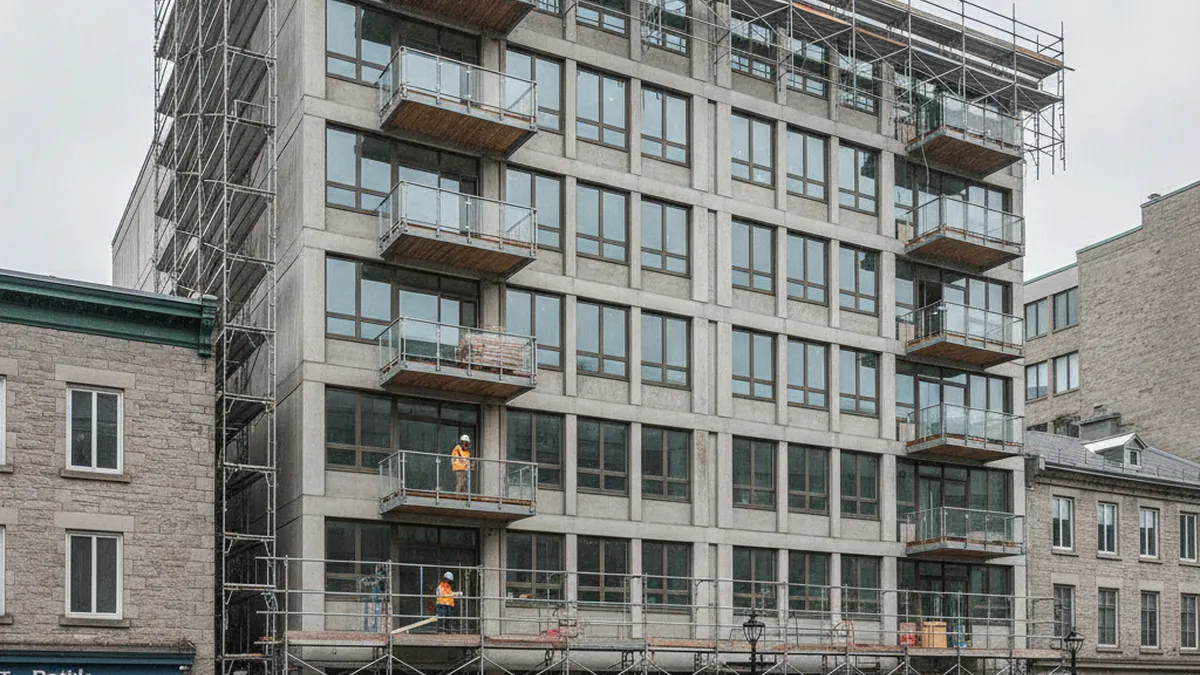
The most ambitious lever is to reclaim space and turn it into an income source. A full rent added to gross income has an amplified effect on NOI and value.
Reclaimable spaces
- The former caretaker's unit: once occupied by an employee, it can become a rentable unit again if operating the building no longer requires it.
- A large developable basement: depending on zoning and the building code, an unused space can sometimes host a compliant unit.
- A vacant commercial space in a mixed building: put back on the market, it adds income to NOI.
Never create a non-compliant unit
A unit added without respecting zoning, the building code and municipal regulations is a liability, not an asset. It exposes the buyer to a restoration order, distorts NOI and can sink the financing. Always validate compliance with your municipality and a professional before undertaking a conversion.
"Reclaimed space only creates value if it is compliant and documented: a real, legal rent is worth several times a theoretical one."
— Sale-preparation principle, ImmoMultiThe mistakes that destroy your optimized NOI
The costliest mistakes: presenting projected rents instead of collected rents, inflating NOI through under-maintenance, forgetting the management allowance, ignoring vacancy, and confusing capital and current expenses. A buyer and a lender normalize NOI and remove anything that is not real, recurring and documented.

Optimizing NOI is powerful, but a handful of classic mistakes can undo all the work at negotiation time. Here they are, with the antidote.
Mistake 1 — Presenting projected rather than collected rents
This is mistake number one. An owner shows the "market" rents they could theoretically obtain, but has not yet applied using the TAL method. The buyer removes these fictitious increases and brings NOI back to its collected reality. Antidote: apply the increases before selling and prove them with leases.
Mistake 2 — Inflating NOI through under-maintenance
Cutting maintenance to show a high NOI backfires: the buyer spots the deferred work and deducts its cost. Antidote: cut avoidable expenses, never necessary maintenance.
Mistake 3 — Forgetting the management allowance
An owner who self-manages sometimes presents a "no management" NOI. But the buyer and the bank always normalize a management allowance. Antidote: build in a realistic management allowance from the start.
Mistake 4 — Ignoring vacancy and bad debt
Presenting a building as 100% leased at all times is not credible. Collège MREX's NNI analysis includes a vacancy allowance based on market standards. Antidote: provision a realistic vacancy.
Mistake 5 — Confusing capital and current expenses
Per Revenu Québec, a capital expense (improvement, addition) is not deductible in the year like a current expense. Treating a capital expense as current distorts your financial statements and will be corrected by the buyer. Antidote: classify each expense correctly.
| Mistake | Consequence | Antidote |
|---|---|---|
| Projected, uncollected rents | Increases removed by the buyer | Apply and prove via leases |
| Under-maintenance | Deferred-work cost deducted | Cut avoidable, not necessary |
| "No management" NOI | Allowance reinstated | Realistic management allowance |
| Vacancy ignored | NOI brought back to standard | Provision for vacancy |
| Capital treated as current | Financial statements corrected | Classify each expense |
Source: Collège MREX — Normalized net income (NNI): everything you need to know.
The action plan: 24 months to boost your plex's NOI
An NOI-boosting plan ideally spans 12 to 24 months: rent increases follow the lease cycle and TAL notice timelines, insurance and energy contracts renegotiate at expiry, and ancillary income needs a 12-month track record to be credible.

Boosting NOI is not a last-minute sprint: it is methodical preparation. An NOI improved over several months, with supporting documents, is far more credible than a projection improvised at listing. Here is a realistic framework.
Months 1 to 6 — Diagnosis and quick wins
- Establish the real NOI line by line and compare it to market standards.
- Identify below-market rents and plan modification notices at the right cycle.
- Shop insurance at the next renewal; review coverage.
- Check the municipal assessment and, if warranted, prepare a review request.
Months 6 to 12 — Income and efficiency
- Set up ancillary income (parking, laundry, lockers) and start collecting it to build a track record.
- Carry out energy-efficiency measures in common areas.
- Apply the first rent increases using the TAL method.
Months 12 to 24 — Consolidation and documentation
- Apply a second round of increases at lease renewal.
- Assemble the file: leases, TAL notices, invoices, collection statements, renegotiated contracts.
- Validate the improved, defensible NOI, ready for a buyer's or lender's normalization.
ImmoMulti: a direct valuation based on your real NOI
Preparing to sell your North Shore plex? We analyze your real NOI and make a direct, commission-free, fully confidential offer — no public listing, no broker. Get a proposal within 48 hours.

