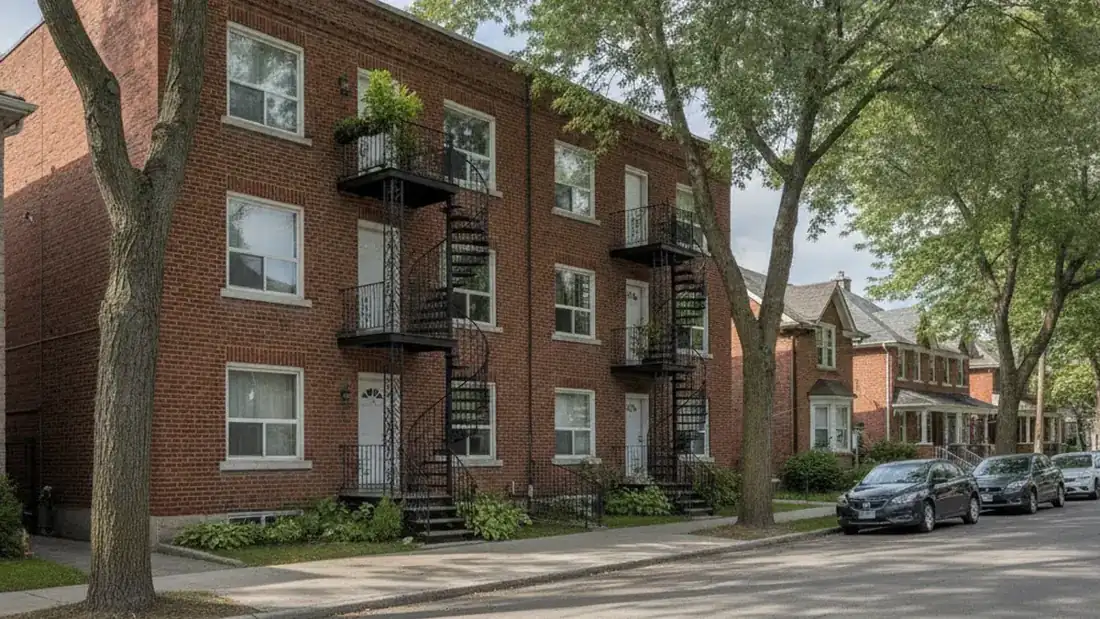
ImmoMulti — direct buyer of income properties on the North Shore — sees owners every week set the price of their plex on a single figure: price per door, or price per square foot. These are handy shortcuts for quickly comparing buildings, but neither captures revenue, expenses or the real condition of the building. For an income property, the income approach — the cap rate and the gross rent multiplier (GRM) — remains the gold standard of chartered appraisers and investors. Here is what each metric measures, where it breaks down, and how a savvy North Shore seller should use them without falling into the trap.
What is price per door, and what does it really measure?
Price per door is the building's price divided by its number of units. A fourplex sold for $800,000 has a price per door of $200,000. It is a quick comparison metric between buildings in the same area — but it ignores revenue, expenses, unit size and building condition.
Price per door is probably the most popular shortcut for talking about a multiplex. The math is trivial: you divide the sale price by the number of rental units. A triplex at $750,000 works out to $250,000 per door; a sixplex at $1.2M to $200,000 per door. The appeal is obvious: a single figure lets you compare buildings of different sizes at a glance.
What price per door measures is essentially how much the market pays, on average, for the "container" of each unit in a given area. It is a comparison benchmark between recent sales of similar plexes — a starting point to position a building against its neighbours.
What price per door does not measure, however, is considerable. It says nothing about the rents collected, the operating expenses, the unit size, the year of construction or the condition of the building. Two triplexes at the same price per door can hide radically different realities: one with large renovated, well-rented units, the other with small studios needing work and rents that lag the market.
How does price per square foot work, and why is it slippery?
Price per square foot is calculated by dividing the sale price by the building's area. Its weakness: the area used varies (livable, gross, with or without basement), so two listings can show very different price-per-square-foot figures for an equivalent building.
The price per square foot is the other classic shortcut. You divide the sale price by the building's area, giving a cost per unit of surface. It is a familiar metric inherited from the single-family market, and it has its logic: at comparable area and quality, replacement cost and value tend to track built surface.
The problem, for an income property, is that you first have to agree on which area you are dividing by. Livable area of the units only? Gross area including walls and common spaces? With or without the basement, finished or not? Depending on the convention chosen, the same building can show a price per square foot that varies twofold. A listing that includes an unfinished basement in its area will look "cheaper" per square foot than one that counts only livable surface — without the real value changing by a dollar.
For small plexes (duplex, triplex, fourplex), the area is also not always documented reliably. The assessment-roll value per square metre often differs from the truly rentable area. In short, price per square foot is a useful construction and comparison benchmark, but it becomes slippery the moment you try to make it a measure of value.
Three questions to ask before quoting a price per square foot
- Which area is used: livable, gross, with or without basement?
- Is the source the same for all the comparables cited?
- Does the figure reflect the truly rentable, revenue-generating surface?
What limits do price per door and price per square foot share?
Both shortcuts share the same fundamental weakness: they capture neither revenue, nor expenses, nor building condition. A plex is first and foremost a revenue-generating asset; a metric that ignores rents cannot, on its own, establish its value.
The limit is the same for both: they are measures of the "container," not the "content." An income property is not worth most for its walls or its number of doors — it is worth the stream of net revenue it generates, year after year. And neither price per door nor price per square foot looks at that stream.
Concretely, these shortcuts account for none of:
- rental revenue and how far it sits from the market;
- operating expenses (taxes, insurance, energy, maintenance);
- building condition (roof, foundation, plumbing, windows);
- unit mix (large units vs small studios);
- upside potential or below-market rents.
As valuation analyses note, price per door and the capitalization rate are "shortcut methods" that investors readily use but that carry inherent limits; an analysis based on cash flows is more complete and more precise. In other words, these figures are for narrowing down, not for concluding.
Source: income-capitalization valuation concepts, Collège MREX — discount rate and intrinsic value.
Why are the cap rate and GRM superior for valuing a plex?
Because they tie price to revenue. The value of an income property = net operating income (NOI) ÷ area cap rate. The cap rate and GRM capture what price per door and per square foot ignore: rents and, for the cap rate, expenses. This is the income approach used by chartered appraisers.

For an income property, the reference is the income approach. The cap rate (in Québec, the taux global d'actualisation or TGA) ties price directly to what the building produces: value equals net operating income (NOI) divided by the area's cap rate. NOI is effective gross revenue minus operating expenses, excluding the mortgage. In Québec in 2026, cap rates for multiplex buildings generally sit in a range of roughly 4% to 7% depending on the area, size and condition — a range that should always be validated against recent comparable sales.
The gross rent multiplier (GRM) is a notch simpler: it is the building's price divided by its annual gross revenue. It is less precise than the cap rate because it ignores expenses, but it has a decisive advantage over price per door: it already ties price to revenue. A GRM is compared between buildings sold in the same area, then applied to the target building to check whether the asking price holds up.
| Metric | What it ties together | Captures revenue? | Captures expenses? |
|---|---|---|---|
| Price per door | Price ÷ number of units | No | No |
| Price per sq. ft. | Price ÷ area | No | No |
| GRM | Price ÷ gross revenue | Yes | No |
| Cap rate | NOI ÷ value | Yes | Yes |
The table sums up the hierarchy: from price per door (the crudest) to the cap rate (the most complete), each metric captures a bit more of the building's economic reality. That is why a chartered appraiser relies on the income approach for an income-generating plex, reserving the shortcuts for consistency checks.
How should a plex seller use these shortcuts with caution?
As starting points, never as the final price. Price per door and per square foot quickly position your plex against comparables, but setting your asking price solely on that basis risks undervaluing a well-rented building or overvaluing a low-yield one. Always validate with the cap rate and, for a significant sale, a chartered appraiser.
For a seller, these shortcuts are not to be discarded — they are to be put in their proper place. The right reflex is to use them as comparison guardrails: "Does my triplex sit within the price-per-door range of recent sales in the area?" is a legitimate question to check you are not completely off-market.
The trap is making it the sole driver of the asking price. Two opposite risks await the seller who relies on it blindly:
- Undervaluing a building whose rents and yield exceed the area average — leaving money on the table because the "average" price per door pulls the price down;
- Overvaluing a low-yield or high-expense building — setting a "market" price per door that no rational buyer running the cap rate will validate.
The savvy seller's discipline is therefore simple: start from revenue, establish a value via the cap rate and GRM, then check that the resulting price per door and per square foot are consistent with comparables. That is the reverse of the order many sellers reach for by instinct.
The danger of "price per door" figures quoted without a source
Be wary of round numbers — "it sells for X per door around here" — quoted without comparable sales to back them up. An area's median price says nothing about the number of units, their size or the condition of the buildings. A price per door only means something when tied to real, recent transactions, ideally validated by a chartered appraiser.
"Investors tend to know capitalization rates or prices per door and to rely on them as a shortcut to value an asset; these methods, however, carry inherent limits."
— Income-capitalization valuation concepts, after Collège MREXHow do you properly value your North Shore multiplex in 2026?
By starting from revenue. Establish NOI, apply the area cap rate (generally 4–7% in Québec in 2026), validate with the GRM, then compare the resulting price per door and per square foot against recent sales. For a significant transaction, have it confirmed by a chartered appraiser. The plex market remained seller-favourable in Québec in early 2026.

On the North Shore of Montréal — Terrebonne, Mascouche, Blainville, Boisbriand, Saint-Jérôme, Saint-Eustache, Deux-Montagnes — the market backdrop remains favourable for plex sellers. According to APCIQ, the median plex price in Québec exceeded $675,000 in the first quarter of 2026, up roughly 8% year over year, under conditions "clearly favourable to sellers." But a provincial median does not replace a valuation specific to your building.
The steps to follow, for an owner considering selling their multiplex, come down to a few ordered moves:
- Establish NOI: effective gross revenue minus actual operating expenses, mortgage excluded;
- Apply the area cap rate: value = NOI ÷ cap rate, validating the rate against recent comparable sales;
- Cross-check with the GRM: price ÷ gross revenue, compared to multipliers observed locally;
- Verify consistency: are the resulting price per door and per square foot within the comparables' range?
- Have it validated: for a significant sale, a chartered appraiser confirms the value and secures the negotiation.
To dig deeper into the mechanics of the cap rate and GRM, see our multiplex yield calculation guide. And to understand when to call in a professional, read when to use a chartered appraiser for an income property.
ImmoMulti: direct buyer of income properties on the North Shore
Rather than set your price on a single shortcut, get a reading grounded in your plex's revenue. ImmoMulti values your building through the income approach and makes a direct offer, with no broker and no commission. Get a proposal within 48 hours.
Informational content only. Market conditions, cap rates and valuation outcomes vary by building and over time. Consult a chartered appraiser and your own advisors for a valuation specific to your property and transaction.

