
Quick answer
In 2026, selling your North Shore plex frees more net capital when your cap rate is below 4.5% or your cash flow turns negative after refinancing. Refinancing at 4.04% (5-year fixed) is preferable if your property stays cash-flow positive and your capital gain exceeds $400,000. Run both scenarios with real numbers — the right answer is always specific to your file.
Should you sell or refinance your plex in 2026? ImmoMulti, direct buyer of multiplexes on the North Shore, gets this question every week from owners who have accumulated $200,000 to $400,000 in equity in their property. The answer depends on four variables to quantify simultaneously: the net equity truly accessible (capped at 80% of market value), the cost of refinancing in 2026 (5-year fixed mortgage rate around 4.04%), the capital gains tax if you sell (50% inclusion rate for individuals in 2026), and the cash flow after refinancing. You've owned a plex on the North Shore for several years and you're asking the question almost nobody actually helps you calculate properly. In 2026, with a North Shore multiplex market still favourable to sellers, the answer is no longer automatic. Here is the complete framework to do this calculation correctly and make the right decision for your situation.
Is it better to sell or refinance your plex on the North Shore in 2026?
It depends on four simultaneous variables: your available equity, the 4.04% refinancing cost, your capital gains tax on a sale, and your post-refinancing cash flow. If your cap rate is below 4.5% or cash flow goes negative after refinancing, selling frees more net capital. If your gain exceeds $400,000 and the property stays cash-flow positive, refinancing is often better.
The decision to sell or refinance your plex is one of the most consequential financial decisions an income property owner can make. Yet it is rarely modelled seriously. You hear: "Refinancing avoids the tax" — true, but incomplete. Or: "Sell now, the market is at its peak" — maybe, but the tax can wipe out a good chunk of the gain.
What makes the question particularly tricky in 2026 on the North Shore is the simultaneous convergence of three factors:
- Fixed mortgage rates have climbed back to 4.04–4.09% despite the Bank of Canada's policy rate holding at 2.25% (pulled by bond yields), which increases the cost of keeping a refinanced plex.
- The capital gains inclusion rate remains at 50% for individuals in 2026 — the proposed increase to 66.67% in 2024 was cancelled in 2025 — but on a property held for many years, the tax bill on a sale is still substantial.
- Plex prices on the North Shore remain supported — provincial median price at $685,000 in May 2026, inventories down 20% — which creates a favourable context for a direct sale if you are a seller.
These three factors pull in opposing directions and must be quantified simultaneously. That is precisely what this article allows you to do.
What this article does NOT cover
The mechanics of mortgage rates (fixed vs. variable, Bank of Canada, bonds) are detailed in our article Multiplex mortgage rates 2026. How the CMHC MLI Select program works is covered in our CMHC financing 2026 guide. This article focuses exclusively on the strategic exit-or-hold decision, for an existing owner considering a change of direction.
How do you calculate the available equity in your plex before deciding?
Accessible equity = 80% of market value minus your mortgage balance (for 2–4 unit residential). On a $600,000 triplex with a $250,000 balance, the maximum refinancing is $480,000, leaving $230,000 extractable — before notary fees, appraisal and any prepayment penalty.

Before comparing selling and refinancing, you need one precise figure: your net available equity. Many multiplex owners on the North Shore confuse gross equity with what they can actually recover or access. They are not the same thing.
Gross equity vs. accessible equity
Your gross equity = current market value of your plex − remaining mortgage balance. That is the flattering number. But it is not what you can touch.
For a refinancing, most lenders allow up to 80% of market value as the maximum mortgage on a 2-to-4-unit residential property. For properties with 5 units or more, commercial rules apply and the ratio may vary.
Concrete example: triplex appraised at $600,000, mortgage balance of $250,000.
- Gross equity: $350,000
- Maximum refinancing: 80% × $600,000 = $480,000
- Accessible capital via refinancing: $480,000 − $250,000 = $230,000 (before fees and penalties)
In the case of a direct sale, you recover the sale price minus the mortgage balance, transaction fees, and capital gains tax. The comparison must be made on net capital after tax and fees — not gross figures.
Market data: APCIQ — Quebec Real Estate Market Statistics 2026
What is the true cost of refinancing a plex in 2026?
In 2026 the true cost includes: appraisal ($400–$700), notary fees ($1,500–$2,500), a possible prepayment penalty (up to $15,000–$20,000), and ongoing interest of ~4.04% per year on the additional debt. Pulling $230,000 costs roughly $9,300/year in interest — any reinvestment must beat that rate to make financial sense.

Refinancing is not free. In 2026, it carries several costs often underestimated by multiplex owners.
Direct costs of refinancing
- Certified appraisal: $400 to $700 for an income property on the North Shore
- Notary fees: $1,500 to $2,500 for the mortgage amendment
- Prepayment penalty: variable — can exceed $15,000 to $20,000 if you break a fixed term before maturity (calculated based on the interest rate differential or 3 months' interest, whichever is greater)
- Mortgage loan insurance (CMHC): if the refinancing exceeds 80% of value or if the property is insurable, the premium may apply (3.10% to 4.00% of the insured amount)
The monthly cost of the extracted capital
This is the cost owners most often overlook. If you pull $230,000 from your plex via refinancing at 4.04% over 25 years, you add to your monthly mortgage payment an additional amount. That borrowed capital costs interest — approximately $9,292 per year for each $230,000 tranche at 4.04% in the early years.
If you reinvest those $230,000 in an asset generating less than 4.04% annual return, you lose money on a net basis. This is a simple arithmetic reality that is often ignored in the excitement of "pulling out equity."
"Refinancing is a powerful lever when the return on the extracted capital exceeds the cost of the debt. At 4.04%, the bar is higher than at 2%. Too many owners calculate their equity, not their marginal cost of capital."
— ImmoMulti Team, multiplex investor, North Shore, June 2026
To compare financing scenarios side by side with real numbers, our multiplex financing comparison tool lets you model two scenarios in real time.
What is the capital gains tax impact if I sell my plex in 2026?
In 2026, the capital gains inclusion rate is 50% for individuals (the proposed 66.67% rate was cancelled in 2025). On a $400,000 gain, 50% ($200,000) is taxable, generating roughly $100,000 in tax at a 50% marginal rate. CCA recapture is taxed at 100% of your marginal rate — often the larger surprise. Always consult a tax professional for your exact figures.

If you have held your plex for 10, 15 or 20 years on the North Shore, there is a good chance your capital gain is substantial. And in 2026, the tax picture has shifted.
The inclusion rate in 2026: still 50%
The capital gains inclusion rate for individuals remains 50% in 2026. The increase to 66.67% (on the portion of gain exceeding $250,000) proposed in the 2024 federal budget was delayed then cancelled in 2025 — it never came into force. In practice:
- 50% of the capital gain is taxable, with no threshold or $250,000 bracket
- The taxable portion is added to your income and taxed at your marginal rate
For an owner at a 50% marginal tax rate (high income, Quebec), selling a plex with a capital gain of $400,000 (adjusted cost base of $350,000, sale price of $750,000) generates an approximate tax of:
- Capital gain: $400,000
- Taxable portion: $400,000 × 50% = $200,000
- Approximate tax: $200,000 × 50% = $100,000
That is $100,000 less in your pocket than if you had refinanced — and your capital gain had remained unrealized. This difference must appear in your calculation.
Source: Department of Finance Canada — cancellation of the proposed capital gains inclusion rate increase (March 21, 2025). The rate remains 50%.
Caution: the adjusted cost base (ACB) is not your purchase price
- The ACB includes the original purchase price + capitalized expenditures added (major renovations, additions)
- Routine maintenance expenses do NOT increase the ACB
- Capital cost allowance (CCA) already claimed can reduce your ACB and increase your capital gain
- Depreciation recapture is taxed at your full marginal rate, not the inclusion rate — it can be heavier than the capital gain itself
- Consult an accountant or tax professional before finalizing your decision
How do you choose between selling and refinancing your plex: the 2026 decision table?
Use the decision table: a cap rate ≤ 4.5%, negative post-refi cash flow, or a capital gain under $200,000 favours selling. A cap rate ≥ 5.5%, solid positive cash flow, and a gain over $400,000 favour refinancing. Assess all six variables together — no single factor is decisive on its own.
Here is the structured decision table used to analyze North Shore multiplex files. It combines the four key variables: available equity, cost of refinancing, capital gains tax, and expected future return.
| Variable | Favours selling | Favours refinancing |
|---|---|---|
| Cap rate of your plex | Cap rate ≤ 4.5% (the plex struggles to cover its cost) | Cap rate ≥ 5.5% (the property performs solidly) |
| Post-refi cash flow | Negative or ≤ $200/month after refinancing | Solid positive cash flow (> $400/month) after refinancing |
| Anticipated capital gain | < $200,000 (manageable tax bill) | > $400,000 (very heavy tax bill) |
| Planned holding period | You want to exit within 3–5 years | You are targeting a 10-year or longer hold |
| Use of freed capital | Need for free liquidity (retirement, diversification, project) | Reinvestment in an asset yielding ≥ 5% |
| Condition of the property | Aging plex, major work coming up | Property in good condition, few foreseeable capital expenditures |
| Tenants | Problematic tenants or below-market leases | Stable tenants, rents near market |
| Prepayment penalty | Term near end or low penalty (< $5,000) | Recent term, high penalty (> $15,000) |
Worked example: sell or refinance a North Shore triplex at $600,000 in 2026?
On a $600,000 triplex (bought at $320,000, mortgage balance $200,000): selling yields ~$328,000 net after tax; refinancing at 80% yields ~$277,000 tax-free but leaves only ~$168/month cash flow. In this scenario the direct sale provides $51,000 more net capital — but outcomes shift significantly based on your marginal tax rate and capital gain size.
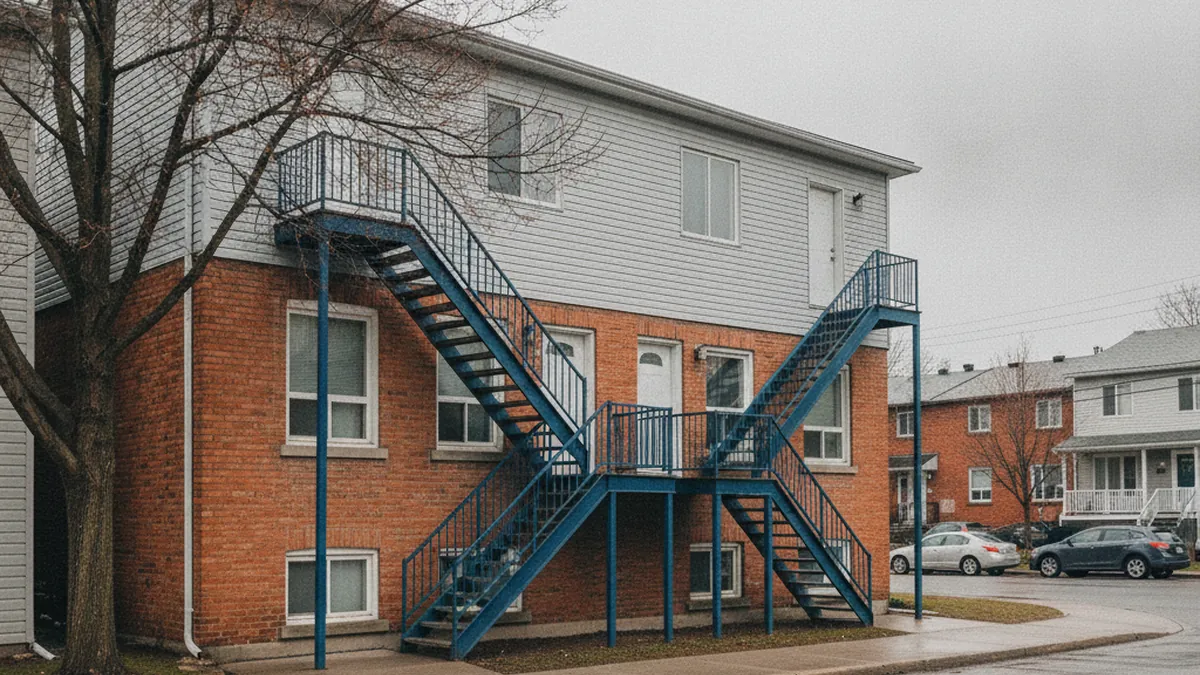
To make this table concrete, here is a simulation on a typical North Shore triplex — say in Terrebonne or Repentigny — purchased 12 years ago at $320,000, worth $600,000 today, with a mortgage balance of $200,000 and gross annual income of $42,000.
Scenario A — Direct Sale
- Sale price: $600,000
- Mortgage repayment: − $200,000
- Notary fees (sale): − $2,000
- Gross capital gain: $280,000
- Approx. tax (50% inclusion × 50% marginal rate): − $70,000
- Net capital available: ~$328,000
- Timeline: 30 to 90 days via direct sale
- Future monthly cash flow on this capital: depends on reinvestment
Scenario B — Refinancing at 80%
- Maximum refinancing: 80% × $600,000 = $480,000
- Capital extracted: $480,000 − $200,000 = $280,000
- Fees (notary + appraisal): − $3,000
- Net capital available: ~$277,000
- New mortgage payment at 4.04% on $480,000 (25 years): ~$2,532/month
- Rental income: $3,500/month
- Charges (taxes, maintenance, insurance): ~$800/month
- Monthly cash flow post-refi: approximately $168/month
- Capital received tax-free immediately (it's a loan)
In this simulation, the direct sale frees up $328,000 in net capital, approximately $51,000 more than refinancing ($277,000), despite the capital gains tax. The refinancing retains the property but compresses cash flow to a thin $168/month — exposing the owner to a smaller buffer in case of vacancies, unexpected repairs or further rate increases at renewal in 5 years.
But if the marginal tax rate is lower, or if the capital gain is higher (plex bought at $250,000 resold at $750,000), refinancing may preserve more net capital. Every situation is unique. These numbers illustrate the method, not a universal recommendation.
In which cases is selling your plex on the North Shore clearly the best option?
Selling is clearly best when: (1) your cap rate is below the refinancing cost (~4.04%); (2) cash flow is already tight or negative; (3) major work is looming ($60,000–$100,000); or (4) you plan to exit within 3–5 years anyway. ImmoMulti buys directly with an offer in 48 h and $0 commission.

Some situations make selling a plex clearly preferable to refinancing. If you recognize yourself in several of these cases, it is worth requesting a direct appraisal.
1. Your current cap rate is below the cost of refinancing
If your income property generates a cap rate of 4.2% and refinancing costs you 4.04% in interest, your net margin is near zero — before maintenance costs, vacancies and property taxes. You own an asset that does not cover its cost of capital. Selling frees up equity to redeploy toward a better-performing asset or simply to diversify.
2. Your cash flow is already under pressure
If your current rents barely cover your mortgage payments, municipal and school taxes, insurance and a minimum maintenance reserve, a refinancing makes things worse. Every extra dollar of debt on your multiplex raises the property's break-even point. This is the time to sell before negative cash flow forces you to sell in a hurry at a less favourable price.
3. Your plex needs major work
A plex that requires $60,000 to $100,000 in work (roofing, foundation, plumbing, heating) over the next 2 to 3 years is a property with uncertain future returns. Refinancing to pull out equity, then having to put money back into the property a year later, is the worst of both worlds. Selling to a direct buyer like ImmoMulti, who buys as-is with no financing or inspection conditions, lets you avoid this trap.
4. Your exit horizon is short
If you plan to sell your income property within 3 to 5 years anyway, a refinancing today merely defers the fees and adds a prepayment penalty to your future calculation. It is often better to sell now under good conditions than to refinance and incur two rounds of transaction costs.
In which cases is refinancing your plex clearly preferable to selling?
Refinancing wins in three scenarios: (1) your cap rate is well above 4.04% and cash flow stays positive post-refi; (2) your capital gain exceeds $400,000 and you want to defer the tax; (3) you plan to hold long-term for estate transfer, potentially resetting the adjusted cost base at death. Outside these three, run the sale calculation seriously.
There are situations where refinancing remains the winning strategy in 2026, even at 4.04%. Here are the three clearest cases.
1. Your capital gain would be very high and you don't need immediate liquidity
If your plex was purchased at $280,000 and is worth $900,000 today, your capital gain is $620,000. At 50% inclusion and a 50% marginal rate, the tax can reach roughly $155,000. If you don't need those funds now and your property generates solid cash flow, a refinancing extracts the equity you need without triggering that tax. The tax authority sees nothing: a loan is not income.
2. Your property performs well and stays cash-flow positive after refinancing
A triplex with a 6.0% cap rate on the North Shore — rents well indexed, stable tenants, maintenance up to date — continues to generate positive cash flow even after refinancing. In this case, refinancing to pull out equity and reinvest it (in another property, in RRSPs, in a business) is financially rational, provided the reinvestment return exceeds the 4.04% interest on the additional debt.
3. You are planning an estate transfer
If you want to keep your income property and pass it on to your children or heirs, refinancing can be an effective wealth-transfer strategy. Estate rules in some cases allow the adjusted cost base to be reset at death, which can eliminate the accumulated capital gain. This strategy must be planned with a notary and a tax professional — ImmoMulti can refer you to specialists in real estate estate planning on the North Shore.
Summary: the 5 questions to ask yourself before deciding
- What is your monthly net cash flow AFTER a full refinancing?
- What would be the net capital gains tax if you sell this year?
- What return will you get when reinvesting the extracted capital (refi or sale)?
- What is your prepayment penalty if you sell now?
- What is your realistic holding horizon for this property?
If you have answered those five questions with precise numbers, you have 80% of what you need to make an informed decision. The remaining 20% is the conversation with your accountant to validate the tax scenario, and with us to validate the sale scenario.
On the North Shore — whether in Laval, Terrebonne, Repentigny, Blainville, Mascouche or Saint-Jérôme — the plex and income property market remains active and transaction timelines for a direct sale are short. If you are leaning toward selling, there is no reason to wait 3 months of agent listing when you can receive a direct offer from ImmoMulti within 48 hours, with no commission, and sign at the notary in approximately 30 days.
Informational content only. Does not constitute legal, tax or financial advice. The simulations presented are for illustrative purposes and do not constitute personalized financial projections. Consult a certified accountant or tax professional before making any decision related to the sale or refinancing of your income property.
Frequently asked questions — Sell or Refinance Your Plex in 2026


