
Quick answer
Montreal duplex values range from ~$710,000 in more affordable areas to $1,050,000+ on the Plateau-Mont-Royal (2026). Value is driven by rental income, not square footage: use the GRM (12–14× gross income) and cap rate to price correctly. You can sell without a broker — no commission, offer in 48 h — and leases transfer automatically to the buyer.
Selling a duplex in Montreal? ImmoMulti is a direct buyer that evaluates your property based on its income and delivers an offer within 48 hours — no commission, no public listing. In 2026, the median price of a duplex on the island ranges from $710,000 in more affordable areas to over $1,050,000 on the Plateau-Mont-Royal. Unlike a single-family home, a duplex's value rests almost entirely on its rental income: the neighbourhood, lease terms and net income matter far more than square footage or architectural style. This guide explains how to set the right price using the GRM and cap rate, compare your selling options and avoid the most common pitfalls — whether you're in Rosemont, Villeray, Verdun, Hochelaga or NDG.
Why is the Montreal duplex so sought after by investors?
The Montreal duplex combines a lower entry price than a triplex or quadruplex with strong rental demand and owner-occupancy flexibility. In 2025–2026, plex prices on the island rose year over year, driven by low vacancy and proximity to services in central neighbourhoods like the Plateau, Rosemont, Villeray, Verdun and NDG.
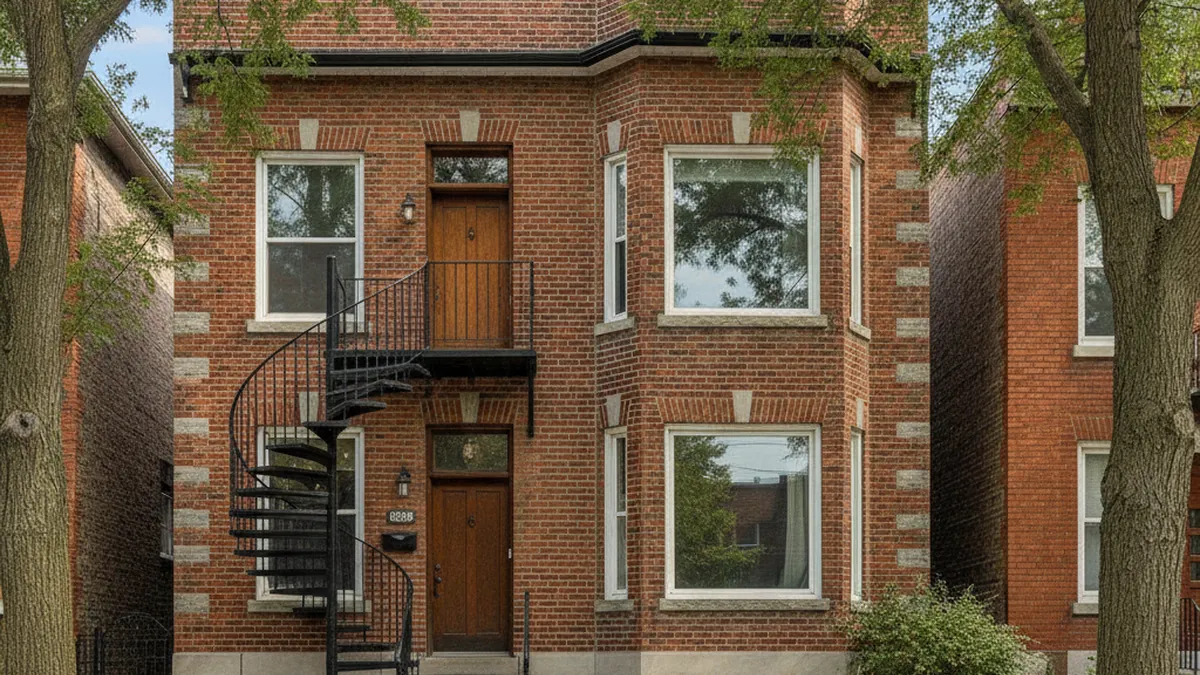
The duplex is one of the most in-demand assets on the island. It combines a lower entry price than a triplex or quadruplex, sustained rental demand and the option, for a buyer, to live in one unit while renting the other. In 2025–2026, the Montreal plex market (2–5-unit income properties) remained dynamic, with median prices rising year over year.
This demand is concentrated in a few central neighbourhoods where tenants compete for units:
- Plateau-Mont-Royal — the most expensive and most coveted area for duplexes, driven by its central location and character.
- Rosemont–La Petite-Patrie — considered affordable for a central neighbourhood, with a family-friendly vibe that appeals to buyers.
- Villeray — one of the fastest-growing areas for transactions, still more affordable than the Plateau.
- Hochelaga-Maisonneuve — a neighbourhood on the rise, with markedly increasing rents.
- Verdun — now very popular, comparable to Villeray or Rosemont in value.
- Notre-Dame-de-Grâce (NDG) — stable demand, higher-income tenants and low vacancy.
In all these neighbourhoods, proximity to services, walkability and low vacancy rates support prices and shorten selling timelines. That's excellent news when the time comes to sell an income property in Montreal.
How is a duplex's value calculated from its income?
A Montreal duplex is valued primarily on its rental income using two metrics: the gross rent multiplier (GRM, typically 12–14× annual gross income in 2026) and the cap rate (NOI divided by price). A duplex generating $48,000/year at a 13× GRM = ~$624,000. Always cross-check with actual net income and building condition.
Unlike a house, a duplex sells primarily on its numbers. Two indicators dominate valuation in Montreal: the gross rent multiplier (GRM) and the cap rate.
The gross rent multiplier (GRM)
The GRM is the most widely used method for plex properties. You divide the sale price by the property's annual gross income. Conversely, to estimate a value, you multiply gross income by the sector's GRM. In Montreal, the GRM for a plex generally falls between 12 and 14 times gross income in 2026, depending on location and building condition.
Quick example
A duplex generating $48,000 in annual gross income, in an area where the GRM is around 13×, would be worth approximately $48,000 × 13 = $624,000. That's a starting point — actual net income and building condition then refine the figure.
The cap rate
The cap rate relates net operating income (NOI) to the property's value. It better reflects true profitability because it accounts for expenses (property taxes, insurance, utilities, maintenance). To go further, see our guide on the cap rate calculator. The right reflex: start from your real numbers, not optimistic projections.
How much is a Montreal duplex worth by neighbourhood in 2026?
Indicative 2026 ranges: Plateau-Mont-Royal $1M+, Rosemont/Villeray/Verdun mid-range (~$710,000–$950,000), NDG mid-to-high range, Hochelaga-Maisonneuve more affordable. The regional median for all plex types was ~$865,000–$885,000 in 2025–2026. Your actual value depends on rental income, not on these benchmarks alone.
The ranges below are provided as a rough guide only and reflect 2025–2026 market data. As a reference, the median price for a plex in the Montreal region was around $865,000 to $885,000 in 2025–2026, and the median duplex price ranged roughly from $710,000 in the most affordable areas to over $1,050,000 on the Plateau-Mont-Royal. Your duplex may be worth more or less depending on its income, condition and configuration.
| Neighbourhood | Indicative range (duplex) | Profile |
|---|---|---|
| Plateau-Mont-Royal | High end (≈ $1 M+) | Most expensive and most coveted |
| Rosemont–La Petite-Patrie | Mid-range | Central but affordable, family-friendly |
| Villeray | Mid-range | Fast-growing transaction volume |
| Verdun | Mid-range | Very popular, rising prices |
| NDG | Mid to high range | Stable demand, low vacancy |
| Hochelaga-Maisonneuve | More affordable | Revitalizing, rents rising |
These benchmarks don't replace a valuation based on your actual income. For a figure specific to your property, first validate value with a purchase offer calculator, then confirm with a buyer or certified appraiser.
Is it better to sell a Montreal duplex with or without an agent?
Nothing in Quebec law requires an agent to sell a duplex. Agents charge 4%–7% commission (up to $51,000+ on an $850,000 duplex). A direct sale to a specialized buyer means $0 commission, no public listing and an offer within 48 h. Compare the net amount in your pocket — not just the listed price — before deciding.
In Quebec, nothing requires you to use an agent to sell a duplex. You essentially have two options.
With an agent
The agent lists the property, markets it (often on Centris), organizes showings and negotiates on your behalf. In return, they charge a commission — often 4% to 7% of the sale price. On an $850,000 duplex, that's roughly $34,000 to $51,000, plus taxes.
Without an agent (direct sale)
You sell directly to a specialized plex buyer. No commission, no public listing. The buyer analyses your numbers and presents an offer; if it suits you, you proceed to the notary. What you save on commission stays in your pocket.
| Criterion | With an agent | Direct sale |
|---|---|---|
| Commission | 4% to 7% | None |
| Typical timeline | Weeks to several months | A few weeks |
| Public exposure | High | None |
| Showings | Multiple | 1, targeted |
| Effort for the seller | Moderate | Low |
Selling directly doesn't mean selling below market value: a serious buyer bases their offer on net income. What matters is comparing the net amount you actually pocket, not just the listed price. To go deeper on the method, see our article on calculating multiplex yield and our GRM calculator.
How do you sell a Montreal duplex quickly and confidentially?
Sell directly to a specialized plex buyer: no public sign, no Centris listing, no tenant disruption. The buyer analyzes your income figures, delivers a firm offer (typically within 48 h), and the notarized deed follows within a few weeks. Leases transfer automatically — no need to evict anyone before closing.

Many duplex owners don't want to list their property publicly: no sign, no online listing, no parade of visitors, no worried tenants. A direct sale to a buyer addresses exactly that need.
- Speed — a firm offer can arrive within 48 hours, and the notarized deed follows within a few weeks.
- Confidentiality — nothing is made public; your tenants and neighbours know nothing.
- Zero commission — no brokerage fees to deduct from your sale proceeds.
- Tenants in place — leases follow the property, you don't need to rehouse anyone.
As a direct plex buyer, ImmoMulti evaluates your duplex from your actual numbers and presents a no-obligation offer. You can also explore our investors and off-market deals page if complete discretion is your priority.
How do you prepare your duplex before listing it?
First assemble the "seller's kit": signed, up-to-date leases, rent-increase notices, income and expense statements for 2–3 years, tax bills, invoices for major repairs, a current certificate of location and seller's declarations. A duplex with documented numbers sells faster and for more than one whose returns can only be guessed at.
Selling a duplex isn't like selling a condo: the buyer is purchasing an income stream and will want to verify it before signing. The more complete your file, the fewer reasons they'll have to lower their offer. Preparation plays out on three fronts: financial documents, the physical condition of the building, and how the units present.
The seller's documentation kit
Gather these items before receiving the first offer. They serve the due-diligence stage and reassure the buyer:
| Document | What it's for | Effect on value |
|---|---|---|
| Leases for both units | Proves actual rents and terms | Basis for GRM/cap-rate calculation |
| Rent-increase notices | Shows rents track the market | Up-to-date rents = higher value |
| Income and expense statements (2–3 yrs) | Establishes net operating income | Credible numbers = less discounting |
| Municipal and school tax bills | Major fixed expense | Direct impact on the net |
| Invoices for major work (roof, windows, plumbing) | Proves condition and recent investment | Reduces perceived risk |
| Current certificate of location | Required by the notary at closing | Avoids signing delays |
| Seller's declarations | Discloses the building's known condition | Protects against disputes |
The certificate of location deserves special attention: the notary will require it to finalize the transaction, and one that is too old (or that no longer reflects changes to the property, such as a shed or fence) can delay signing by several weeks. If you haven't done major work and the existing certificate accurately describes the premises, it can often be reused; when in doubt, order a new one early in the process.
Getting rents and leases in order
This is the most underrated lever. A duplex with rents well below market sells for less, because the buyer capitalizes current income, not potential income. Before selling, make sure your rent-increase notices were sent on time and that each lease is signed, dated and complete. A unit rented at $1,100 while the market is $1,500 shaves value: at a 13× GRM, that missing $400/month represents roughly $62,000 in value ($400 × 12 × 13). Documenting upside — without ever resorting to abusive practices or bad-faith repossessions — helps the buyer see the margin, but it's the actual rent on the lease that sets the price.
Tending to physical condition and presentation
A duplex doesn't need a top-to-bottom renovation to sell well, but visible defects fuel negotiation. Fix the small things (a dripping faucet, peeling paint in common areas, a wobbly staircase) and gather proof of recent big-ticket work. If major work is approaching — a roof at the end of its life, an original plumbing stack — it's better to know and factor it into your price than to let it surface at inspection. A direct buyer specialized in plex properties will account for these items transparently in their offer rather than backing out at the last minute.
A quick pre-sale checklist
Before you invite the first offer, run through this short list. Each item you can tick removes a lever the buyer could otherwise use to chip away at your price:
- Leases signed and dated for both units, with any addenda attached.
- Rent-increase notices sent within the legal timelines and kept on file.
- Two to three years of income and expense statements reconciled with your tax returns.
- Proof of major work — roof, windows, plumbing, electrical — with dates and amounts.
- Certificate of location that reflects the current state of the property.
- Utility and tax accounts up to date, with no arrears that would complicate closing.
- A written seller's declaration listing everything you know about the building's condition.
Owners who walk into a sale with this file already assembled routinely close faster and defend a higher price, because there is simply less for a buyer to question. The opposite — scrambling to find a lease or explain a gap in the numbers mid-transaction — is exactly what invites a price cut.
What taxes and costs should a duplex seller expect?
The seller mainly pays capital gains tax — half (50%) of the gain remains taxable in 2026, the two-thirds increase announced in 2024 having been cancelled. Add the recapture of depreciation (CCA) previously claimed, possible mortgage-discharge fees, notary fees and, where applicable, brokerage commission. The welcome tax is paid by the buyer.

The biggest seller mistake is confusing the listed price with the money that actually lands in your pocket. Between the two sit taxes and closing costs. Here are the main items — to be validated with a tax accountant, since every situation is different.
Capital gains tax
When you sell an income property for more than its tax cost (price paid + improvements), the difference is a capital gain. In Canada, 50% of that gain is added to your taxable income for the year. The increase in the inclusion rate to two-thirds, proposed in 2024, was deferred and then cancelled by the federal government: the one-half rate therefore remains in effect for realized gains, per the Department of Finance Canada announcement. On a $300,000 gain, that means $150,000 is added to your income and taxed at your marginal rate.
Recapture of depreciation (CCA)
If you claimed capital cost allowance (CCA) on the building over the years to reduce your rental income, part of it may be "recaptured" on sale and taxed at 100% as ordinary income, not as a capital gain. Many owners forget this item and end up with a bigger tax bill than expected. That's one reason to model the after-tax result before accepting an offer.
Principal residence and the occupied portion
If you lived in one of the duplex's two units, the portion corresponding to your principal residence may, under certain conditions, qualify for the principal-residence exemption and reduce tax on that share of the gain. Splitting the gain between the rental and occupied portions (often by floor area) is a delicate calculation: exactly the kind of situation where a tax specialist saves you far more than their fee.
Worked example (illustrative)
Duplex sold for $850,000, tax cost of $550,000 → $300,000 gain. Taxable portion: 50% × $300,000 = $150,000 added to income. CCA recapture may be added on top. The actual tax owed depends on your marginal rate and the principal-residence split: only a tax specialist can figure it precisely.
The seller's other closing costs
- Notary fees — the deed of sale must be notarized; some fees fall to the seller (a mortgage discharge, for example).
- Mortgage penalty and discharge — repaying a loan before term may trigger a penalty; check with your lender.
- Certificate of location — if a new one is needed, it's generally the seller's responsibility.
- Brokerage commission — 4% to 7% if you use an agent; none in a direct sale.
- Adjustments — prepaid municipal and school taxes and tenant deposits are apportioned at closing.
Note: the real estate transfer duties (the "welcome tax") are paid by the buyer, not you. The sale of a used residential property is also generally exempt from GST/QST, though exceptions exist (new buildings, major renovation): confirm your case.
What are the steps in a duplex sale, from offer to notarized deed?
The typical path: (1) valuation and pricing, (2) receiving a promise to purchase, (3) the condition period (financing, inspection, document review), (4) removal of conditions, (5) notary preparation, (6) signing the deed of sale and releasing the funds. In a direct sale, this path can close in a few weeks rather than several months.

An income-property sale follows a precise mechanism. Knowing it spares you nasty surprises and lets you keep control of the timeline.
1. The promise to purchase
It all starts with a promise to purchase (sometimes called an offer to purchase): a document setting the price, conditions, desired signing date and an inventory of what's included. For a duplex, it also specifies how the leases and tenant deposits are handled. Once you accept it, it binds both parties, subject to the conditions it contains.
2. The condition period (due diligence)
Most promises include conditions to be removed within a set period: the buyer securing financing, a building inspection, review of the leases and financial statements. This is where your documentation kit makes the difference: the clearer and more verifiable your numbers, the faster conditions clear. A buyer who discovers surprises (undocumented rents, hidden work) will use this stage to renegotiate.
3. Removal of conditions
When the buyer is satisfied, they remove their conditions in writing. The sale then becomes firm. Conversely, if a condition isn't met (financing refused, unfavourable inspection), the promise can collapse — hence the value of dealing with a solid, well-financed buyer.
4. The notary and signing
In Quebec, the deed of sale of a property must be received by a notary. They verify title, draft the deed, handle the discharge of your mortgage and apportion adjustments (taxes, rents, deposits). At signing, the price is released to you (minus what must be settled), and ownership changes hands.
| Step | Sale with agent | Direct sale |
|---|---|---|
| Marketing | Listing, photos, showings | None — analysis of the numbers |
| Receiving an offer | Variable (days to months) | Offer within 48 h |
| Conditions | Financing + inspection | Targeted verification |
| Notary and signing | A few weeks | A few weeks |
| Typical total timeline | Weeks to several months | A few weeks |

Duplex, triplex or quadruplex: what impact on resale in Montreal?
The duplex offers the lowest entry price and the widest buyer pool (investors and owner-occupants), which supports liquidity. Triplexes and quadruplexes spread rental risk across more units and mainly attract investors. In Montreal, the duplex stands out for its dual demand: the buyer who wants to live in one unit and rent the other, and the pure income-property investor.

The number of units changes the nature of the asset and, therefore, the buyer's profile. Understanding where your duplex sits on this spectrum helps you target the right buyer and defend your price.
| Type | Buyer profile | Resale strength |
|---|---|---|
| Duplex (2 units) | Owner-occupant + investor | Widest buyer pool, strong liquidity |
| Triplex (3 units) | Investor, sometimes owner-occupant | Diluted rental risk, often higher yield |
| Quadruplex (4 units) | Investor | Economies of scale, income-based valuation |
| 5 units and up | Investor (commercial financing) | Valued purely on cap rate, separate financing |
The duplex occupies an enviable position: it attracts both the buyer who wants to live in one unit and rent the other (the classic "owner-occupant") and the pure investor. This dual pool of demand supports prices and shortens selling timelines, especially in Montreal's central neighbourhoods. The owner-occupant can also access more favourable residential financing than an investor, further widening the market for your property.
Conversely, the more units there are, the more the typical buyer becomes an investor reasoning strictly on returns — GRM, cap rate and net operating income. From five units up, the property crosses into commercial financing, with distinct rules. For a duplex, the resale challenge isn't to convince a niche market but to present solid numbers well to an already-broad buyer pool. That's what makes selling an income property in Montreal particularly smooth when the file is clean.
How do you manage leases and tenants during a duplex sale?
Leases follow the property: the buyer takes over tenants under the same terms, and you have no one to rehouse. You must respect tenants' privacy during showings, keep leases and notices up to date, and know that lease assignment under Bill 31 changes the picture. A duplex sold occupied, with clean leases, remains fully attractive to an investor.

Unlike a house, a duplex often sells occupied — and that's good news. The investor-buyer specifically wants rented units producing income from day one. You still need to handle the tenant relationship properly during the transaction.
Leases transfer, with no repossession needed
In Quebec, the lease is attached to the unit, not the landlord. When you sell, the buyer becomes the new landlord and takes over each lease on existing terms: same rent, same duration, same clauses. You therefore don't need to repossess, give a notice of non-renewal or rehouse anyone before selling. Any deposits and the current month are apportioned at closing by the notary.
Respecting privacy during showings
Even in a direct sale, there may be a technical visit. The law governs access to the unit: the tenant is entitled to reasonable notice and access must occur at suitable hours. This is a major advantage of a direct, confidential sale: instead of a parade of visitors and multiple showings that disturb your tenants, there's a single targeted visit — or none if analyzing the numbers is enough. To understand your obligations, consult the Administrative Housing Tribunal.
Lease assignment and Bill 31
Since Bill 31 came into force, the rules around lease assignment have evolved and the landlord has new grounds to refuse an assignment. This mainly affects day-to-day management, but it influences how a buyer assesses the potential to "reset" rents to market. Don't rely on shortcuts: every case is different, and bad faith (a sham repossession, harassment to push a tenant out) is penalized — if you genuinely need a unit vacated, a negotiated cash-for-keys agreement is the lawful route. Sell on the basis of actual rents and let the buyer own their own rental strategy.
"Clean" leases are worth more
A buyer pays a premium for clear leases: signed, dated, with rent-increase notices sent on time and a documented payment history. Conversely, a unit with a disputed rent, a defaulting tenant or a missing lease introduces risk — and risk translates into a discount. Getting your leases in order before selling is one of the most profitable actions you can take.

How do you negotiate price and compare offers on a duplex?
Always compare the net you pocket, not the listed price. A higher offer carrying a 6% commission and fragile conditions can net less than a direct, fee-free offer. Anchor your position with the GRM and cap rate, keep your numbers on hand, and evaluate each offer on three axes: price, buyer strength and closing certainty.

Negotiating a duplex isn't an ego contest: it's an exercise in arithmetic. Whoever knows the numbers best leads the dance. Here's how to approach this stage from a position of strength.
Anchor the price on income
Before any discussion, set your range using the GRM (12 to 14× gross income in Montreal) and the cap rate. This objective basis protects you from two traps: asking too much (the property lingers) and accepting too little (you leave money on the table). Keep your financial statements handy to justify every figure — a serious buyer respects a prepared seller.
Compare net, not gross
This is the heart of the decision. A "higher" offer isn't always more rewarding once the commission and fees are deducted. Look at what actually stays in your pocket:
| Item | Offer via agent | Direct offer |
|---|---|---|
| Listed price | $870,000 | $850,000 |
| Commission (≈ 6%) | − $52,200 | $0 |
| Net before tax (approx.) | ≈ $817,800 | $850,000 |
| Closing certainty | Variable | High |
In this illustrative example, the offer with the lower listed price actually nets the seller over $30,000 more, because no commission eats into it. To build your own comparison, lean on a purchase offer calculator and our article on calculating multiplex yield.
Assess the buyer's strength
The price means nothing if the transaction never reaches the notary. A buyer who depends on uncertain financing, piles on conditions or wants long delays introduces risk. A well-capitalized direct buyer specialized in plex properties offers, by contrast, high closing certainty: that's sometimes what makes an offer slightly lower on paper actually superior in practice.

Conditions and clauses to watch in an offer
Price is only one line of an offer. The conditions attached to it often matter just as much, because they determine whether — and when — the sale actually closes. When you compare offers, read the fine print with the same care you give the number at the top:
- Financing condition — how long does the buyer have, and how solid is their pre-approval? A short, well-supported condition is far less risky than an open-ended one.
- Inspection condition — a normal request, but watch for language that lets the buyer walk away or renegotiate for trivial findings.
- Document review — the buyer will want to see leases and financials; a clean file keeps this condition short.
- Signing date — a date that suits your own plans (and any tenant considerations) is worth real money in convenience.
- Deposit — a meaningful deposit signals a committed buyer.
A direct offer from a specialized buyer typically carries fewer and tighter conditions, which is part of why its closing certainty is high. When two offers look similar on price, the one with cleaner conditions and a stronger deposit is usually the better deal — even if it isn't the highest headline number.
Should you inspect your duplex and address defects before selling?
A pre-listing inspection isn't mandatory, but it spares you nasty surprises and strengthens your negotiating position. Above all, the sale is in principle covered by the legal warranty of quality: you must disclose known defects. Hiding a significant defect exposes you to a claim after the sale. Transparency protects the seller as much as the buyer.

Inspection is often experienced as a stressful moment for the seller, because it can derail a transaction. The best defence is anticipation: it's better to know your duplex's true condition than to discover it at the same time as the buyer.
The pre-listing inspection: optional but useful
Nothing requires you to inspect your property before selling. But a pre-listing inspection gives you three advantages: you set a realistic price that factors in upcoming work, you prevent a last-minute discovery from becoming a renegotiation lever, and you demonstrate good faith. For a duplex, pay particular attention to costly items: roof, structure, plumbing, electrical, foundation, French drain and signs of water infiltration.
The legal warranty and hidden defects
In Quebec, a property sale is in principle covered by the legal warranty of quality: the seller warrants that the property is free of hidden defects that would make it unfit for its purpose or so reduce its usefulness that the buyer wouldn't have paid that price. A "hidden" defect is a serious flaw, not apparent, existing at the time of sale and unknown to the buyer. If such a defect surfaces after the sale, the buyer may have a claim. To understand the scope of this warranty, see Éducaloi.
Disclose rather than conceal
The temptation to keep quiet about a problem is human, but it's a bad bet. A complete, honest seller's declaration that discloses known defects strongly reduces the risk of a dispute. Some sellers choose to sell "without legal warranty, at the buyer's risk" — a formula that must be handled with care and does not excuse you from disclosing what you know. A direct buyer specialized in plex properties, who buys with full knowledge of the numbers and the building's condition, further reduces that risk: the transaction rests on transparency rather than on hoping nothing surfaces.
When the inspection turns up a problem
Even a well-kept duplex can surprise you at inspection — an aging roof, a section of knob-and-tube wiring, a hint of moisture in the basement. The worst reaction is to pretend it isn't there. You essentially have three options: fix the issue before closing, adjust the price to reflect the cost of the work, or sell as-is to a buyer who prices the repair into their offer transparently. Each can be reasonable; what matters is that the decision is deliberate rather than forced on you at the last minute. A direct buyer specialized in plex properties will typically fold a known repair into their number up front, which is very different from a retail buyer who discovers it late and uses it to reopen the whole negotiation. Knowing the building's real condition — through your own pre-listing inspection — is what lets you choose the response instead of reacting to it.
What mistakes should you avoid when selling a Montreal duplex?
Top mistakes: pricing by gut feeling instead of GRM/cap rate; neglecting to update leases before the sale (below-market rents reduce value); ignoring capital gains tax when comparing options; listing publicly and alerting tenants unnecessarily; accepting the first offer without having validated value yourself first.
- Setting a price by gut feeling rather than from income. Anchor your expectations with the GRM and cap rate.
- Neglecting your leases: outdated leases or below-market rents reduce value. Get them in order before selling.
- Forgetting the tax implications and confusing sale price with net proceeds after capital gains tax.
- Sacrificing confidentiality by listing publicly, which alerts tenants and competitors.
- Accepting the first offer without having validated the property's value yourself.
In summary
A Montreal duplex sells on its numbers and its neighbourhood. Value it with the GRM and cap rate, compare what you net with and without an agent, and consider a direct sale if speed and discretion matter. Demand for duplexes on the island remains strong — this is the right time to know your property's true value.


