
Quick answer
Rooming houses on the North Shore sell at a 25–30% discount below economic value on the conventional market, due to difficult financing and a limited buyer pool. A direct sale to ImmoMulti eliminates this discount: firm offer within 48 hours, $0 commission, notarial closing in ~30 days — no broker, no financing condition, as-is.
ImmoMulti buys rooming houses on the North Shore — and the first thing our sellers discover is that this type of building trades at a systematic discount of 25 to 30% below its real economic value, meaning $75,000 to $120,000 less on a property generating $90,000 in gross income. This discount exists because lenders perceive this type of property as atypical and risky: many conventional institutions hesitate to finance it, valuation is more complex (few comparable sales), and buyers who cannot obtain insured financing fall back on private lenders (rates of 8 to 12%) and must offer less to maintain their return. On the North Shore — in Saint-Jérôme, Laval, Terrebonne and Repentigny — this atypical multiplex waits an average of 90 to 180 days on the conventional market. Understanding these mechanisms lets you choose the strategy that maximizes your net proceeds.
What is a rooming house under Québec law and the real estate market?
A rooming house is a building where individual rooms are rented without a complete private unit per tenant — shared bathroom, no private kitchen. It is subject to the RBQ Building Act for fire safety and specific municipal bylaws. Despite generating strong income per square foot, it trades at a steep discount due to financing and regulatory complexity.
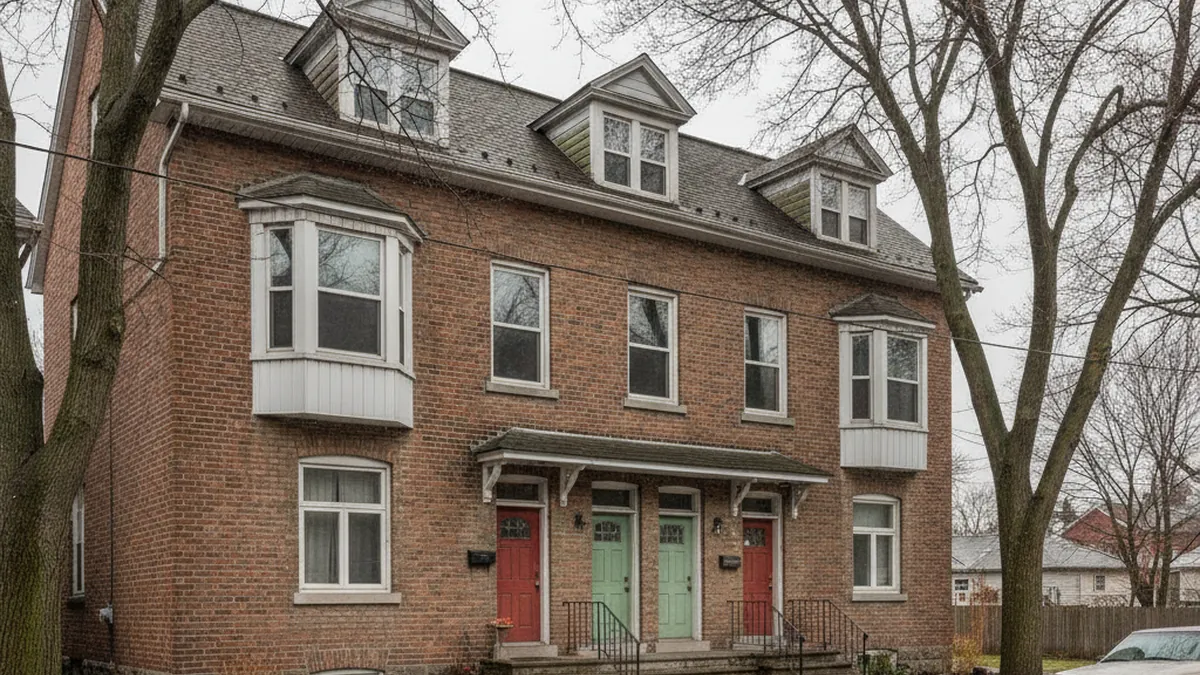
A rooming house is a building where individual rooms are rented to separate persons, without a complete self-contained unit per tenant. Each resident has a private sleeping space, often with a shared bathroom, but without a private kitchen included in the lease.
On the North Shore of Québec, rooming houses are found mainly in high-density rental areas: downtown Saint-Jérôme, neighbourhoods near CEGEPs and hospitals in Laval, commercial strips in Terrebonne and Repentigny. These buildings meet a real need: travelling workers, students, people in transitional housing. The structural vacancy rate of a well-maintained rooming house is between 5 and 15% — far lower than the property's reputation might suggest.
From the seller's perspective, a rooming house generates gross income often higher than a conventional plex of equivalent size — because you rent by the room rather than the full unit. A 10-room building at $750/month generates $90,000 per year in gross income. That figure is one many conventional multiplexes don't reach.
Yet at sale, this asset is massively undervalued by the market. Why?
Why rooming houses sell at a 25–30% discount
The discount observed on rooming houses at sale — on the North Shore and across Québec — is not random. It stems from three structural factors that feed each other: scarcity of buyers, financing difficulty, and the regulatory complexity specific to this type of atypical income property.
An extremely limited buyer pool
When you list a conventional duplex or triplex on the North Shore, your potential buyer could be an owner-occupant, a beginner investor or an acquisition fund. The market is wide. For a rooming house, it is different: the buyer must have the operational experience to manage a multi-occupant building, a higher tolerance for rental risk, and — above all — the capital to finance the acquisition without a conventional mortgage.
In practice, your property will be seriously evaluated by a few dozen buyers across the entire North Shore, compared to several hundred for an ordinary plex. This scarcity creates a power imbalance unfavourable to the seller: the buyer knows they are one of the few who can close, and they leverage that for negotiating room.
Extended sale timelines that amplify pressure
The combination of a small buyer pool and difficult financing significantly extends sale timelines. On the North Shore, a rooming house listed through a broker or on a FSBO platform will typically sit on the market for 90 to 180 days. During that time, you continue paying property taxes, insurance, maintenance, and managing tenants.
Each additional week on the market reinforces the perception that the building has problems — even if it doesn't. Potential buyers ask themselves: "Why hasn't anyone bought it yet?" It is a vicious cycle that amplifies the final discount.
"Atypical properties like rooming houses don't lack economic value — they lack buyers capable of financing them. The problem is on the financing side, not the asset."
— ImmoMulti Team, multiplex investor, North Shore, June 2026
Why is it so difficult to obtain financing to buy a rooming house?
Conventional lenders (Desjardins, National Bank, BMO, TD) routinely decline rooming house mortgages: few comparable sales make appraisal unreliable, and the property is seen as atypical. CMHC insures individual rooms (SRO) under MLI Select for eligible buildings (5+ units), but most buyers fall back on private lenders at 8–12%, dramatically reducing the buyer pool and depressing offer prices.

This is where the core problem lies. Conventional financial institutions — Desjardins, National Bank, BMO, TD — are often reluctant to finance a rooming house under their standard mortgage products, and insured financing (CMHC) remains demanding in terms of the file. The reasons are multiple and cumulative.
Why banks decline
- No transaction comparables: The chartered appraiser hired by the bank cannot establish a reliable market value because there are very few recent sales of comparable rooming houses in the area. No comparables, no value. No value, no loan.
- An asset perceived as atypical: Several lenders hesitate to apply conventional residential evaluation criteria to a rooming house, and insured financing requires a strong file — income history, borrower experience, compliance — that not all buyers can present. A rooming house remains a residential property, but its multi-occupant nature and higher tenant turnover are perceived as riskier.
- Insured financing is possible but demanding: Canada Mortgage and Housing Corporation (CMHC) does insure individual rooms (Single Room Occupancy, SRO), a product eligible under MLI Select, provided the building has at least 5 units and is predominantly residential. In practice, eligibility depends on the file (borrower experience, net worth, building compliance): a buyer who does not qualify for insured financing has a reduced pool of options, which limits demand.
- Perceived vacancy and casualty risk: Property insurers apply higher premiums to rooming houses due to more frequent tenant turnover and perceived fire risk in a multi-occupant building with shared common areas.
The buyer who still wants to acquire your rooming house on the North Shore therefore has two options: pay cash (very few can) or go through a private lender at rates of 8 to 12% with origination fees of 1 to 3%. These financing conditions flow directly into the price they are willing to offer.
Key point: Insured financing (CMHC) exists for this type of property, but not all buyers qualify. A buyer who must fall back on a private lender at 10% rather than a conventional or insured mortgage at 5.5% sees their debt service nearly double for the same amount borrowed. To maintain profitability, they will offer you less — which explains most of the observed discount.
What are the RBQ, permit and zoning issues when selling a rooming house?
The RBQ requires smoke detectors, sprinklers, compliant emergency exits and fire separation — non-compliance can cost $15,000–$80,000, deducted from any offer. Municipal zoning varies across North Shore cities: a legal non-conforming use can block buyers from renovating. These regulatory layers further shrink the pool of conventional buyers.
Financing is not the only obstacle. Rooming houses are subject to a regulatory framework distinct from conventional plexes and multiplexes, and this framework creates uncertainty — which buyers translate into lower price demands.
RBQ requirements for rooming houses
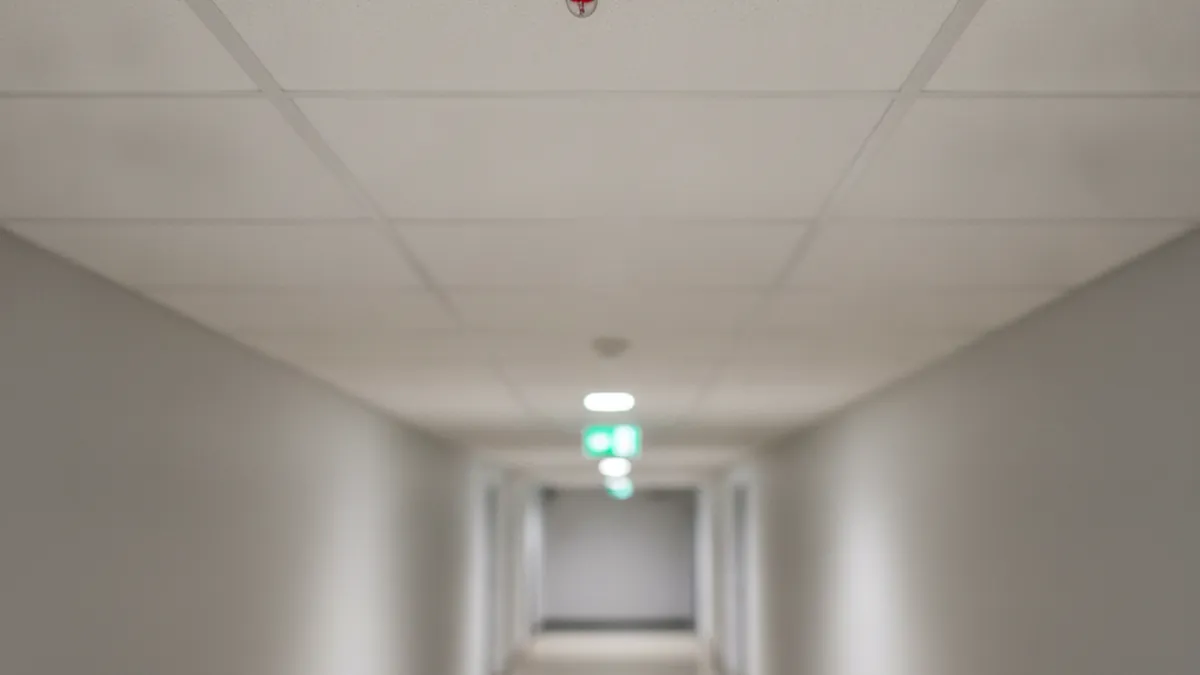
The Régie du bâtiment du Québec (RBQ) classifies rooming houses by number of occupants and imposes specific fire safety requirements. For existing buildings on the North Shore, the main obligations concern:
- Smoke detectors and carbon monoxide alarms in each room and in common areas
- Sprinklers (mandatory in new construction and when significant changes of use occur)
- Emergency exits clear and compliant with Safety Code dimensions
- Fire separation between rooms and common areas
- Emergency lighting in corridors
A building that does not meet these requirements cannot be sold without the buyer assuming the risk of costly compliance work. Depending on the age and condition of the building, this work can cost between $15,000 and $80,000 — an amount the buyer will deduct from their offer price.
Municipal zoning: a variable often overlooked
On the North Shore, zoning bylaws vary considerably from one municipality to another. In Saint-Jérôme, Laval or Terrebonne, a rooming house may be a conforming use or a legal non-conforming use depending on the zone. If the building is in a legal non-conforming use, a buyer who wants to modify it (major renovations, partial change of use) risks losing the operating right.
This regulatory uncertainty discourages buyers seeking to optimize the property after acquisition. It further reduces the buyer pool and amplifies the discount. Before selling, it is recommended to obtain advice from the Rental Housing Tribunal (TAL) on tenant obligations in the event of sale, and to verify with your municipality's urban planning department the exact zoning status of your property.
How do you calculate the real discount when selling a rooming house on the conventional market?
On a rooming house generating $108,000/year gross income with an economic value of ~$890,000 (6.5% cap rate): a broker-assisted sale nets ~$622K–$672K after the 25% financing discount plus 4–5% commission. A FSBO sale nets ~$645K–$695K. A direct sale to ImmoMulti targets a significantly better net with $0 commission and no financing discount.

Let's put concrete figures on this reality. Take the example of a rooming house with 12 rooms in Terrebonne, on the North Shore, generating annual gross income of $108,000 ($9,000/month on average).
| Sale scenario | Calculated value | Deductions | Net to seller |
|---|---|---|---|
| Economic value (6.5% cap rate) | ~$890,000 | — | Reference value |
| Conventional market (broker) | $650,000 – $700,000 | 4–5% commission (~$28,000) + 25% financing discount | ~$622,000 – $672,000 |
| FSBO (no broker) | $650,000 – $700,000 | FSBO platform fees ~$5,000 + 25% financing discount | ~$645,000 – $695,000 |
| Direct sale — ImmoMulti | Firm offer within 48 h | $0 commission, 0% fees | Net offer — no deductions |
In the conventional market scenario, you actually lose on two fronts simultaneously: the 25 to 30% discount imposed by financing difficulty, and the brokerage commission on top. Using a broker, you pay approximately 4–5% on an already-reduced price. In the example above, that is $218,000 to $268,000 in net loss compared to the building's economic value.
Add the carrying costs during the 90 to 180-day sale period: property taxes, insurance, minimal maintenance, and the stress of keeping the building operational during a prolonged transition period.
The real question to ask
The question isn't "how much is my rooming house worth?" — it's "how much will I actually receive net, in how much time, with what certainty of closing?" A direct offer with no commission and no financing condition may be higher than a conventional market process, even if the face price appears slightly lower.
How to avoid the discount by selling your rooming house on the North Shore directly?

ImmoMulti buys rooming houses and atypical income properties directly across the entire North Shore: Saint-Jérôme, Laval, Terrebonne, Repentigny, Blainville, Mascouche, Mirabel, Sainte-Thérèse, Rosemère, Boisbriand, Deux-Montagnes and Saint-Eustache.
Unlike a conventional buyer who depends on a bank mortgage, ImmoMulti evaluates the property based on its actual income, current condition and potential — not on a bank's standardized grids that are not designed for this type of asset. This is precisely what allows us to make an offer on a property that no conventional buyer can finance.
How a direct sale works concretely for a rooming house
- You complete the contact form at immomulti.com with basic information about your building: address, number of rooms, monthly gross income.
- We contact you within 24 hours for a confidential evaluation conversation. No imposed visit, no intrusive approach to your tenants.
- You receive a firm purchase offer within 48 hours, with a net price and no financing condition. The offer takes into account the building's condition, existing permits and current income.
- If you accept, the transaction is completed at the notary in approximately 30 days. You choose the transfer date. No extensions, no surprises.
There is no commission, no hidden fees, and no obligation: if the offer doesn't work for you, you are free to continue your own process. For a property this difficult to sell through conventional channels, receiving a firm offer within 48 hours with no conditions is often revealing.
What ImmoMulti does after buying a rooming house
We do not resell properties immediately. We operate them, improve them or reposition them based on the potential of the asset and the area. On the North Shore, several of our acquisitions have been converted to conventional multiplexes, rezoned with municipal authorities, or renovated to optimize rental yield. This absorption capacity is what allows us to offer a realistic price even for complex properties.
If you are considering selling quickly or want a discreet transaction without a public listing, a direct sale is often the best solution for this type of asset.
Informational content only. Does not constitute legal, tax or financial advice. The discount ranges presented are indicative and vary based on each property's specific characteristics, location and market conditions at the time of sale. Consult a qualified professional for your personal situation.
Frequently asked questions


