
In Laval, the welcome tax applies the provincial scale up to $500,000, then a municipal rate of 3% on the entire excess — effective since the 2026 budget (previously a tiered 1.5%/2%/3% structure). On a $2,000,000 income property, the buyer pays approximately $50,610 in land transfer tax. For a bill over $300, Laval allows payment in two instalments. Property taxes add each year as an operating expense; the rate for a 6+ unit building is approximately $0.80 per $100 of assessed value (indicative; assessed using the income approach). This guide explains the calculation, presents the bracket-by-bracket example and covers annual property taxes to integrate in your profitability analysis. Whether you are buying or considering selling an income property in Laval, factoring in these amounts from the offer stage changes the negotiation. Indicative amounts (2026): validate with the City of Laval and the assessment roll before signing.
Quick answer
In Laval, the welcome tax (land transfer tax) is paid by the buyer. For 2026, Laval applies the provincial scale (0.5% / 1.0% / 1.5%) up to $500,000, then 3% on the entire excess. On a $2,000,000 income property the buyer owes approximately $50,610. Bills over $300 can be paid in two instalments. The seller pays nothing — but it influences what buyers offer. Confirm exact figures with the City of Laval and your notary.
What is the welcome tax and who pays it in Laval?
The buyer pays the land transfer tax — not the seller. In Laval, the bill arrives a few weeks to months after the deed is signed. The amount is calculated progressively on the tax base (the highest of the price paid, the assessment roll value, or the stipulated consideration).
The "welcome tax" is the popular nickname for the land transfer tax. Despite the friendly name, it is not a hospitality charge — the name comes from Quebec minister Jean Bienvenue, who introduced the legislation in the 1970s. The City of Laval collects this tax each time a property changes hands, including income properties (plex, multiplex).
Three key points to remember:
- The buyer pays, not the seller. The bill arrives after the deed of sale, sometimes a few months later.
- It is calculated on the tax base: the highest of the price paid, the value on the assessment roll (adjusted by a comparative factor) and any other consideration.
- The calculation uses progressive brackets: each slice of value is taxed at its own rate.
For the general Quebec mechanism and a quick estimate, see our dedicated welcome tax tool and our guide Welcome Tax 2026: Calculation and Exemptions.
What is the 2026 welcome tax scale in Laval?
Laval's 2026 scale: 0.5% up to $62,900 · 1.0% up to $315,000 · 1.5% up to $500,000 · 3.0% on the entire portion above $500,000 (municipal rate set in Laval's 2026 budget). Provincial thresholds are indexed annually.
The land transfer tax is progressive. Quebec sets a base provincial scale, and each municipality may, by by-law, add an upper bracket (up to 3%) on the portion of value above $500,000. In its 2026 budget, Laval simplified that upper bracket: a single rate of 3% applies to the entire portion above $500,000 (previously Laval used a progressive structure with intermediate brackets of 1.5% and 2%).
Here is the scale in effect in Laval for 2026. The first two thresholds come from the provincial scale and are indexed annually against Quebec's consumer price index.
| Tax base bracket | Rate (2026) | Rate source |
|---|---|---|
| $0 to $62,900 | 0.5% | Provincial scale |
| $62,900.01 to $315,000 | 1.0% | Provincial scale |
| $315,000.01 to $500,000 | 1.5% | Provincial scale |
| Above $500,000 | 3.0% | Laval municipal rate (2026 budget) |
Source: brackets set by the Act Respecting Duties on Transfers of Immovables (CQLR c D-15.1) and the City of Laval by-law (2026 budget).
The 3% bracket above $500,000 is what most distinguishes Laval from cities that cap at 1.5%: on a $2,000,000 property, this bracket alone accounts for $45,000 of the bill.
Check before signing
The thresholds of $62,900 and $315,000 are indexed annually and may differ slightly for the current year. The 3% municipal rate above $500,000 results from Laval's 2026 budget and could be revised in a future budget. Note: for a land transfer tax bill over $300, Laval allows payment in two instalments (the first within 30 days of receiving the invoice). Always confirm the current rates, thresholds and payment terms with the City of Laval, and have the exact calculation validated by your notary before pricing a transaction.
How much does the welcome tax cost on a $2,000,000 property in Laval?
Approximately $50,610: $314.50 (0.5%) + $2,521 (1.0%) + $2,775 (1.5%) + $45,000 (3% on $1,500,000 above $500,000). The 3% municipal bracket alone accounts for $45,000 of the bill. Confirm the exact tax base and thresholds with the City of Laval and your notary.
Take an income property with a tax base (the highest of the price or the assessment roll value) of $2,000,000. Applying Laval's 2026 scale bracket by bracket:
| Bracket | Amount in bracket | Rate | Tax |
|---|---|---|---|
| $0 – $62,900 | $62,900 | 0.5% | $314.50 |
| $62,900 – $315,000 | $252,100 | 1.0% | $2,521.00 |
| $315,000 – $500,000 | $185,000 | 1.5% | $2,775.00 |
| $500,000 – $2,000,000 | $1,500,000 | 3.0% | $45,000.00 |
| Total | $2,000,000 | ≈ $50,610 |
The buyer must budget approximately $50,600 in welcome tax on top of the purchase price, down payment and notary fees. That is the weight of Laval's 3% bracket: the portion above $500,000 alone accounts for $45,000. As a reference point, a smaller duplex or triplex in Laval at around $622,000 generates approximately $9,300 in land transfer tax — the 3% bracket applying only to the ~$122,000 excess above $500,000. Since provincial thresholds are indexed, the actual total may differ by a few hundred dollars: confirm the amount with the City of Laval and the notary at the time of the transaction.
Validate property value with our cap rate calculator and offer calculator or GRM calculator.
What are the property taxes on an income property in Laval?
Property taxes in Laval are annual. For 6+ unit buildings the rate is approximately $0.80 per $100 of assessed value (2025 indicative). Income properties are valued using the income approach. The exact 2026 rate is set by the City's annual budget — always verify with your tax bill and the assessment roll.
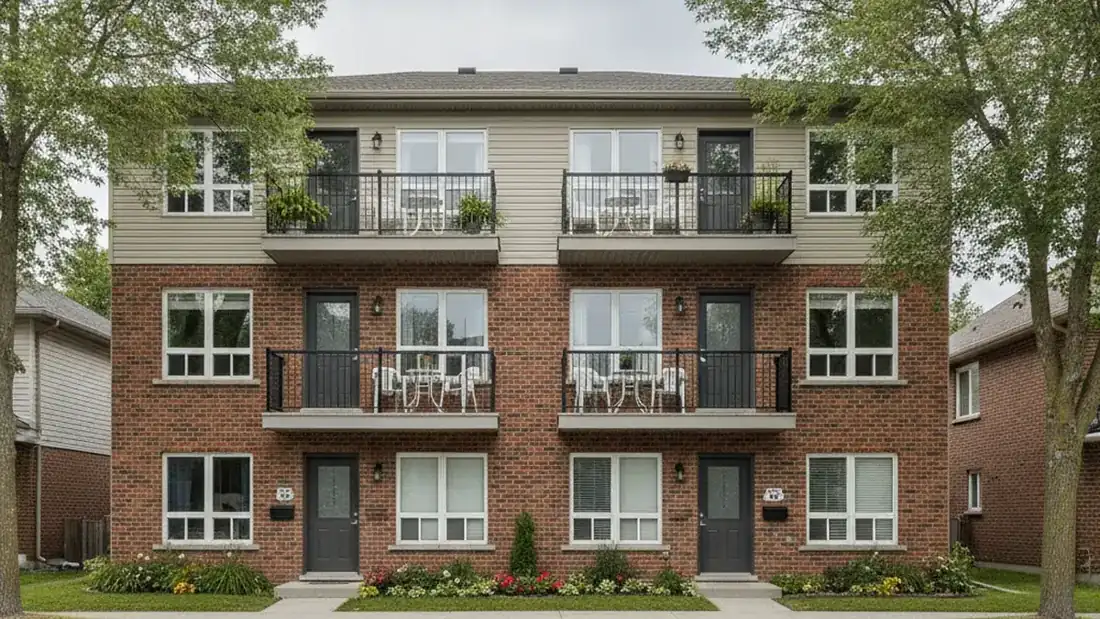
The welcome tax is one-time; property taxes are annual. For an income property, they weigh directly on profitability because they are part of operating expenses.
The calculation is straightforward in principle: the assessed value on the assessment roll is multiplied by the rate for the property category. Laval applies distinct rates by category, and residential buildings with 6 or more units have their own rate. As an indicative figure (2026), this rate is around $0.80 per $100 of assessed value, but it is set annually in the budget: verify the exact rate for your category with the City of Laval.
Two important nuances for a multi-unit building:
- The assessed value of an income property is often established using the income approach (based on the net income it generates), not solely by comparison with similar sales.
- The tax bill sometimes includes a service charge (water, roads) in addition to the general property tax. Refer to your annual bill for the breakdown.
To link these expenses to property value, look at the cap rate and the gross rent multiplier (GRM): higher property taxes reduce NOI, and therefore the value a buyer will pay.
Where to find your exact figures
Your property's assessed value appears in Laval's assessment roll, and the 2026 rates are published by the City with its budget. These two official sources take precedence over any estimate, including this guide.
What land transfer tax exemptions exist in Laval?
The main exemptions are: transfers between spouses (married or civil union), transfers in a direct line (parent–child, grandparent–grandchild), certain transfers to a corporation controlled by the transferor, and a tax base below $5,000. Each case has strict conditions — confirm eligibility with your notary before the transaction.

The law provides certain exemption cases for land transfer tax. The most common:
- Transfer between spouses who are married or in a civil union (and under certain conditions, common-law partners).
- Transfer in the direct line, ascending or descending: between a parent and child, or grandparent and grandchild.
- Transfer to a corporation by a shareholder holding more than 90% of the voting shares (and vice versa, under conditions).
- Tax base below $5,000.
These exemptions mainly concern family transfers and reorganizations — relevant for a property owner planning a real estate inheritance or a restructuring. Each case has precise conditions: have your eligibility validated by a notary before proceeding.
What is the impact for the seller and buyer of an income property in Laval?
The seller pays nothing — but informed buyers factor the ~$50,610 transfer duty into their offer on a $2M property. The land transfer tax is added to the buyer's capital cost (not immediately deductible), while annual property taxes are deductible from rental income. Have a tax accountant validate your structure.
On the seller's side, the good news is that the welcome tax does not come out of your pocket — it is the buyer's responsibility. But it has an indirect influence on negotiations. An informed buyer factors in all acquisition costs — land transfer tax, notary fees, inspection — when determining the price they are willing to offer. The heavier the tax bill, the greater the potential downward pressure on the net price.
On the buyer's side, the land transfer tax is generally added to the capital cost of the property rather than being an immediately deductible expense. Annual property taxes, however, are normally deductible from rental income. The distinction has a real effect on after-tax return: a tax accountant must validate your structure.
In summary
In Laval, the buyer of an income property pays a progressive land transfer tax: provincial scale up to $500,000 (0.5% / 1% / 1.5%), then 3% above (as of the 2026 budget). On a $2,000,000 property, budget approximately $50,610. For a bill over $300, two instalments are allowed. Annual property taxes add to this: indicatively ~$0.80/$100 assessed for 6+ unit buildings. Before pricing a transaction, confirm rates and thresholds with the City of Laval and have the exact calculation validated by your notary.
Are you considering selling your property? See our guide to selling an income property in Laval, or first assess a realistic offer with the purchase offer calculator. To compare with the rest of the province, see our article on the welcome tax in Quebec. All our guides and tools are grouped in the resources section.

