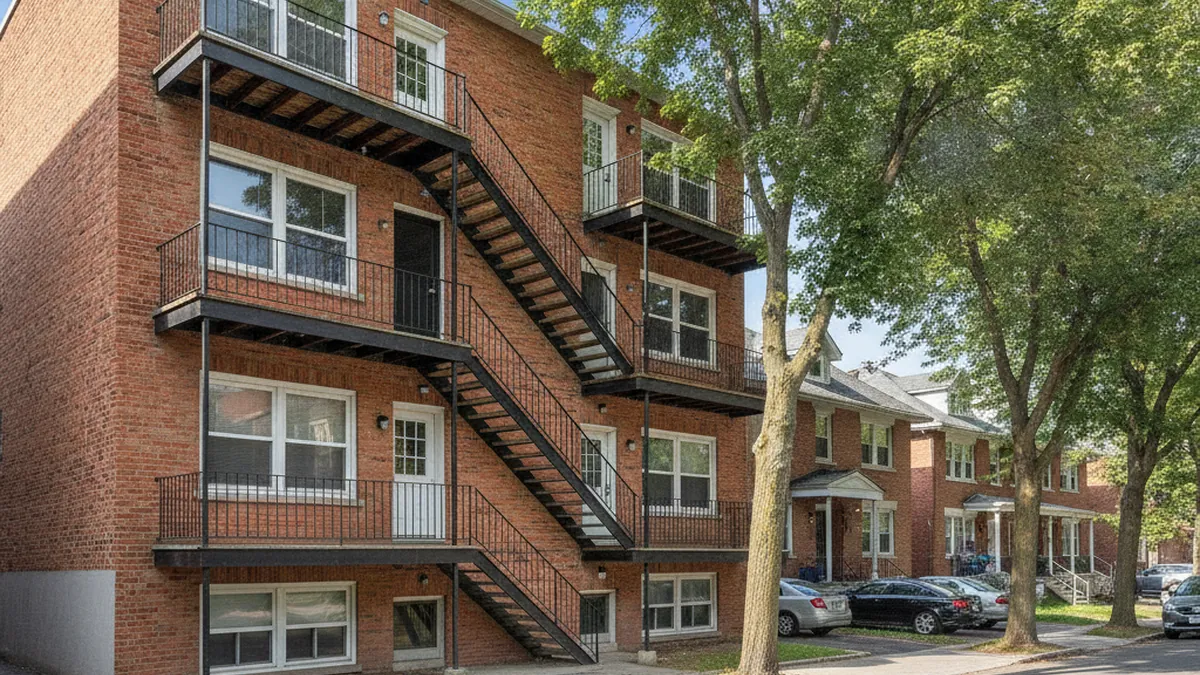
ImmoMulti — a direct buyer of multi-unit buildings on the North Shore — closely tracks the signals CMHC is sending developers in 2026. According to an article in La Presse dated July 10, 2026, Canada Mortgage and Housing Corporation wants to curb the race toward micro-units by steering developers toward larger, less luxurious housing. Yet on the North Shore — in Laval, Terrebonne, Mascouche, Blainville, Boisbriand, Saint-Jérôme — 63% of two-bedroom apartments built between 2021 and 2023 are 1,000 square feet or less. This reversal of CMHC's position has a direct implication for you: your existing older plex or multi-unit building, with its more generously sized units, is an increasingly hard-to-reproduce asset in the North Shore market.
The worrying trend: micro-units are taking over new construction on the North Shore
On the North Shore, 63% of two-bedroom apartments built between 2021 and 2023 in Laval are 1,000 square feet or less. Developers have made floor area a central adjustment variable to lower construction costs — at the expense of housing quality.
This is not an abstract trend: it is a measurable reality in your market. In Laval — the benchmark market for the greater North Shore region — 63% of two-bedroom apartments built between 2021 and 2023 are 1,000 square feet or less, according to data reported by La Presse on July 10, 2026. Ten or twenty years ago, a two-bedroom apartment of 1,000 sq ft or less would have been called cramped. Today, it represents the majority of what the market produces.
The reason is economic: faced with rising construction costs in Québec, developers have turned floor area into an optimization lever. Less area to build means fewer materials, fewer labour hours, less financial risk per unit. This logic, understandable from a developer's standpoint, produces an increasingly cramped stock of new rental housing.
For tenants looking for space — families, roommates, remote workers — the conclusion is clear: new construction on the North Shore offers less square footage per rent dollar. And that is precisely what CMHC has decided to call out publicly.
Source: La Presse — "La SCHL veut des logements plus grands et moins luxueux" (July 10, 2026)
What CMHC wants to fix for multi-unit housing in Québec
CMHC (Canada Mortgage and Housing Corporation) wants to steer developers toward larger, less luxury-oriented housing to better meet the real needs of Québec households. It identifies a contradiction between what the market builds and what tenants need.
In its July 2026 report and communications, CMHC points to a fundamental contradiction in the Québec rental market: the market is producing more and more small units, while households need adequately sized housing. Canada Mortgage and Housing Corporation, which plays a central role in financing housing in Canada through its mortgage loan insurance programs, is seeking to influence developer behaviour toward more affordable — and larger — housing.
This CMHC positioning is significant because it comes from an institution that controls the tap on mortgage financing for multi-unit buildings. When CMHC says it wants to guide developers toward more size and less luxury, that has concrete implications for what will be financed and subsidized in the future. In other words: new supply will have to adjust.
| Type of housing | What the market produces (2021–2023, North Shore) | What CMHC wants to encourage |
|---|---|---|
| New two-bedroom apartment | 63% are ≤1,000 sq ft in Laval | Adequate floor area for households |
| Product positioning | Trend toward compact luxury | Affordable, functional, larger |
| Developer logic | Shrink floor area to control costs | Put livability back at the centre |
| Your North Shore plex (pre-1990) | Larger units, inherited from another era | Aligned with the CMHC vision |
Source: La Presse, July 10, 2026 — CMHC — Mortgage loan insurance: multi-unit and rental buildings
Your North Shore plex vs. micro-units: the size advantage
Plexes and multi-unit buildings built before the 1990s on the North Shore offer units that are generally more generously sized than new construction. In a market where CMHC itself acknowledges that new supply is too small, your existing plex meets a need that today's developers are not filling.
The duplexes, triplexes, quadruplexes and multi-unit buildings built on the North Shore before the 1990s — an era when construction standards differed from today's — typically offer units with enclosed kitchens, separate bedrooms, and distinct living rooms. These are the livability features tenants are looking for, and the very features today's micro-units sacrifice in favour of minimal floor area.
"CMHC believes it is necessary to keep building, especially cheaper and larger housing, and it wants to guide developers in that direction."
— La Presse, July 10, 2026, summarizing the position of Canada Mortgage and Housing CorporationThis quote is telling for you, the owner of a plex or multi-unit building on the North Shore: CMHC itself confirms that what you already own — adequately sized units in a market that produces fewer and fewer of them — is exactly what the market needs. This is not a marketing argument: it is the diagnosis of the federal housing authority.
For a tenant looking for a two-bedroom apartment larger than 1,000 sq ft on the North Shore, the options in new construction are increasingly scarce. They then turn to the existing stock — your plexes, your triplexes, your quadruplexes. This demand pressure supports your occupancy rates and, by extension, your rental income. And solid income means a property value that holds.
Your North Shore plex's advantage at a glance
- Units with more generous floor area than most new construction
- Sustained rental demand from households fleeing micro-units
- An increasingly hard-to-reproduce asset in the North Shore market
- A position recognized by CMHC itself as meeting the market's real need
What it means for the value of your income property
A well-occupied plex with adequately sized units generates stable income, which supports its valuation via cap rate (TGA) and gross rent multiplier (GRM). In a market where new supply produces micro-units, well-sized existing North Shore buildings are harder to replace — a tangible value argument.

The value of an income property on the North Shore is measured mainly through its net operating income (NOI) and the overall capitalization rate (cap rate, or TGA) buyers apply. Anything that supports your rental income — starting with a low vacancy rate — translates directly into value.
Now, if tenants looking for space prefer your plex over the micro-units of new supply, your occupancy rate is naturally supported. No empty units, no lost rent, no discount at sale. This is not a theoretical advantage — it is one that shows up in your financial statements and that any investor can calculate.
You also have to consider replacement cost. Building a triplex or quadruplex today on the North Shore with generously sized units costs substantially more than it did ten years ago — in both materials and labour. Your existing building, if well maintained, represents a value the new-construction market cannot reproduce at an equivalent cost. It is a scarcity premium.
CMHC programs available for your existing plex in 2026
CMHC offers preferential financing programs for owners of existing rental buildings who want to renovate or improve them: multi-unit mortgage loan insurance, and MLI Select for projects targeting energy efficiency and affordability. These programs let you improve your plex and increase its value.
If CMHC's signal prompts you to improve your existing units — enlarge a room, renovate to boost appeal — several CMHC financing programs can help:
- CMHC multi-unit mortgage loan insurance: available for buildings of 5 units and up, this program offers preferential financing terms for existing rental buildings. Details on CMHC's official site.
- MLI Select: a CMHC program offering financing incentives for rental projects targeting affordability, accessibility, or energy efficiency. If your building meets the criteria, the financing can be particularly attractive. See our complete guide to MLI Select 2026.
- Provincial energy grants: RénoClimat and Logisvert help fund energy-efficiency work in North Shore rental buildings. See our article on energy grants for North Shore plexes.
The guiding idea is simple: if your plex already has adequately sized units, a few targeted improvements can position it even more favourably — and make its financing more accessible through affordability-oriented CMHC programs.
Selling or holding your North Shore plex: what the CMHC signal changes
CMHC's message confirms that your existing plex with generously sized units is an increasingly rare asset on the North Shore. If you are considering selling, it is a value argument to put forward. If you are holding, it is one more reason to keep your units in good condition to attract tenants fleeing the micro-units of new supply.
CMHC's July 2026 position sends you a clear signal, whether you are a seller or a long-term investor:
- If you are considering selling: your plex or multi-unit building on the North Shore, built before the 1990s with generously sized units, is an asset the new-construction market can no longer easily produce. Buyers and investors who understand the rental market will recognize this advantage in their valuation.
- If you are keeping your building: highlight the size of your units in your rental listings. In a market where 63% of new two-bedroom units are under 1,000 sq ft, your spacious 4½ or 5½ is a strong differentiator for attracting good tenants.
- If you are looking to refinance: stable rental income and a solid occupancy rate — both supported by your size advantage — are exactly what financial institutions want to see. Use our guide to multiplex yield calculation to document your file.
ImmoMulti: direct buyer of multi-unit buildings on the North Shore
ImmoMulti buys plexes and multi-unit buildings directly across the entire North Shore — Terrebonne, Mascouche, Blainville, Boisbriand, Saint-Jérôme, Saint-Eustache and surrounding areas. No broker, no commission, offer within 48 hours. Get a confidential proposal.
To sell your income property under the best conditions, see our complete guide: How to sell your North Shore income property fast.