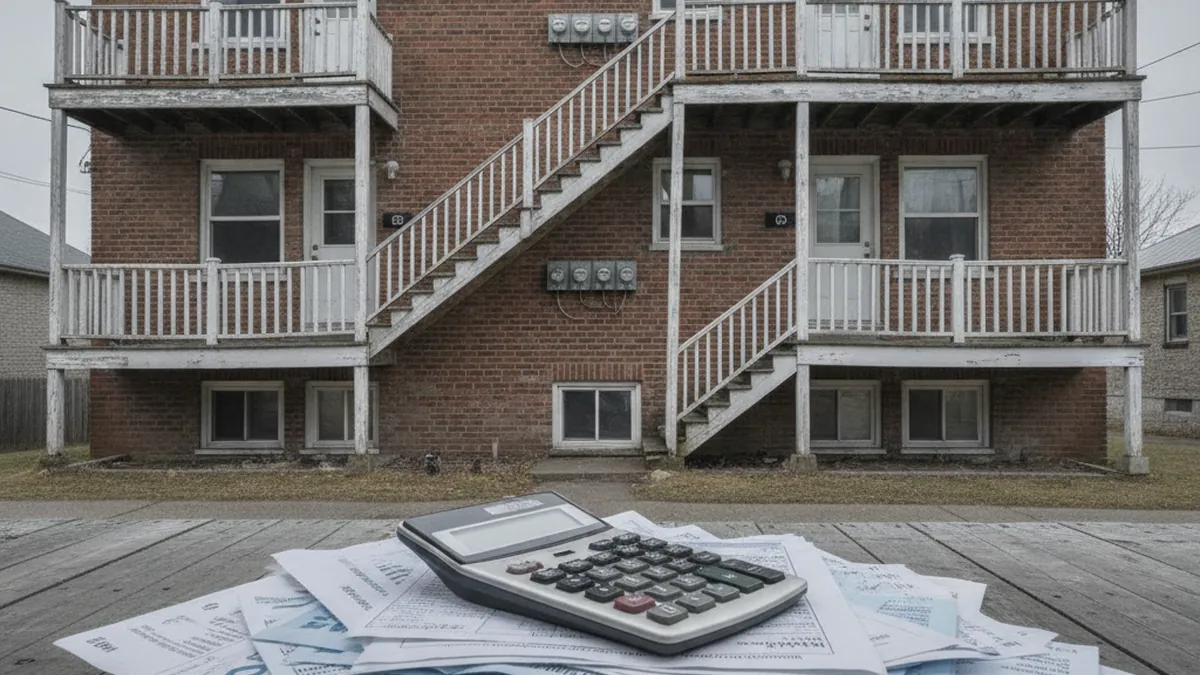
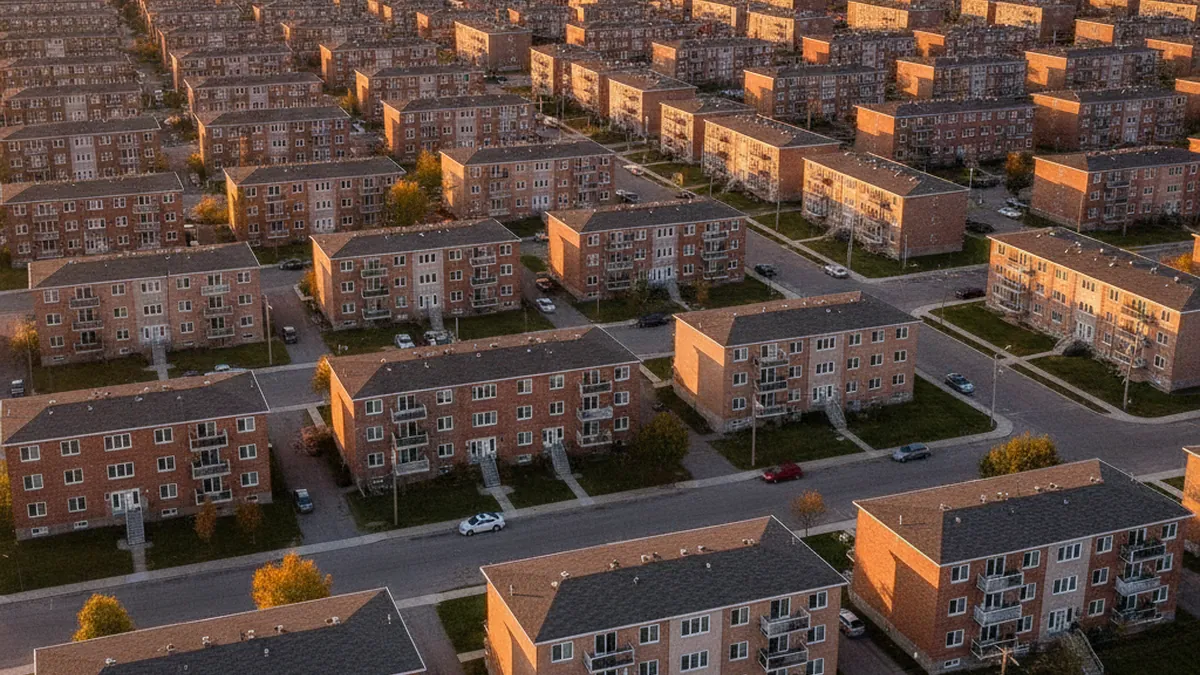
Commission avoided, timeline shortened, full control of the transaction. More and more plex owners on the North Shore are choosing to sell without a broker — but doing it properly means knowing the rules of the game.
Why more sellers are skipping the broker in 2026
The plex market on Québec's North Shore remains active in 2026, despite the normalization of interest rates that began in 2024. Investors are more numerous and better informed than they were ten years ago — which creates natural pressure on the traditional commission model.
The reality is simple: a real estate broker collects between 4 and 6% of the sale price, shared between the seller's broker and the buyer's broker. On a triplex sold for $650,000, that represents $26,000 to $39,000 that disappears at the moment of signing before the notary.
In exchange, the broker offers visibility (Centris, MLS, listing platforms), negotiation expertise and legal protection. But those advantages come at a price — and some sellers feel that price is too high, especially when demand is sustained and the building well maintained.
Note: Selling without a broker does not mean selling without help. A notary is mandatory in Québec for any property transfer, and their role is considerable. You can also call on a specialized lawyer to secure your transaction.
What you actually save by selling without a broker
The real saving depends on your situation. Here is a concrete overview based on median plex prices on the North Shore in the second quarter of 2026:
| Type of plex | Median North Shore price | Commission 5% | Saving if sold directly |
|---|---|---|---|
| Duplex | $450,000 | $22,500 | $22,500 |
| Triplex | $620,000 | $31,000 | $31,000 |
| Quadruplex | $780,000 | $39,000 | $39,000 |
| 5-8 units | $1,100,000 | $55,000 | $55,000 |
These amounts are gross. In practice, part of the saving can be absorbed by additional costs: lawyer or real estate advisor fees, DuProprio fees if you choose that route, or the personal time invested.
But you should not overestimate those costs either. A notary's fees for a typical building sale range between $1,500 and $3,500, whether there is a broker or not. These fees are generally shared between buyer and seller or paid by the buyer depending on the agreement.

The 3 ways to sell your plex without a broker on the North Shore
1. Sell directly to a specialized buyer (the fastest route)
Companies like ImmoMulti buy directly from owners — no commission, no MLS, no repeated visits. The process is simple: you describe your building, you receive a firm offer within 48 hours, and if you accept it, the transaction closes before the notary in 30 to 90 days.
Advantages: speed, certainty, no visits, no commission, confidentiality. Ideal for situations involving an estate, divorce, retirement, or a building that needs work.
Limitation: the offer may be slightly below market price, because the direct buyer assumes the risk and costs that an ordinary buyer would normally take on with the help of a broker and multiple visits. But once the commission is eliminated, the net proceeds are often comparable or higher.

2. Sell through DuProprio
DuProprio is Québec's reference platform for no-broker sales. You pay a fixed package (between $800 and $3,000 depending on the services chosen) to publish your listing and be supported through to signing.
Advantages: national visibility, presentation tools (professional photos, virtual tour), basic legal support included.
Limitation: you must handle the calls, the visits, buyer qualification and negotiation yourself. For an income property, that can become time-consuming, especially if you have tenants in place. The average selling time through DuProprio is 3 to 6 months.
3. Private sale (owner to owner)
Some sellers find their buyer through their personal network, via Facebook Marketplace, or through local real estate investor groups. This approach is free but requires a solid knowledge of the legal process and the ability to seriously qualify potential buyers.
If this route interests you, it is strongly recommended to retain a notary from the outset to guide you on drafting the offer to purchase.
The mandatory documents to sell a plex in Québec
Whatever your sale method, certain documents are essential. Prepare them in advance to avoid delays:
- Title of ownership (current deed of sale) — obtained from the Québec Land Register or your notary
- Recent certificate of location — must be less than 10 years old and reflect the current state of the building
- Seller's declarations — the legal form where you disclose the known state of the building (defects, work, claims…). You can complete your seller's declaration online
- Current leases — copies of all active leases and renewal notices
- Financial statements of the building — rental income, expenses, tax statements
- Municipal and school tax bills
- Municipal assessment — the triennial roll in force
- Mortgage statement — remaining balance with your financial institution
Practical tip: If your certificate of location is more than 10 years old or you have carried out significant renovations since (adding a unit, changing the façade, a permanent above-ground pool), it will generally be requested by the buyer or their financial institution. Allow 4 to 8 weeks to obtain a new one and a cost of $1,500 to $3,000.

Drafting and signing the offer to purchase without a broker
The offer to purchase is the most important document in the transaction — it sets the price, the conditions, the deadlines and the transfer terms. Without a broker, it is possible to:
- Use the standardized forms of the Organisme d'autoréglementation du courtage immobilier du Québec (OACIQ) — available on their website, accessible to private individuals
- Retain a notary or specialized lawyer to draft or review the offer (recommended)
- Use a simplified offer with a professional buyer who has their own legal department
The most important clauses in a plex sale include: the financing condition, the inspection condition, the possession transfer date, the fate of the leases, and the treatment of the welcome tax.

The pitfalls to avoid when you sell without an intermediary
Under-valuing (or over-valuing) your building
Without a broker's help to establish market value, you risk two opposite errors: selling too low and missing tens of thousands of dollars, or pricing too high and staying on the market for months without serious offers. To avoid this:
- Use our offer calculator based on the cap rate and GRM
- Consult our map of plex prices by sector on the North Shore
- Ask an active buyer for an informal valuation — with no obligation
Neglecting buyer qualification
An enthusiastic buyer is not necessarily a qualified buyer. Before withdrawing your listing or signing an offer, make sure the buyer has a mortgage pre-approval letter or proof of sufficient funds. An offer to purchase conditional on financing that falls through costs you 60 to 90 days.
Forgetting the tax impact
The sale of an income property generally triggers a taxable capital gain and a recapture of capital cost allowance (CCA). Before setting your sale price or accepting an offer, calculate your after-tax net to know whether the transaction is truly worthwhile. An accountant specialized in real estate can make a big difference in your planning.
Forgetting your obligations toward tenants
The sale of a rental property does not affect tenants' rights. Their leases are automatically transferred to the new buyer. You do not have the right to force a tenant to leave to facilitate the sale — except in the case of a repossession under the strict conditions set out in the Civil Code of Québec and the Tribunal administratif du logement.
How much is your North Shore plex really worth in 2026?
The value of an income property depends on several factors that professional buyers examine closely:
- Gross annual income (all rents collected)
- The capitalization rate (cap rate): between 4.5% and 6.5% depending on the sector and the state of the building
- The gross income multiplier (GRM): between 13 and 18 depending on the sector
- Physical condition: roof, foundations, mechanical systems, asbestos, pyrite…
- Rent-increase potential: the gap between current rents and market rents
For 2- to 4-unit plexes on the North Shore, median prices in Q2 2026 range roughly between $420,000 (duplex, remote sector) and $850,000 (quadruplex, Laval or Rosemère, well maintained). Use our cap rate calculator and our GRM calculator to position your building.
Get an offer to purchase within 48 hours
ImmoMulti is a direct buyer specialized in plexes on the North Shore of Québec. No commission, no broker, no repeated visits. We present a firm offer within 48 hours of your request.
Submit my plex to ImmoMultiThe complete step-by-step process of a no-broker sale
Many owners hesitate to sell without a broker because they cannot picture the concrete steps. Yet the process is perfectly mapped out. Here is the complete sequence, from the moment you decide to sell until the cheque is handed over before the notary. Each step is achievable by an organized owner — and on the North Shore, where buyers of income properties are numerous, none of these steps requires a licence.
Step 1 — Gather the building's file (week 1)
Before even setting a price, assemble all the documents that describe your plex: signed leases, rent roll, tax bills, energy bills for the common areas, history of major work (roof, windows, heating), mortgage statement and certificate of location. A serious buyer — private individual or direct buyer — will ask for these documents from the first discussions. Having them ready saves you weeks and projects the image of a credible seller.
Step 2 — Establish the market value (weeks 1 to 2)
This is the step where a broker historically adds the most value. Without one, you must reproduce their analysis: compare your building to recent sales in the same sector, apply a realistic capitalization rate (cap rate) and gross income multiplier (GRM), and account for the physical condition. We detail this method in the "Setting the right price" section below.
Step 3 — Choose the sale channel (week 2)
Direct buyer, DuProprio or private sale: your choice depends on your priority among speed, listing price and personal effort. A seller who wants to close quickly and without repeated visits turns to a specialized buyer; a seller who wants to test the market more broadly lists on DuProprio.
Step 4 — Marketing, visits and qualification (weeks 3 to 10, variable)
If you market publicly, be ready to receive calls, filter the curious and organize visits. A crucial point for a rental property: you cannot show occupied units without respecting tenants' rights (see the dedicated section). With a direct buyer, this step is eliminated: a single assessment, often without setting foot in the units.
Step 5 — Offer to purchase and conditions (1 to 3 days of negotiation)
Once a buyer is interested, the offer to purchase sets the price, the transfer date and the conditions (financing, inspection, lease review). It is the document that binds you: have it reviewed by a notary if you have the slightest doubt.
Step 6 — Removal of conditions (30 to 60 days)
The buyer carries out their inspection, obtains financing and reviews your documents. This is the most uncertain period of a traditional sale: a financing condition that fails sends you back to square one. A direct buyer who has their own funds sharply reduces this risk.
Step 7 — Signing before the notary (transfer day)
The notary verifies the titles, repays your mortgage, adjusts taxes and rents on a pro-rata basis, registers the deed in the Land Register and hands you the net balance. This is where the transaction becomes official — never before.

| Step | Direct buyer | DuProprio | Private sale |
|---|---|---|---|
| File preparation | 1 week | 1 week | 1 week |
| Marketing / visits | None | 1 to 4 months | Variable |
| Receiving an offer | ~48 h | Variable | Variable |
| Removal of conditions | Often reduced | 30 to 60 days | 30 to 60 days |
| Typical total timeline | 30 to 90 days | 3 to 6 months | 1 to 6 months |
Key takeaway: none of these seven steps requires a broker. What the broker sells is time and expertise. If you have the time to manage the visits or if you choose a buyer who absorbs that complexity, the commission saving comes back to you in full.
Setting the right price: valuing your plex like a professional buyer
This is the no-broker seller's number-one fear: "What if I leave money on the table?" The good news is that valuing an income property rests on objective methods, not intuition. A plex is not sold like a single-family home: its value comes mainly from its income, not its appearance. Mastering three approaches puts you on equal footing with any professional.
Method 1 — Income capitalization (cap rate)
This is the go-to method for buildings of five units and up, and increasingly used from the triplex. You divide the net operating income (rental income minus operating expenses, excluding the mortgage) by the sector's capitalization rate (cap rate).
Worked example: a quadruplex in Terrebonne generates $62,000 in annual rents. After deducting taxes, insurance, maintenance and management (about $22,000), the net operating income is $40,000. If the sector's cap rate is 5%, the estimated value is $40,000 ÷ 0.05 = $800,000. If the buyer instead requires a cap rate of 5.5% (a building needing renovation), the value drops to $727,000. Half a point of cap rate therefore changes the price by more than $70,000 — hence the importance of properly documenting the state of the building.
Method 2 — The gross income multiplier (GRM)
Simpler, the GRM multiplies the gross annual income (all rents, without deduction) by a factor observed in comparable sales. On the North Shore, this factor generally ranges between 13 and 18 depending on the sector and the state of the building.
Example: the same quadruplex at $62,000 in rents, in a sector where the average GRM is 13, would be worth about $806,000 — consistent with the cap rate method. When the two methods converge, your estimate is solid. When they diverge, look for why: below-market rents, abnormal expenses, or poorly chosen comparables.

Method 3 — Adjusted comparables
The third approach consists of finding similar buildings sold recently in your sector, then adjusting for the differences (number of units, garages, condition, rents). It is the most intuitive method, but also the most treacherous: two neighbouring triplexes can differ by $100,000 in value if one has rents frozen for fifteen years and the other has market rents.
The factor that changes everything: the gap between your current rents and market rents. A building whose rents are 25% below market offers an "upside potential" that buyers pay for — but within the strict limits of rent fixing set by the Tribunal administratif du logement. Document this potential: it is your best pricing argument.
To cross-check these three methods quickly, use our cap rate calculator, our GRM calculator and our offer calculator. In ten minutes, you get a defensible value range — exactly what a broker would charge you for in their comparative market analysis.
Understanding the commission: what the 5% really pays for
Before deciding to do without it, you have to understand what the commission actually finances. Too many sellers see the percentage without seeing the work — and too many brokers present the percentage as a fixed rate when it is entirely negotiable. Let's break it down.
How the commission is split
On a traditional sale, the 4 to 6% commission is usually divided between the listing broker (the seller's) and the collaborating broker (the buyer's). On a triplex at $620,000 with a 5% commission, that represents $31,000, often split equally: about $15,500 on each side, before sales taxes (GST and QST apply to the broker's fees). This detail matters: the commission is taxable, which inflates the real bill by nearly 15%.
| Sale price | Commission 5% | + GST/QST (~14.975%) | Total brokerage cost |
|---|---|---|---|
| $450,000 (duplex) | $22,500 | $3,369 | $25,869 |
| $620,000 (triplex) | $31,000 | $4,642 | $35,642 |
| $780,000 (quadruplex) | $39,000 | $5,840 | $44,840 |
| $1,100,000 (5-8 units) | $55,000 | $8,236 | $63,236 |
Federal (GST 5%) and provincial (QST 9.975%) sales taxes do indeed apply to real estate brokerage fees in Québec — a fact often forgotten in savings calculations. On a quadruplex, that is nearly $5,800 in taxes added on top of the commission itself.

What the broker delivers in exchange
Let's be fair: the commission is not money thrown out the window. It finances the marketing (photos, Centris and MLS listing), the valuation, managing the visits, qualifying buyers, negotiation, coordination with notaries and legal protection via the broker's liability insurance. For a seller who has neither the time nor the appetite for these tasks, this service has real value.
When doing without a broker makes the most sense
- Your building is easy to sell: good sector, well maintained, reasonable rents. Demand does part of the broker's work for them.
- You already have a buyer: a network contact, an interested tenant, a neighbouring investor. Paying 5% to formalize a deal already concluded makes no sense.
- You prioritize discretion: an estate, a separation, or simply no desire to advertise your building publicly.
- You accept dealing with a direct buyer: the expertise and certainty come from the buyer, not from an intermediary you pay.
Always negotiable: even if you decide to use a broker, know that the commission rate is set by no law or scale. On a high-value building, a sliding or flat rate is perfectly open to discussion.
Closing costs and the notary's role
Selling without a broker does not exempt you from the unavoidable costs of a real estate transaction. Good news: most of these costs would exist anyway, with or without a broker. Here is what really makes up the closing cost of a plex sale on the North Shore.
The notary's fees
In Québec, going before a notary is mandatory for any transfer of real property. The notary drafts the deed of sale, verifies the titles in the Land Register, obtains the mortgage discharges, carries out the adjustments and registers the sale. For a typical building sale, their fees generally range between $1,500 and $3,500. By convention, it is often the buyer who chooses and pays the officiating notary, but everything is negotiable in the offer to purchase.
Transfer duties (welcome tax) — paid by the buyer
The famous "welcome tax" is paid by the buyer, not the seller. But as a seller, it is better to understand it: it influences your buyers' appetite and offer. For the 2026 year, Québec sets the following base brackets, indexed each year according to the consumer price index:
| Tax base bracket (2026) | Rate |
|---|---|
| $0 to $62,900 | 0.5% |
| $62,900.01 to $315,000 | 1.0% |
| Above $315,000 | 1.5% |
Municipalities may, by by-law, apply a higher rate (up to 3%) on any portion exceeding $500,000 — a flexibility that several North Shore and metropolitan-area cities use. These brackets come directly from the Government of Québec. For a plex sold at $620,000, the base welcome tax therefore reaches about $7,900 — a figure your buyer factors into their total budget. Our welcome tax calculator lets you estimate it by municipality.

Closing adjustments
On signing day, the notary allocates several items on a pro-rata basis between you and the buyer:
- Municipal and school taxes: if you have paid them for the full year, the buyer reimburses you for the portion after the sale.
- Current month's rents: the rents collected for the period after the sale go to the buyer.
- Security deposits and last months' rent: transferred to the buyer, who inherits the obligations toward the tenants.
- Fuel (heating oil), if applicable: the full tank is adjusted pro rata.
Mortgage penalty: don't forget to check with your lender the cost of prepaying your mortgage. On a fixed-rate loan, this penalty can reach several thousand dollars and eat into your net proceeds. Ask for the exact amount before setting your transfer date.
Selling with tenants in place: visits, leases and repossession
The vast majority of plexes are sold occupied. It is even an asset: units rented to good tenants reassure the buyer about the income. But selling a rental property involves precise rules that a broker knows by heart — and that you must master to sell on your own without a misstep.
Visits: the tenant has rights
You cannot show an occupied unit on a whim. Under article 1931 of the Civil Code of Québec, the landlord must give the tenant 24 hours' notice before showing the unit to a potential buyer. In addition, the tenant may refuse a visit before 9 a.m. or after 9 p.m., and may require that the landlord (or their representative) be present during the visit. These rules are detailed by Légis Québec.
Concretely, a six-unit building can require tedious coordination: six notices, six schedules to respect, six more-or-less cooperative tenants. This is one of the reasons many owners prefer a direct buyer: they assess the building on its documents and a single visit, without disturbing the tenants repeatedly.

Leases follow the building
A fundamental point: the sale of a rental property does not end the leases. They are automatically transferred to the new buyer, who becomes the new landlord under the same conditions. You do not have to ask the tenants' permission to sell, nor can you force them to leave to "facilitate" the sale. The buyer inherits the current rents, the deposits and the obligations.
Repossession: it is the buyer who must carry it out
A buyer who wants to occupy a unit (or house an eligible relative there) must proceed with a repossession of the dwelling. According to the Tribunal administratif du logement, notice must be given at least six months before the end of a lease longer than six months. A crucial fact for you: it is the new owner who must undertake these steps, and only once the sale is closed before the notary — not on the strength of a mere offer to purchase. This point is confirmed by the Tribunal administratif du logement.
Since the 2024 changes, senior tenants (aged 65 and over) meeting certain income and seniority criteria benefit from enhanced protection against repossession and eviction. A savvy buyer takes this into account in their offer — and you should inform your buyers honestly.
Occupied or vacant? A building fully rented to good tenants at near-market rents is easy to finance and sells well. A vacant unit, on the other hand, lets an owner-occupant move in without a repossession — which can widen your pool of buyers. There is no universal answer: it depends on the buyer profile you are targeting.
Lease assignment and Bill 31
Since 2024, the rules surrounding lease assignment have changed with the adoption of Bill 31. For a seller, the key is to provide the buyer with up-to-date leases, any renewal or rent-modification notices, and the history of agreements with each tenant. A clean and transparent rental file speeds up the removal of conditions and avoids bad surprises after the sale.
The tax impact of the sale: capital gain and CCA recapture
Here is the most costly blind spot of a plex sale: the tax authorities. Before rejoicing over a nice sale price, you must calculate your after-tax net. Two mechanisms apply to the sale of an income property in Québec: the capital gain and the recapture of capital cost allowance.
The capital gain
The capital gain is the difference between the sale price (less disposition costs) and the adjusted cost base (price paid plus capitalized improvements). Good news for 2026: the inclusion rate remains at 50%. The increase to 66.67% that had been proposed for 2024, then deferred to 2026, was finally cancelled, as confirmed by the Department of Finance Canada and Revenu Québec. Concretely, only half of your gain is added to your taxable income.
Simplified example: you bought a triplex for $400,000 and sell it for $620,000. Ignoring costs and depreciation, the capital gain is $220,000. Half of it, or $110,000, is added to your income for the year. The actual tax amount depends on your combined federal-provincial marginal rate — hence the value of consulting a tax specialist before signing.

Capital cost allowance (CCA) recapture
If you claimed capital cost allowance (CCA) on your building over the years to reduce your taxable rental income, the sale triggers a recapture. Unlike the capital gain, this recapture is taxable at 100% — not 50%. This is often the sellers' bad surprise: a building held for a long time and heavily depreciated can generate a heavier tax bill than expected, even at a 50% inclusion rate.
| Item | Nature | Taxable portion |
|---|---|---|
| Capital gain | Appreciation on the price | 50% (2026) |
| CCA recapture | Depreciation recovered | 100% |
| Disposition costs | Notary, surveyor, etc. | Deductible from the gain |
Strategies to soften the bill
- The capital gains reserve: if you finance part of the price (vendor take-back), you can sometimes spread the gain over several years.
- The timing of the sale: selling in a year when your other income is lower reduces your marginal rate.
- Holding through a corporation: depending on your structure, the tax may differ — a question to validate with your accountant.
Use our capital gains calculator to get a ballpark, then validate with a tax specialist. No general rule replaces an analysis of your specific file.
Direct buyer, DuProprio or private sale: the in-depth comparison
We touched on the three routes above. Let's go deeper, because the right choice depends entirely on your priority: the listing price, the speed, or the effort you are willing to invest. No option is "better" in absolute terms — they serve different seller profiles.
| Criterion | Direct buyer | DuProprio | Private sale |
|---|---|---|---|
| Direct cost | $0 | $800 to $3,000 | $0 |
| Commission | None | None | None |
| Speed | High (30-90 d) | Medium (3-6 months) | Variable |
| Seller effort | Minimal | High | High |
| Visits to manage | None | Many | Variable |
| Closing certainty | High | Medium | Low to medium |
| Potential listing price | Market or slightly below | Full market | Full market |
| Confidentiality | Total | Low (public listing) | Medium |
The trap of "listing price" versus "net proceeds"
The most misleading column is the listing price. A seller sees "full market" and concludes that DuProprio or a private sale necessarily brings in more. That forgets two things: first, a building listed at full market does not always sell at that price — buyers negotiate. Second, time has a cost. Three to six months of marketing is three to six months of management, vacancy risk, running interest, and uncertainty. The right indicator is never the listing price: it is the net amount that lands in your account, on a certain date.

Who each option suits
- Direct buyer: you value speed, certainty and discretion. A situation involving an estate, separation, retirement, relocation, a building to renovate, or simply no desire to manage a sale process. The net proceeds stay competitive once the commission is eliminated.
- DuProprio: you have time, you are comfortable managing calls and visits, and your building is in excellent condition in a sought-after sector. You aim for the maximum price and accept the delay.
- Private sale: you already have a potential buyer in your network or an interested tenant. It is the cheapest channel, but the one that demands the most legal rigour — retain a notary early.
Tip: nothing stops you from requesting a direct-buyer offer in parallel with a DuProprio process. This gives you a firm, no-obligation floor that serves as a reference point for judging any other offer. It is free information that strengthens your negotiating position.
Special cases and preparation: maximizing your net proceeds
Every plex sale has its context. Here is how to approach the most frequent situations among no-broker sellers on the North Shore, and how to prepare your building to get the best price for it.
Sale in an estate context
The liquidator of an estate who sells an income property faces particular rules. Death entails a deemed disposition of the assets at their fair market value, which can trigger a capital gain in the deceased's return. The discretion and speed of a direct buyer are often sought to settle the estate without stretching the process over several months. Gather the titles, the will, the appointment of the liquidator and the building's documents before starting the sale.

Sale in a separation or divorce context
When a couple must liquidate a jointly held income property, speed and simplicity often take precedence over the maximum price. A direct buyer makes it possible to fix a clear net amount, on a known date, which facilitates the division. The notary plays a key role here in allocating the sale proceeds according to the agreement between the parties.
Building needing work
A plex with a roof at the end of its life, a foundation to redo, or run-down units sells poorly on the traditional market: bank-financed buyers hesitate, and inspections sink the offers. This is precisely the type of building a direct buyer buys "as is," without requiring you to first invest in renovations that you may not recover at the sale price.
Non-resident seller
If you are no longer a Canadian tax resident, the sale of a Québec property triggers particular obligations, notably obtaining a certificate of compliance and a withholding at source by the buyer. This is a case where the support of a notary and a tax specialist is essential — do not sign anything without having clarified these obligations.
Preparing your building: the seller's checklist
- Up-to-date documents: leases, rent roll, tax bills, financial statements, certificate of location, mortgage statement.
- Work history: invoices and warranties for major renovations (roof, windows, heating, electrical plumbing).
- Documented rents: proof of current rents and, if relevant, of the potential increase toward the market.
- Small visible repairs: a clean, well-kept building inspires confidence and reduces negotiation points.
- Net-proceeds calculation: before any offer, quantify your net amount after mortgage, penalty, notary and taxes.
- Defensible price: a value range supported by the cap rate, the GRM and comparables.
The golden rule: a prepared seller negotiates from strength. Every missing document, every uncertainty about the rents or the state of the building, becomes a bargaining lever for the buyer. Invest one day in building a complete file: it is the best hourly return of your entire sale.
Informational content only. Does not constitute legal, tax or financial advice. Rules on taxation, tenants' rights and transfer duties are subject to change. Consult a notary, a tax specialist or the Tribunal administratif du logement for advice specific to your situation.