
ImmoMulti — direct buyer of multi-unit properties on the North Shore — tells every owner who moves from a fourplex to a 5-unit building the same thing: financing a building of 5 or more units has almost nothing in common with financing a plex. It isn't just a matter of size. In Canada, the moment a building has five units or more, it leaves the world of the residential mortgage and enters that of the commercial multi-residential loan. Down payment, qualification, ratios, amortization, required documents: it all changes. This guide explains concretely why crossing from 4 to 5 units flips your financing — and how to prepare for it.
Why does 5 units change everything in financing?
In Canada, the residential mortgage boundary stops at 4 units. A property of 1 to 4 units qualifies for standard residential loans. From 5 units onward, it becomes a commercial multi-residential building: the lender qualifies the building first by its income, not just your personal file. CMHC uses the same line between its 1-to-4-unit loans and its multi-unit programs (5 units and up).
The most important dividing line in rental real estate isn't between the duplex and the triplex, nor between the triplex and the fourplex. It sits between 4 units and 5 units. Below it, you're in residential territory: the lender looks mostly at your income, your credit and your personal debt capacity, much like for a house. The fourplex is the "last" building financeable as residential.
From the fifth unit, the logic flips. The building is treated as a business that produces income. The lender first wants to know whether the building itself generates enough net income to repay the debt. This is the world of commercial multi-residential credit, with its own lenders, its own rules and its own timelines. The CMHC applies the same boundary: its insurance products for 1-to-4-unit buildings are distinct from its programs for buildings of 5 or more units.
Source: CMHC — Mortgage Loan Insurance (1-4 unit and multi-unit products).
What are the 5 differences between a residential and a commercial loan?
A residential loan (1-4 units) qualifies the borrower; a commercial loan (5+ units) qualifies the building first by its net income. Commercial generally requires a higher down payment, relies on the debt service coverage ratio, demands a commercial appraisal and building financial statements, but can offer longer amortization.

| Criterion | Residential (1 to 4 units) | Commercial (5 units and up) |
|---|---|---|
| Qualification basis | Borrower's income and credit | Building's net operating income (+ borrower's file) |
| Down payment (conventional) | Lower | Generally higher (often ~25%+) |
| Key ratio | Debt-service ratios (GDS/TDS) | Debt service coverage ratio (DSCR) |
| Amortization | Up to 25-30 years | Often longer (up to 40, even 50 years with MLI Select) |
| Required appraisal | Residential appraisal | Commercial appraisal (economic value) |
These differences aren't mere administrative nuances: they determine how much capital you must lock in and whether the building qualifies at all. Exact parameters (rate, ratios, insurance premium) vary by lender, insurer and the building's profile; always confirm the figures with a professional before making an offer.
How much down payment for a building of 5 or more units?
For a conventional (uninsured) commercial loan on a 5-or-more-unit building, the down payment is generally higher than in residential — often in the range of 25% or more of value. With CMHC multi-unit mortgage loan insurance, the eligible loan-to-value can be higher, which lowers the required down payment, in exchange for an insurance premium.
This is often shock number one for the fourplex owner eyeing a bigger building: the down payment climbs. Where an owner-occupied plex could be financed with a modest down payment, a commercial building of 5 or more units typically demands a larger share of capital in conventional lending. The lender's reasoning is simple: the bigger the building, the greater the exposure to rental risk, so it wants more of a cushion.
This is precisely where CMHC mortgage loan insurance becomes appealing: by insuring the loan, it often allows a higher loan-to-value (thus a lower down payment), a better rate and a longer amortization. The trade-off is an insurance premium and meeting the program criteria. To compare insured and uninsured scenarios, our financing comparator estimates the effect on the monthly payment.
How does the debt service coverage ratio work?
The debt service coverage ratio (DSCR) = annual net operating income ÷ annual debt service (principal + interest). A DSCR of 1.20 means the building generates $1.20 of net income for every $1 of mortgage payment. Commercial lenders generally require a minimum DSCR (often 1.20 to 1.30 for conventional loans); CMHC-insured loans may accept a lower ratio.

In residential, the lender calculates your gross and total debt service ratios (GDS/TDS) from your income. In commercial, it looks at the building first through the debt service coverage ratio (DSCR). The formula is straightforward:
The DSCR formula
- DSCR = Net operating income (NOI) ÷ Debt service (principal + interest)
- NOI = rental income minus operating expenses (taxes, insurance, maintenance, management, vacancy), before the mortgage.
- A DSCR ≥ 1 means the building "pays for itself"; below 1, it operates at a deficit.
Concretely, if a 6-unit building produces $60,000 of NOI and its annual debt service is $50,000, its DSCR is 1.20. Most commercial lenders want a cushion: a minimum DSCR around 1.20 to 1.30 is common in conventional lending. A longer amortization lowers the annual payment, raises the DSCR and therefore helps the building qualify — one of the major advantages of CMHC-insured loans. To master the NOI and yield calculation, see our guide to calculating a multiplex's return.
What are the real down payment rules in residential (1 to 4 units)?
In Canadian residential financing, the down payment depends on the number of units and occupancy. For a 1- or 2-unit building occupied by the owner, it starts at 5% (10% on the portion above $500,000). For a 3- or 4-unit building occupied by the owner, it's 10%. As soon as you occupy no unit (a purely rental building), the minimum down payment climbs to 20% — and below that threshold, mortgage loan insurance becomes mandatory.

Before understanding the shock of crossing into commercial, you have to grasp just how flexible the residential regime is. That contrast is exactly what makes the fifth unit hurt the wallet. In Canada, as long as the building has between one and four units, it remains eligible for insured mortgages designed for homeownership. The CMHC and the other insurers (Sagen, Canada Guaranty) then accept much lower down payments than in commercial.
The residential scale by number of units
The base rule fits in a few lines, but it changes everything in an acquisition plan. The owner who lives in one of the units enjoys the most favourable regime:
| Building type | Owner-occupant | Purely rental (not occupied) | Insurance required |
|---|---|---|---|
| 1 to 2 units | 5% (10% above $500,000) | 20% | Yes if < 20% |
| 3 to 4 units | 10% | 20% | Yes if < 20% |
| 5 units and up | Commercial regime — see following sections | Optional (CMHC multi-unit) | |
Source: CMHC — Purchase Mortgage Loan Insurance (homeownership programs).
A concrete example shows the gap. An owner buying a fourplex at $700,000 and occupying one unit can finance it with a 10% down payment, or $70,000. The same buyer, targeting a 5-unit building at $850,000, crosses into commercial: the conventional down payment can reach 25% or more, or $212,500 and up. The purchase price rose by only $150,000, but the capital required at entry more than tripled. That's why the four-unit threshold is the true fault line of rental financing.
The stress test applies too
In residential, the borrower must qualify at the minimum qualifying rate (the greater of the contract rate plus 2% or the benchmark rate). This stress test protects the borrower against a rate increase, but it also reduces borrowing capacity. Combined with the gross (GDS) and total (TDS) debt service ratios, it means residential qualification rests on your shoulders, not on the building's. This is exactly the opposite of the commercial logic, where the building's income takes over. For an owner already thinking of selling a plex to finance a bigger building, understanding this shift prevents building an acquisition plan on a mistaken down payment assumption.
The tipping point in one sentence
- 1 to 4 units = residential regime: low down payment possible, qualification on your income.
- 5 units and up = commercial regime: higher down payment, qualification on the building's income.
- The building's price isn't the trigger — it's the number of units.
What does structuring a commercial multi-residential loan look like?
A commercial multi-residential loan (5+ units) rests on the building's economic value, established by capitalizing the net operating income. The lender requires a qualified commercial appraisal, a rent roll, financial statements, often a Phase I environmental study, and sets the loan at the lesser of price, value and the amount that respects the minimum DSCR. The term is generally 5 years, amortization 25 to 30 years conventionally (longer with CMHC).

Past the five-unit mark, the lender no longer reasons like a residential mortgage banker: it reasons like a commercial credit analyst. Its starting point isn't the asking price, but the building's economic value — the value its income justifies. This is the income capitalization mechanic: you divide the net operating income (NOI) by an overall capitalization rate (cap rate). A building generating $60,000 of NOI, capitalized at a 5% cap rate, is economically worth $1,200,000 in the lender's eyes — regardless of the seller asking $1,350,000.
The loan is capped by the most constraining of three tests
The amount the bank will lend isn't a simple percentage of price. It's the smallest of three constraints:
- Loan-to-value (LTV): conventionally often 75% of the retained economic value, sometimes up to 80%.
- Debt service coverage ratio (DSCR): the maximum loan is the one whose annual service leaves a sufficient cushion on the NOI (often 1.20 to 1.30).
- Purchase price: the bank never finances above value, and if the price exceeds the economic value, the buyer bridges the gap.
In practice, on well-leased North Shore buildings, it's often the DSCR that caps the loan before LTV, especially when rates are high. A building may "be worth" $1.2M on appraisal, but if its NOI doesn't support the debt service of a loan at 75%, the lender reduces the financed amount — and the buyer must increase the down payment. Many plex owners discover this mechanism abruptly on their first commercial purchase.
The documents and checks specific to commercial
The commercial file is considerably heavier than the residential one. Beyond your personal file, the lender wants to "X-ray" the building:
- Qualified commercial appraisal (by an appraiser member of the OACIQ/OEAQ order), based on the income approach.
- Rent roll and copies of the current leases.
- Income and expense statements, ideally over 1 to 3 years, with municipal and school taxes, insurance, energy, maintenance.
- Phase I environmental study for certain buildings (especially with a former commercial use on the ground floor or a buried tank).
- Inspection / building condition report and sometimes a reserve for component replacement.
The term of a commercial loan is typically 5 years (sometimes 1, 3, 7 or 10 years), at the end of which the loan is renegotiated. Conventional amortization runs around 25 to 30 years, but CMHC insurance can stretch it well beyond, which mechanically improves the DSCR. To visualize the effect of a structure on the purchase value, our cap rate calculator and financing comparator let you test different scenarios before making an offer.
Careful: the price–value gap is paid in cash
If the seller asks a price above the economic value retained by the appraiser, the bank finances on value, not price. The buyer must bridge the difference out of pocket, on top of the down payment. On a North Shore building overpaid by $100,000 above its economic value, that's $100,000 of additional capital to put up — a classic trap for the hurried buyer.
How does CMHC multi-unit insurance work for a 5-or-more-unit building?
CMHC insures loans on buildings of 5 or more units through its multi-unit programs. An insured loan often offers a better rate, a higher loan-to-value and a longer amortization, in exchange for a premium. The MLI Select program adds incentives (amortizations that can reach up to 50 years depending on eligibility) tied to energy efficiency, affordability and accessibility.
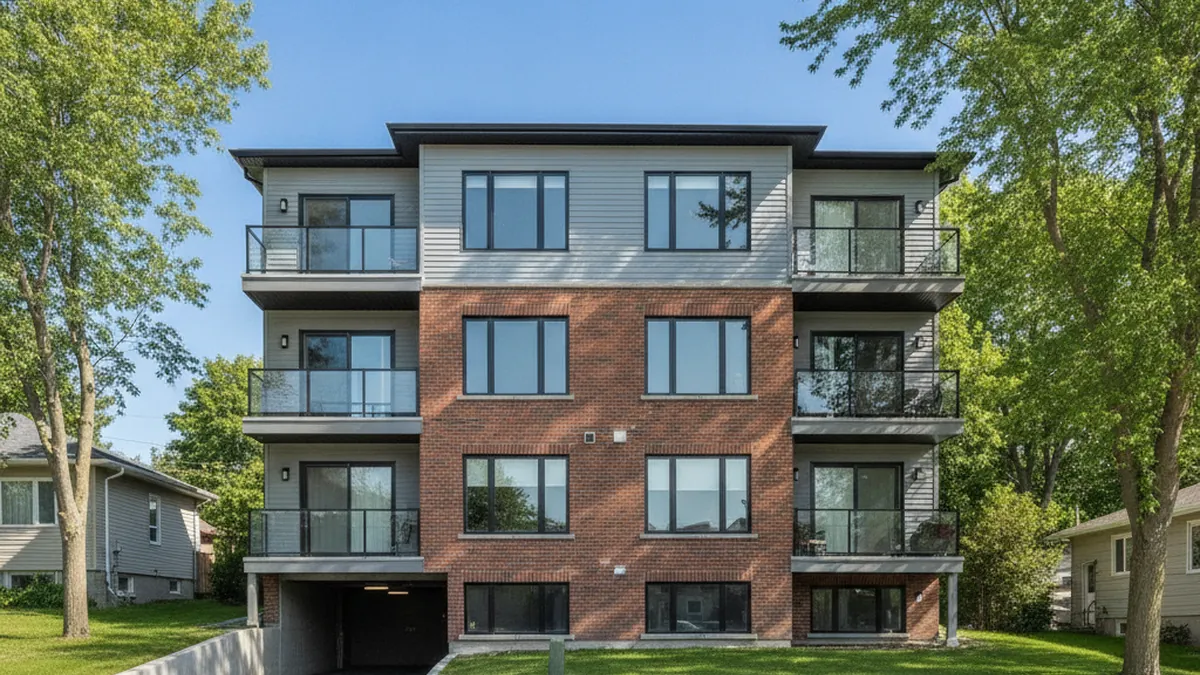
CMHC mortgage loan insurance is not mandatory for a commercial building, but it often transforms the economics of the project. By reducing the lender's risk, it unlocks better terms. The flagship program for new or existing buildings is MLI Select (Multi-Unit Loan Insurance Select), which grants increasing benefits — reduced down payment, extended amortization — based on a points system covering energy efficiency, accessibility and housing affordability. We detailed its mechanics in our CMHC MLI Select financing guide.
Careful: "eligible" doesn't mean "automatic"
A building of 5 or more units is eligible for CMHC's multi-unit programs, but it must meet the criteria (building condition, income, ratios, borrower's file). A fourplex converted to 5 units without permits or compliance may be refused. Always verify eligibility before buying.
Source: CMHC — Multi-Unit Mortgage Loan Insurance and MLI Select.
CMHC standard vs MLI Select: which program for your building?
CMHC offers two main families of products for buildings of 5 or more units. The "standard rental housing" insurance allows a loan-to-value of up to 85% and amortization of up to 40 years, with a minimum DSCR of 1.10 (1.20 from 7 units). The MLI Select program goes further: up to 95% loan-to-value, 50 years of amortization and a DSCR of 1.10, in exchange for commitments on affordability, energy efficiency and accessibility measured by a points system.
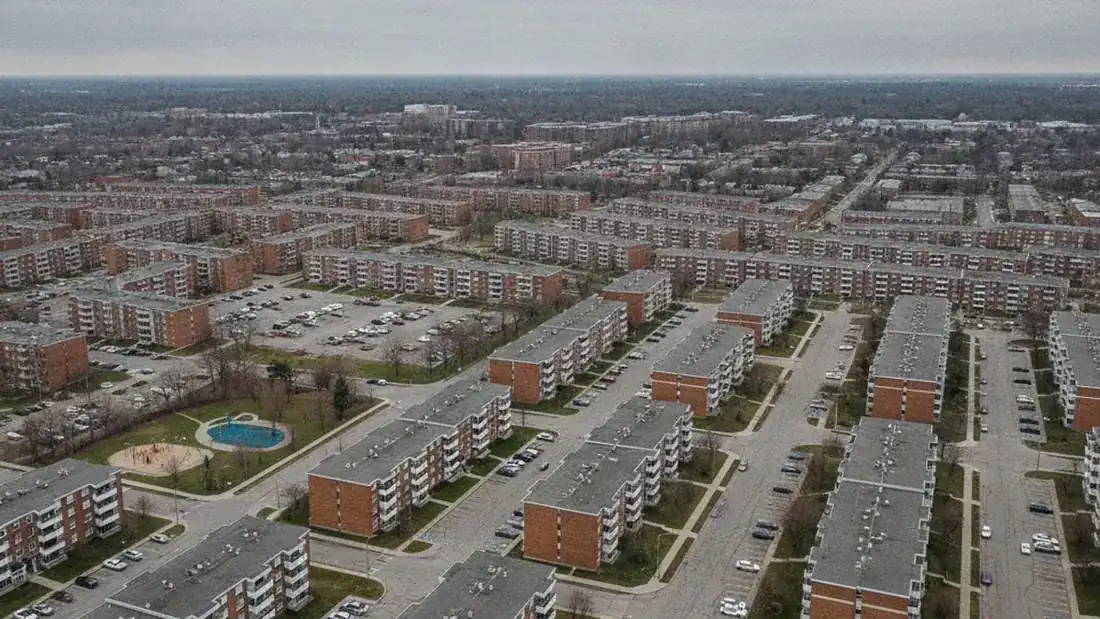
Many owners reduce CMHC to a single product. In reality, for a building of five or more units, two logics coexist: the standard program (classic rental housing) and the MLI Select program, more generous but conditional on commitments. The right choice depends on your building, your project (purchase, refinance, construction) and your willingness to commit to social and energy criteria.
The standard program: the baseline
For standard rental housing, CMHC can insure a loan of up to 85% of value, with amortization of up to 40 years. The required debt service coverage ratio is at least 1.10 for buildings of 5 to 6 units, and climbs to 1.20 from 7 units. Amortization beyond 25 years triggers a surcharge: roughly 0.25% more per additional 5 years, or about 0.75% surcharge for a 40-year amortization. Base premiums, under the risk-based pricing model, sit in a broad range that only a CMHC quote can pin down.
Source: CMHC — Mortgage Loan Insurance for Standard Rental Housing (5+ units).
MLI Select: the flagship program
The MLI Select program rewards projects that commit along three axes — affordability, energy efficiency and accessibility — through a points system. The more points you accumulate, the bigger the benefits: loan-to-value up to 95%, amortization up to 50 years and a DSCR lowered to 1.10. These three levers combined radically change a project's economics: a lower down payment, a monthly payment spread over half a century and a more accessible qualification threshold.
| Parameter | Conventional (uninsured) | CMHC standard | CMHC MLI Select |
|---|---|---|---|
| Max loan-to-value | ~75% (sometimes 80%) | Up to 85% | Up to 95% |
| Max amortization | 25-30 years | Up to 40 years | Up to 50 years |
| Minimum DSCR | ~1.20-1.30 | 1.10 (5-6 units) / 1.20 (7+) | 1.10 |
| Insurance premium | None | Yes (+ amortization surcharge) | Yes (often reduced by points) |
| Conditions | None (beyond lender criteria) | CMHC criteria | Affordability / energy / accessibility commitments |
Sources: CMHC — MLI Select; CMHC — Standard Rental Housing.
"The MLI Select product rewards borrowers who make commitments to affordability, energy efficiency or accessibility for residential properties of 5 or more units."
— CMHC, MLI Select program descriptionWe've dedicated a full guide to this program; to dig into the points and benefits calculation, see our CMHC MLI Select financing guide 2026 or try our MLI Select estimator.
How does the MLI Select points system work?
MLI Select grants its benefits based on a total of points combining affordability, energy efficiency and accessibility. A minimum of 50 points gives access to program benefits; you generally need to target around 100 combined points to unlock the maximum parameters (up to 95% loan-to-value, 50 years of amortization, a DSCR of 1.10). New energy efficiency requirements apply to new construction as of September 30, 2026.
MLI Select's strength — and complexity — lies in its points system. Rather than granting its best parameters to everyone, CMHC modulates them based on the borrower's commitments. Three families of criteria feed the score:
The three scoring axes
- Affordability: a commitment to keep a share of rents below a threshold defined against median income or median market rent, for a set duration.
- Energy efficiency: improving the building's energy performance (reducing consumption and emissions) against a benchmark.
- Accessibility: universal design and units adapted to people with reduced mobility.
The tiers structure the whole program. A minimum of 50 points opens the door to benefits; to obtain the maximum parameters (lowest down payment, 50-year amortization, DSCR of 1.10), you generally need to reach around 100 combined points. This is what pushes many developers and owners to invest in their building's energy efficiency: the financing gains can far exceed the cost of the work.
| Points tier | Indicative effect on financing |
|---|---|
| Under 50 | No access to MLI Select benefits (fall back to the standard program) |
| 50 points | Access to the program's base benefits |
| ~100 combined points | Maximum parameters: up to 95% loan-to-value, 50-year amortization, DSCR 1.10 |
Source: CMHC — MLI Select (points system and benefits).
New in 2026: energy requirements tighten
New energy efficiency requirements apply to new construction submitted to MLI Select as of September 30, 2026. An owner considering a construction or conversion project must integrate these criteria as early as possible in the design, or risk losing points — and therefore financing benefits. Always validate the current version of the criteria directly with CMHC.
For an existing building on the North Shore, the question becomes: is it worth investing in energy renovations to reach the targeted points tier? The answer depends on the cost of the work, the financing gain, and the holding horizon. Our renovation calculator helps quantify the investment, while the MLI Select estimator simulates the score.
Worked example: a 6-plex on the North Shore, conventional vs CMHC
Take a 6-plex at $1,200,000 generating $66,000 of net operating income. Conventionally at 75% loan-to-value ($900,000), the down payment reaches $300,000 and the DSCR, with a 25-year amortization, stays tight. With a CMHC MLI Select structure at 85-95% and a 40-50 year amortization, the down payment falls sharply and the DSCR improves — at the cost of an insurance premium and commitments. The gap in initial capital can exceed $150,000.

Nothing beats a worked example to grasp the real impact of the financing choice. Take a building representative of the North Shore market: a 6-plex at $1,200,000, in good condition, whose rents generate a net operating income (NOI) of $66,000 after taxes, insurance, energy, maintenance, management and a vacancy allowance. The figures below are illustrative — actual rates, premiums and ratios depend on the lender, insurer and file — but they show the mechanics.
Scenario A — Conventional uninsured (75%)
At 75% loan-to-value, the loan reaches $900,000 and the down payment, $300,000. With a 25-year amortization at a hypothetical rate of 5.5%, the annual debt service is around $66,000. The DSCR is then about 1.00 ($66,000 ÷ $66,000) — insufficient. To meet a DSCR of 1.20, the lender would reduce the loan: it's the DSCR, not the LTV, that caps the financing. The buyer would have to increase the down payment beyond $300,000.
Scenario B — CMHC MLI Select (85%, 40 years)
At 85% loan-to-value, the loan rises to $1,020,000 and the down payment drops to $180,000. Above all, the 40-year amortization sharply reduces the annual payment: the debt service falls to around $55,000, which lifts the DSCR to about 1.20 ($66,000 ÷ $55,000) — above the required 1.10 threshold. The building qualifies comfortably, with $120,000 less capital locked in than conventionally.
| Item | Scenario A — Conventional 75% | Scenario B — MLI Select 85% / 40 yrs |
|---|---|---|
| Price / value | $1,200,000 | $1,200,000 |
| Loan | $900,000 | $1,020,000 |
| Down payment | $300,000 | $180,000 |
| Amortization | 25 years | 40 years |
| Debt service (approx.) | ~$66,000/yr | ~$55,000/yr |
| DSCR (NOI $66,000) | ~1.00 (too low) | ~1.20 (qualifies) |
| Insurance premium | None | Yes (+ commitments) |
The lesson is clear: on the same building, the CMHC structure can make the difference between a refused loan and an approved one, while reducing the capital to put up by six figures. In exchange, the insurance premium is added to the loan and the MLI Select commitments (affordability, energy, accessibility) must be honoured over time. It's a trade-off between liquidity at entry and long-term constraints. To test your own figures, our financing comparator and yield calculation guide are designed for exactly this.
How does the 2026 rate context influence qualification?
In July 2026, the Bank of Canada held its policy rate at 2.25%, a sixth consecutive hold, with CPI inflation at 3.2% in May. A stable policy rate supports more predictable commercial mortgage rates, which improves DSCR readability and eases qualification compared with previous rate peaks. The next decision was set for September 2, 2026.

Commercial financing isn't decided in a vacuum: it moves with monetary policy. In commercial lending, the rate flows directly into the debt service, therefore the DSCR, therefore the amount a building can support. A rate hike reduces the maximum loan; a cut (or a hold) increases it. That's why the 2026 context deserves the attention of any owner considering buying, refinancing or selling a building of five or more units.
A stable policy rate at 2.25%
On July 15, 2026, the Bank of Canada held its target for the overnight rate at 2.25% — a sixth consecutive hold. CPI inflation stood at 3.2% in May, driven notably by oil prices. The Bank projected GDP growth of 0.7% in 2026, then a rebound toward 1.8% in 2027 and 2028. The next announcement was set for September 2, 2026.
Source: Bank of Canada — Policy rate press release, July 15, 2026.
For a North Shore building, a stable policy rate is good news: it makes the debt service more predictable and eases DSCR modelling over the term. A less volatile rate environment also reduces the risk at the end of the 5-year term, a sensitive point for owners who bought at the rate peak and dread renewal. Our detailed analysis of 2026 multiplex mortgage rates digs into these issues, while the cost of refinancing is worth quantifying before any decision.
How do you build a winning commercial financing file?
A solid commercial file revolves around the building: an up-to-date rent roll, signed leases, clean financial statements over 2-3 years, a commercial appraisal, proof of down payment and a management plan. Plan for a longer timeline than in residential (often 60 to 90 days or more), a specialized commercial mortgage broker, and a cash reserve for fees (appraisal, environmental study, legal fees, CMHC premium).

The quality of the file often makes the difference between smooth financing and a refusal. In commercial lending, the lender assesses a business plan, not just a borrower. Here's the checklist every owner should prepare before even making an offer on a building of five or more units.
The documents to gather
- Up-to-date rent roll, with current rents and lease expiry dates.
- Signed leases for each unit, including addenda and increases.
- Clean income and expense statements, ideally over 2 to 3 years.
- Municipal and school tax accounts, insurance policy and energy bills.
- Qualified commercial appraisal (often ordered by the lender, at your expense).
- Proof of down payment and source of funds.
- Personal net worth statement, credit file and management experience.
The crux: time and team
Commercial financing takes more time than a residential loan: between the appraisal, credit analysis, a possible environmental study and, where applicable, CMHC approval, you often have to plan for 60 to 90 days, or more. This directly affects the deadlines you write into a purchase offer. Working with a commercial mortgage broker who knows the multi-unit lenders and the CMHC structure avoids losing weeks — and losing a transaction on a badly calibrated deadline.
The fee reserve not to forget
- Commercial appraisal (often a few thousand dollars).
- Phase I environmental study when required.
- Notary fees and inspection costs.
- CMHC insurance premium (added to the loan, but with sales tax on the premium to budget for).
- Land transfer tax ("welcome tax") calculated on the building's value.
A well-prepared file translates into a better rate, faster processing and fewer nasty surprises. It's also a signal of seriousness to the lender. To anticipate the land transfer tax, use our welcome tax calculator; to estimate your available equity before a refinance, our offer calculator can serve as a starting point.
What mistakes should you avoid going from 4 to 5 units?
The most common traps: believing a 5-unit building finances like a plex, underestimating the commercial down payment, ignoring the DSCR, adding a 5th unit without permits or compliance, and using a residential broker without access to commercial lenders. Each of these mistakes can derail qualification.

- Thinking "5 is like 4": the jump to commercial changes the down payment, ratios and timelines. Budget accordingly from the purchase offer.
- Underestimating the down payment: in conventional lending, plan for a higher capital share than in residential. Check whether a CMHC structure can reduce it.
- Ignoring the DSCR: if the building's net income doesn't cover the debt service with the required cushion, the loan won't pass — regardless of your personal file.
- Adding a non-compliant unit: converting a fourplex to 5 units without permits or a certificate can exclude you from commercial financing and CMHC insurance.
- The wrong broker: a commercial multi-unit mortgage broker has access to the right lenders and knows how to assemble the file (leases, financial statements, appraisal). A residential generalist often does not.
The takeaway: the moment you target a building of 5 or more units, prepare to think like a commercial investor, not a plex buyer. The number of units isn't just a statistic — it's the variable that decides the very nature of your loan. If you already own such a building and are torn between keeping, refinancing or selling it, our team can give you a numbers-based read of its economic value.
Sell, refinance or hold: how to decide?
For an owner of 5 or more units, the choice between selling, refinancing or holding depends on three variables: the building's current economic value, the accumulated equity and the cost of renewing the loan at term. Refinancing lets you extract equity without triggering immediate tax, but reloads the debt. Selling crystallizes the gain (with CCA recapture and capital gain to plan for). Holding bets on rent growth and debt reduction.

Financing isn't only about buying: at every term renewal, the owner of a building of five or more units faces the same crossroads. Should you sell, refinance to extract equity, or hold and let time work? The answer depends on the numbers-based read of the building — exactly the exercise a commercial buyer would do.
Refinance: extract equity without selling
On a building whose economic value has climbed (rising rents, improved NOI), refinancing lets you tap part of the accumulated equity without triggering immediate tax, since a loan isn't taxable income. It's a powerful lever to fund another project. The downside: the debt increases, so does the debt service, and the DSCR tightens. The building must therefore support the new loan.
Sell: crystallize the value
Selling lets you realize the value created, but carries tax consequences: recapture of the depreciation deducted and a capital gain on the appreciation. For an owner who no longer wishes to manage, who faces a costly renewal or who prefers to redeploy capital elsewhere, selling is often the simplest decision. Our capital gains calculator helps estimate the tax bill before deciding.
Hold: let the debt melt away
Holding bets on two forces: the gradual rise in rents (regulated by the housing tribunal) and the reduction of principal over the payments. Over a long horizon, leverage works in your favour. But it takes staying power to absorb rising taxes, insurance and maintenance — and above all to weather a term renewal at a higher rate if the context deteriorates.
The decision grid in three questions
- Has my economic value risen enough to justify a profitable refinance?
- Will my term renewal drop my cash flow below a comfortable threshold?
- Do I still have the desire and capacity to manage the building for the next 5 to 10 years?
In all cases, the decision rests on a numbers-based read of the building's economic value — the same lens as the commercial lender's. That's exactly what ImmoMulti provides free of charge to North Shore owners who are undecided: an income-based valuation, with no obligation.
ImmoMulti: direct buyer of multi-unit properties on the North Shore
Whether your building has 5, 8 or 12 units, we can send you a direct offer based on its economic value — no broker, no commission, in full confidentiality. Get a proposal within 48 hours.
To dig deeper into how rates and the financing structure affect the purchase value of a larger building, see our analysis of 2026 multiplex mortgage rates, and if you're considering holding the building through a corporation, weigh the trade-offs before deciding.


