
You're planning major work on a rental property on the North Shore? ImmoMulti finds that this tax mechanism — which can represent $10,000 or more recovered on a major project — is one of the least known on the North Shore. According to Revenu Québec, the owner of a new residential rental building or one that has undergone major renovations may obtain a partial rebate of GST and QST, provided that at least one unit is rented long-term — at least 12 months — as a primary residence. This rebate is distinct from the ordinary deduction of expenses. But the fiscal definition of "major renovations" is far more demanding than in everyday language: replacing a kitchen or re-roofing generally does not qualify — virtually the entire interior must be replaced. This guide explains the conditions, the strict definition, the current expense/capital expenditure distinction, and the concrete steps. Never assume your eligibility without validating with a tax specialist.
Quick answer
On a rental property on the North Shore, you can recover part of the GST (federal) and QST (provincial) paid on major renovation work — up to 36% of GST (standard rate) or up to 100% of QST (enhanced rate) — provided the work qualifies as "major renovations" under the fiscal definition (virtually the entire interior replaced), and the unit is rented as a primary residence for at least 12 months. Always validate with a tax specialist before assuming eligibility.
The principle: how can you recover part of the sales taxes on a rental property renovation?
Because residential rental income is an exempt supply under GST/QST, landlords cannot normally claim input tax credits. A specific rebate mechanism compensates for this: owners of new rental buildings or buildings that have undergone "major renovations" can recover a portion of the GST and QST paid — provided at least one unit is rented as a primary residence for at least 12 months.
When you renovate a rental property, you pay GST and QST on materials and labour, like any consumer. Yet unlike a business that resells taxable goods and recovers these taxes through input tax credits, the owner of a residential rental property provides an exempt service — meaning they generally cannot claim these taxes in the usual way.
To address this in certain cases, Revenu Québec provides a distinct mechanism. The owner of a new residential rental building or one that has undergone major renovations may be entitled to a partial rebate of the GST and QST paid on that work. The idea: to avoid unduly penalizing the creation or renewal of rental housing intended for long-term residential use.
The key word here is "partial." This is not about recovering all the taxes paid, but a fraction determined according to precise rules. It is also a mechanism specific to sales taxes — the GST and QST — and has nothing to do with deducting expenses from your rental income for income tax purposes.
Source: Revenu Québec — New or substantially renovated residential rental property
36% standard or 100% enhanced: how much can you recover?
Standard rebate: 36% of taxes paid, capped at $6,300 (GST) and $7,182 (QST) per unit — phases out above $350,000/unit (GST) and $200,000/unit (QST). Enhanced 100% QST rebate: applies to new-construction residential rental buildings only, subject to meeting specific criteria. Most North Shore renovation projects fall under the standard 36% regime.
Before discussing the process, it is important to understand that there is not one rebate rate but two very different regimes. The amount you can recover — and therefore the profitability of your project — depends directly on which one applies to your property.
The standard rebate: 36%, with caps and phase-out
The basic regime — which applies notably to major renovations — entitles you to a rebate equal to 36% of taxes paid per eligible unit. However, this rebate is not unlimited: it is capped at $6,300 for the GST and $7,182 for the QST per unit. Furthermore, it phases out progressively as the fair market value of the unit increases.
For the GST, the rebate decreases when the value exceeds $350,000 per unit and becomes nil at $450,000. For the QST, the phase-out occurs between $200,000 and $225,000 per unit. In other words, for a high-value unit, the standard rebate may be reduced or even eliminated entirely.
Source: Revenu Québec — Partial GST and QST rebate for the owner of a residential rental property
The enhanced rebate: 100% GST for new purpose-built rental buildings
Since September 14, 2023, the federal government has introduced an enhanced rebate that raises the GST rate from 36% to 100% and eliminates the caps and phase-outs described above. This is currently the most advantageous program: the GST on an eligible project is fully recovered.
However, this enhancement does not apply to just any construction project. It targets new purpose-built rental residential buildings whose construction begins between September 14, 2023 and December 31, 2030 (and is completed no later than December 31, 2035). The building must generally include at least four private units (or ten rooms or suites), of which at least 90% are reserved for long-term residential rental.
Important: the 100% enhanced rebate applies to new builds, not your major renovations
The enhanced 100% GST rebate applies to new construction of rental buildings — it does not generally cover major renovations of an existing building or condominium units. If your North Shore project is a gut renovation of your existing plex, it is the standard 36% regime that applies. And the QST follows its own provincial rules. Have both regimes validated before putting any numbers on paper to determine which one actually applies to your project.
Source: Department of Finance Canada — Enhanced GST Rental Rebate for purpose-built rental housing
Revenu Québec conditions to meet for this rebate

Entitlement to this rebate is not automatic. Revenu Québec sets out one essential condition: at least one unit in the building must be rented long-term — at least 12 months — as the primary residence of a tenant. In other words, the mechanism targets stable residential rental, not short-term accommodation or a vacant unit.
This logic makes sense from the owner's perspective: if you are gutting a triplex to rent it durably to families, you are contributing to residential housing supply, which the rebate seeks to recognize. Conversely, renovations carried out with a view to a quick resale or non-residential use do not fall within the same framework.
Key conditions to keep in mind
- The property is a new residential rental building or has undergone major renovations.
- At least one unit is rented long-term, for at least 12 months.
- That unit serves as the tenant's primary residence.
- The GST and QST rebate is partial, not total.
Other conditions may apply depending on the nature of your project and the ownership structure of your multiplex. That is why the list above is a starting point, not a complete eligibility checklist. The official reference remains Revenu Québec.
Source: Revenu Québec — Recovery and rebate of taxes paid
"Major renovations": a strict fiscal definition and why it matters
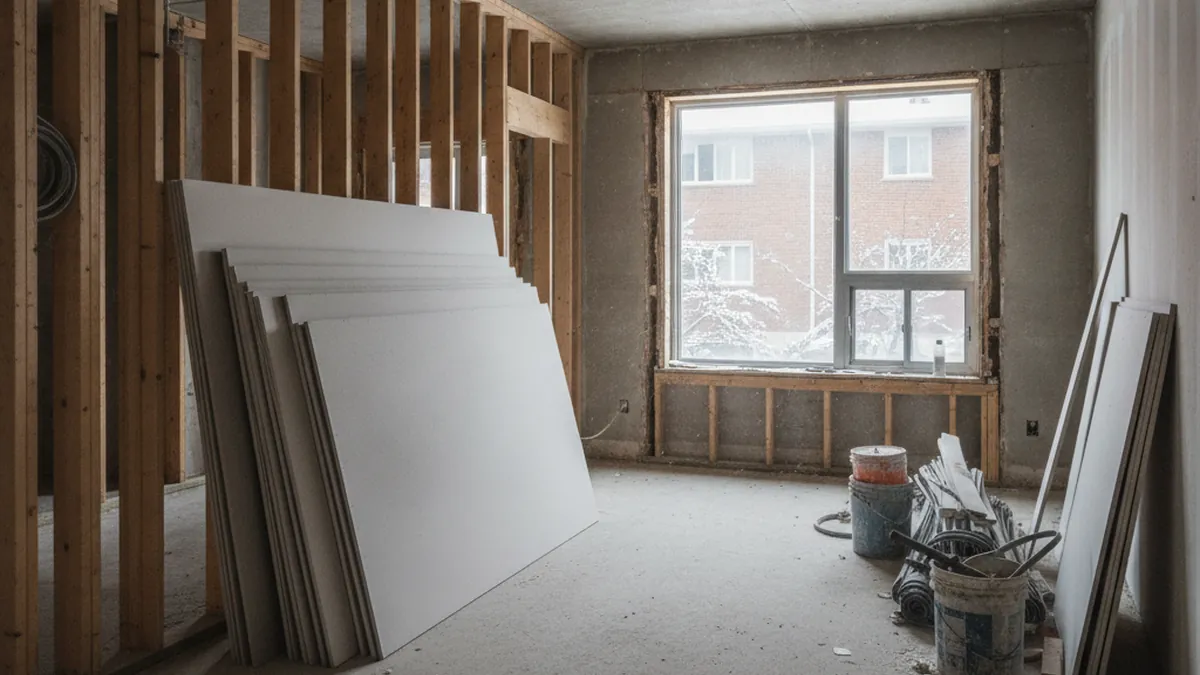
This is where many plex owners get it wrong. In everyday language, redoing a kitchen, replacing windows, or renovating a bathroom counts as a "major renovation." But for GST and QST purposes, the concept of major renovations has a far more demanding fiscal definition.
Essentially, for renovations to qualify as major under the tax rules, virtually the entire interior of the building must be removed or replaced. We are talking about a project that amounts to rebuilding the interior of the building — not a series of individual improvements, however costly. A complete unit refresh, the replacement of a heating system, or a roofing project generally does not meet this threshold.
Caution: do not assume any percentage
The fiscal definition of "major renovations" is precise and the threshold is high. Do not estimate your eligibility "by eye" or based on an approximate percentage of the work. Refer to the official Revenu Québec definition and, above all, have your situation validated by an accountant or tax specialist before filing any claim. A poorly grounded claim may be denied.
This rigour is not a detail: it determines whether your project qualifies for the rebate or not. Two projects that look similar on the surface — and cost comparable amounts — may receive opposite tax treatment depending on whether or not they clear the major renovations threshold. This is why it is important to document the full scope of the work from the outset.
Source: Revenu Québec — Applicable definition for major renovations
Current expense vs capital expenditure: what difference for your plex and your tax return?
Two separate questions: (1) the GST/QST rebate (sales taxes, based on "major renovation" eligibility) and (2) income tax treatment. For income tax: current expenses (repairs, maintenance) are deductible in the year incurred; capital expenditures (improvements) are added to CCA and deducted gradually. The work that qualifies for the GST/QST rebate is almost always a capital expenditure — never assume they are treated the same way.
Two fiscal questions often overlap in the minds of property owners, and they must be kept separate. On one side, the GST and QST rebate discussed above. On the other, the treatment of your renovation work in calculating your rental income for income tax purposes. These are two different mechanisms.
On this second front, Revenu Québec clearly distinguishes two types of expenses. Current expenses — maintenance and repairs — are deductible from your rental income in the year they are incurred. Capital expenditures — improvements — are not: they are added to the capital cost of the building for depreciation (CCA) purposes, and are therefore deducted gradually.
| Type of expense | Typical examples | Tax treatment (income tax) |
|---|---|---|
| Current expense | Maintenance, repairs that restore the property to its original condition | Deductible from rental income in the year incurred |
| Capital expenditure | Improvements that increase value or extend the useful life of the property | Added to the capital cost of the building, deducted through depreciation (CCA) |
| GST/QST rebate | New rental building or major renovations (strict fiscal sense) | Distinct mechanism: partial rebate of sales taxes, conditions to validate |
Why does this distinction matter so much for the owner of a multiplex? Because it changes the year and amount of the deduction, and therefore your real cash flow. Misclassifying an improvement as a current expense — or vice versa — can trigger a reassessment. And this classification is, once again, independent of your potential entitlement to the GST and QST rebate.
Source: Revenu Québec — Rental property owner: income and expenses
What this means for your North Shore plex
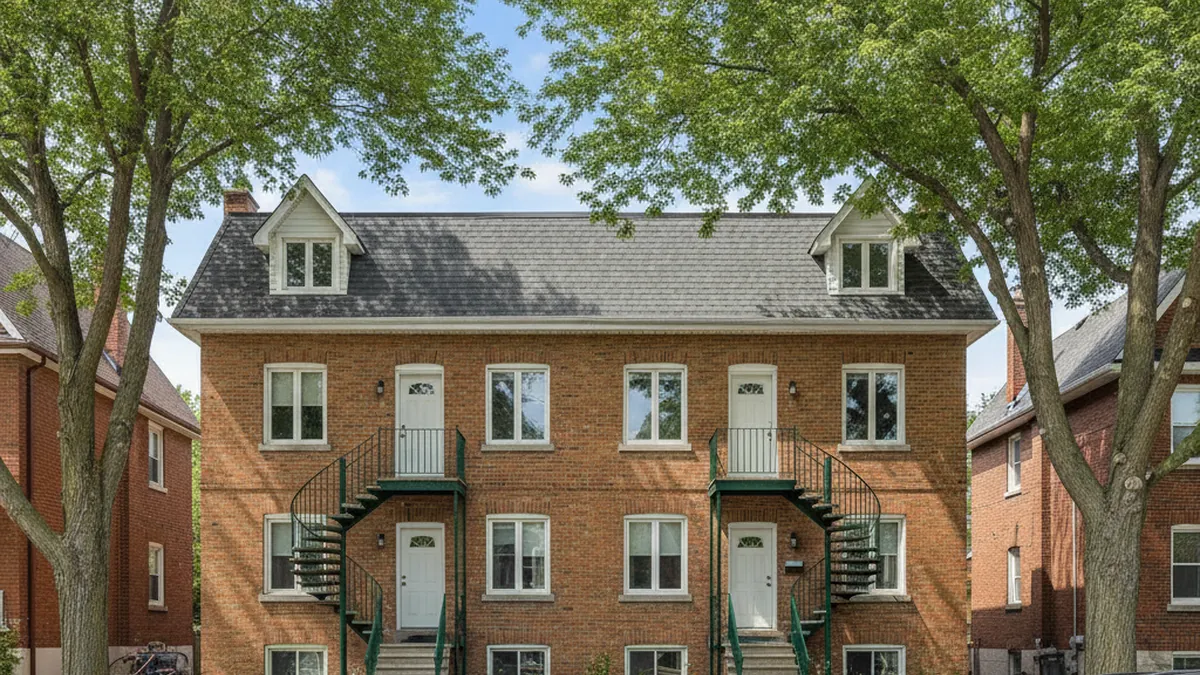
On the North Shore of Montréal — Terrebonne, Mascouche, Blainville, Boisbriand, Saint-Jérôme, Saint-Eustache, Deux-Montagnes — a large portion of the plex and multiplex stock is no longer new. To remain competitive and keep units rented, many owners are considering large-scale renovation projects. This is precisely the context in which the GST and QST rebate becomes relevant.
When the calculation is worthwhile
If you are planning to gut-renovate a rental property on the North Shore for long-term rental, and the scope of the project approaches the major renovations threshold, checking your eligibility for the rebate can represent real savings. On a project worth tens of thousands of dollars, a fraction of the GST and QST is not negligible.
When it probably does not apply
On the other hand, for one-off projects — roofing, windows, a refresh between tenancies — you will most often be in the "current expense or capital expenditure" framework rather than the sales tax rebate one. The right reflex is to calculate the expected return on your work before committing, to distinguish what constitutes maintenance from what represents a genuine capital reinvestment in your North Shore plex.
"The best fiscal renovation is the one you've run the numbers on before you start: the treatment of taxes and expenses is decided on the drawing board, not in a shoebox of year-end receipts."
— Perspective from a North Shore multiplex ownerThe approach: assume nothing, validate everything

The GST and QST rebate on major renovations is a real opportunity, but it is also an area where improvisation is costly. Here is a cautious approach for the owner of a plex or multiplex on the North Shore.
- Document the scope of the project: before and after photos, detailed quotes, invoices with GST and QST itemized. The "major renovations" classification rests on verifiable facts.
- Keep proof of rental: leases showing long-term rental (at least 12 months) as the primary residence for at least one unit.
- Consult Revenu Québec for the exact definition: do not rely on a percentage heard elsewhere; the fiscal definition is strict and authoritative.
- Have an accountant or tax specialist validate everything: eligibility, calculation of the recoverable partial amount, and preparation of the claim. This is the step that protects your filing.
- Keep income tax and sales taxes separate: the "current expense / capital expenditure" treatment is handled in parallel, with the same documentary rigour.
ImmoMulti: direct buyer of multiplexes on the North Shore
Weighing whether a major renovation is worth it, or whether it's better to sell as-is? We buy plexes and multiplexes anywhere on the North Shore — no broker, no commission, in complete confidence. No public listing, no obligation. Receive a proposal within 48 hours.
To put numbers on this decision, our multiplex yield calculation guide explains how to assess the real return on your property, and our page on selling a property that needs renovation details the option of selling without undertaking the work yourself. If the profitability of your plex is a broader concern, our analysis on the unprofitable plex in Québec in 2026 puts these fiscal decisions in the context of the North Shore market.


