
Before buying a plex in Quebec, one document deserves as much attention as the leases and the inspection: the location certificate. As a buyer or investor, knowing how to read a location certificate keeps you from inheriting an encroachment, a restrictive servitude or a unit added without a permit. At ImmoMulti, a direct buyer of multi-unit properties on the North Shore, we examine it in every transaction. This guide explains what the document contains, how to spot red flags in it, and when to demand an up-to-date version before you sign.
What is a location certificate in Quebec?
A location certificate is a document signed by a land surveyor that expresses their professional opinion on the current situation of a property relative to the titles of ownership, the cadastre, and applicable laws and regulations. It includes a written report and a plan.
According to the Ordre des arpenteurs-géomètres du Québec (Quebec Order of Land Surveyors), the location certificate is a professional's opinion on the state and situation of a property. Only a land surveyor who is a member of the Order may prepare and sign it. It is neither a mere description nor a decorative document: it is an expert opinion that engages the professional liability of its author.
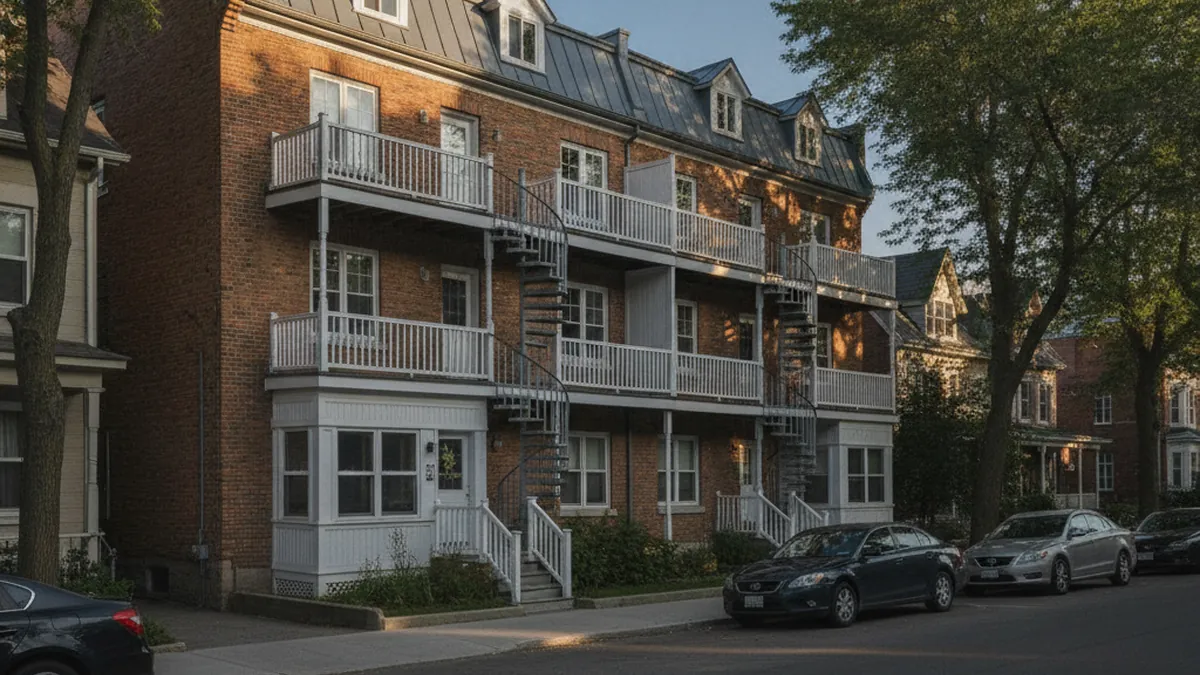
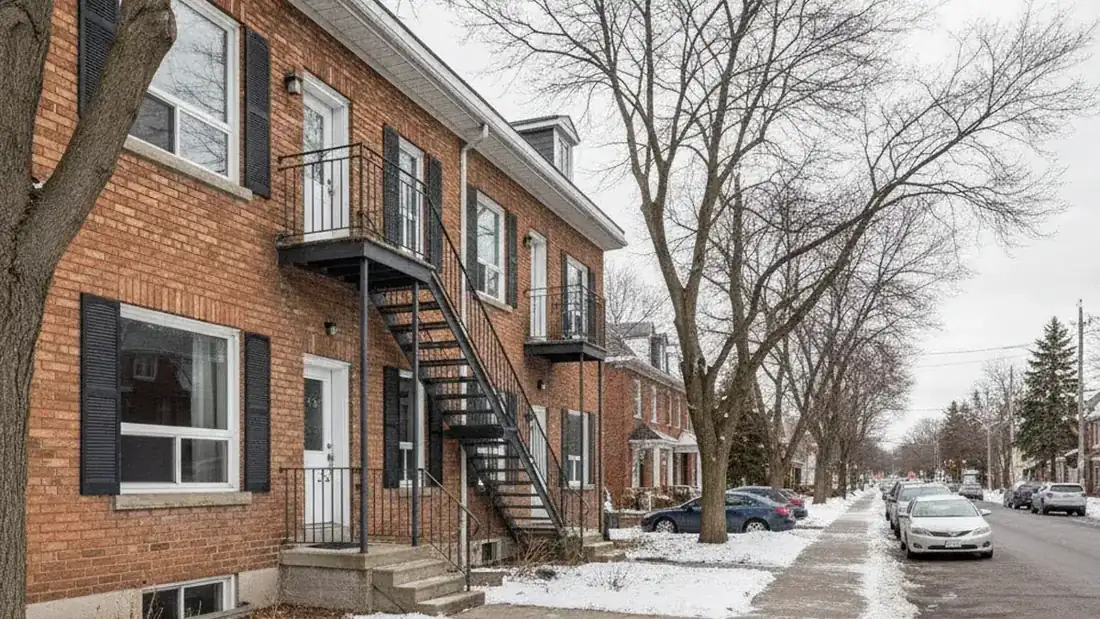
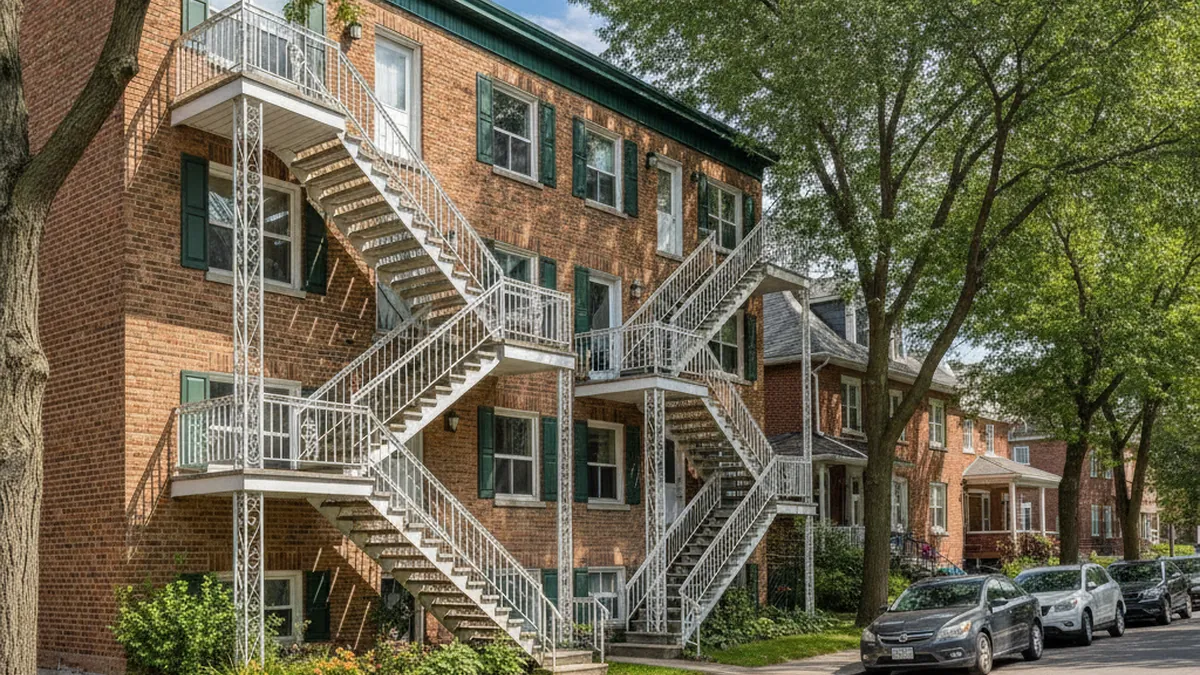
For a plex, this document is crucial because an income property often involves sensitive elements: shared parking, balconies and emergency staircases that may extend over a neighbour's land, sometimes an extra unit fitted out in the basement. The location certificate is the tool that reveals whether the building's actual footprint matches the titles and the municipal regulations.
What does a location certificate contain for a plex?
A certificate is read in two parts: the plan (the drawing of the land and building) and the report (the surveyor's text). Both must be examined together. Here are the essential elements to look for.
| Element | What it reveals for a plex buyer |
|---|---|
| Lot boundaries and cadastre | The actual area, lot number and consistency with the titles. |
| Building footprint | The exact placement of the plex on the lot, with its dimensions. |
| Setbacks | The distances between the building and the boundaries; flags setbacks that don't meet zoning. |
| Servitudes | Rights of way, public-utility (Hydro, city), view or sewer servitudes that burden the land. |
| Encroachments | Fences, balconies, sheds or parts of the building extending over or from the neighbour. |
| Accessory structures | Shed, pool, parking, decks — their compliance and presence on the plan. |
| Surveyor's notes | Mentions of acquired rights, non-compliance or uncertainties to clarify. |
According to Éducaloi, the location certificate notably helps you know whether the construction complies with municipal regulations and whether servitudes or encroachments exist. Read every surveyor's note: it is often in those remarks, more than on the plan, that the real issues hide.
How to spot problems: encroachments, servitudes and setbacks
Usefully reading a location certificate means hunting for three families of problems. None should be ignored by a plex buyer.
Encroachments
An encroachment occurs when a structure extends past a lot boundary. On a plex this is common: an emergency staircase, a rear balcony, a shed or a fence biting into the neighbour's land — or the reverse. The surveyor flags it. An unresolved encroachment can block financing, require a servitude, corrective work or a written agreement. Never sign without measuring its impact.
Servitudes
A servitude is a charge burdening the land: a right of way, a public-utility, view or sewer servitude. For an income property, a servitude can reduce the use of parking, constrain the backyard or prevent a future extension — all things that affect profitability. Verify each servitude with your notary.
Setbacks and non-compliance
An insufficient setback, a unit fitted out without a permit or non-regulation parking are forms of non-compliance. Sometimes the building enjoys acquired rights; sometimes not. The municipality's planning department can confirm the situation. Zoning and planning rules fall to municipalities, whose tools are accessible through Québec.ca — Housing and territory.
Red flags you must never ignore
An unresolved encroachment, a servitude that limits parking or extensions, a unit not shown on the certificate, a non-compliant setback without confirmed acquired rights, or a certificate predating work visible on site. Each deserves a written verification before signing.
When to demand an up-to-date location certificate
The law sets no expiry date. A certificate remains valid as long as it reflects the current state of the premises. In practice, many lenders and notaries consider that a certificate older than about ten years — or one predating modifications — no longer reflects reality.
Demand an up-to-date certificate if…
- Work has been done: extension, added unit, garage, deck, pool, fence, repaved parking.
- The certificate provided is old and doesn't show structures visible on site.
- Your mortgage lender requires it as a financing condition.
- Your notary finds a discrepancy between the certificate, the titles and reality.
State in the purchase promise who provides and pays for the certificate. By custom, the seller delivers a certificate reflecting the current state; the OACIQ, the body that oversees real estate brokerage in Quebec, stresses the importance of framing these obligations clearly in transaction contracts. Put it in writing to avoid any ambiguity.
Common mistakes plex buyers make
Even seasoned buyers stumble on the location certificate. Here are the most common traps — and how to avoid them.
- Trusting the plan without reading the report. The surveyor's written notes often hold the most important issues (acquired rights, uncertainties, non-compliance).
- Accepting a certificate that's too old. A 15-year-old document that doesn't show the extension or the added unit is worthless for your due diligence.
- Confusing the certificate with the inspection. The certificate covers the land and compliance, not physical condition. Do both.
- Not validating servitudes with the notary. A harmless-looking servitude on the plan can block an extension project or reduce parking use.
- Overlooking undeclared units. A quadruplex "officially" a triplex can mean an illegal rent and a regulatory risk you inherit.
Reading a location certificate correctly protects your investment before you even pay. Always combine it with the pre-purchase inspection of the income property, the notary's title review and a rigorous analysis of the purchase-promise clauses. And don't forget the legal warranty against latent defects, which complements — without replacing — what the certificate reveals.
The legal framework: the A-23, r. 10 practice standard
A location certificate is not an improvised document: it follows a precise regulatory standard. In Quebec, it is governed by the Regulation respecting the standard of practice relating to the location certificate (A-23, r. 10). This standard tells the land surveyor what to verify, how to present it and what responsibilities they take on. Understanding this framework helps you, as a plex buyer, know what the document is meant to cover — and what it does not.
According to the Ordre des arpenteurs-géomètres du Québec, the certificate expresses the surveyor's professional opinion on a building's situation relative to titles, encroachments and the laws and regulations that may affect it. It is a document that reflects the state of the property at the time of its production: its value declines as time passes and the premises change. For a plex on the North Shore, where parking, galleries and accessory units evolve over the years, that nuance is critical.
Don't confuse the four survey documents
Many plex buyers confuse the location certificate with other survey mandates. Yet they have neither the same purpose, nor the same scope, nor the same price. Here is how to tell them apart.
| Document | What it is for | Useful for a plex when… |
|---|---|---|
| Location certificate | Complete opinion on the building's state vs titles, cadastre and regulations. | You are buying, financing or selling — the transaction's reference document. |
| Cadastral operation | Represent and number a lot on the cadastre (subdivision, cadastral renewal). | You divide land, correct a lot or detach a portion. |
| Staking | Mark on the ground the presumed position of boundaries. | You need to locate a fence or feature near a boundary. |
| Boundary determination | Definitively and irrevocably fix the line between two lots (official procedure). | A boundary dispute with a neighbour must be settled permanently. |
Remember this: only the location certificate gives an overall reading of compliance. Staking says nothing about servitudes or zoning; a boundary determination settles a boundary but not municipal regulations. For an income property, the certificate remains the central due-diligence tool, to be combined with the inspection and the title review.
Read the plan AND the report, line by line
A location certificate has two inseparable parts: the plan (the drawing) and the report (the text). The classic mistake of the rushed buyer is to glance at the drawing, note that "the building sits on the lot" and move on. It is often in the report that a plex's most consequential mentions hide.
What to spot on the plan
- The lot number and cadastre. It must match exactly your titles and the Quebec cadastre record. A number mismatch is a first thing to clarify.
- The scale and orientation (north). They let you estimate real distances and place the building relative to the street and neighbours.
- The setback measurements. These are the distances between the building and each boundary. Compare them with the zoning minimums.
- The footprint of the plex and its annexes. Galleries, fire escapes, shed, garage, parking, pool: everything built should appear on the plan.
- The servitude lines and encroachment hatching. The surveyor draws and identifies them with a legend. Read the legend.
What to read in the report
The report translates the plan into words and adds what the drawing does not show. Systematically look for:
- the listed servitudes (right of way, public utility, view, sewer) and their origin;
- the encroachments noted, in either direction;
- the non-compliance with regulations (insufficient setback, unauthorized use, apparent construction without a permit);
- mentions of acquired rights or, conversely, the absence of confirmation of such rights;
- the particular constraints: agricultural zone, flood zone, wetland, environmental protection zone, airport zone — all elements the surveyor must verify under the practice standard.
The golden rule of reading
- Always read the report BEFORE concluding anything from the plan.
- Highlight every mention of a servitude, encroachment, non-compliance and acquired right.
- Carry each highlighted item into a list of questions for your notary and, if needed, the city.
- Check concordance: lot number, area and address must be identical across the certificate, titles and cadastral record.
Cadastre, lot number and concordance with titles
Behind every plex hides a land identity: a lot number. It is the key that links the location certificate, the property titles and the land register. When the buyer of a multi-unit building confirms that these three documents "speak of the same lot," they eliminate at once a large share of the legal risk.
The Quebec cadastre has a long history. Created in 1860, it had become, over time, incomplete and imperfect. In 1994 the government launched a vast cadastral renewal program. Before that work, roughly 850,000 properties were not directly registered on the cadastre and nearly 750,000 lots contained anomalies affecting their dimensions or area. The renewal is now complete and the register is fully computerized, which makes verification easier for the buyer.
Why concordance matters for a plex
A multi-unit building rarely trades on a "clean" lot with zero anomalies. It may straddle two former lots, have undergone a cadastral correction, or carry a slightly different area on the title versus the cadastre. These gaps are not necessarily serious, but they must be explained. Here are the checks to make.
| To verify | Where | Warning sign |
|---|---|---|
| Lot number | Certificate, titles, cadastral record | Three numbers that do not match. |
| Land area | Certificate vs cadastre | A large gap not explained by the surveyor. |
| Civic address | Certificate vs assessment roll | An address that does not match the plex visited. |
| Number of units | Certificate, roll, leases | One "extra" unit on site versus on the documents. |
That last point is decisive for an income property: a plex presented as a triplex but built as a quadruplex immediately raises the question of the added unit and its legality. Have the notary and the planning department settle it before you commit.
Encroachments: what the Civil Code says
An encroachment is not just a line on a plan: it is a legal question whose outcome depends on good or bad faith and on the seriousness of the situation. For a plex buyer, knowing the broad rules avoids panicking over a minor encroachment — or, conversely, underestimating a serious one.
Under article 992 of the Civil Code of Québec, an owner in good faith who has built beyond the limits of their land onto a parcel belonging to the neighbour may, at the choice of the owner of the encroached land, be required either to acquire that parcel by paying its value, or to pay compensation for the temporary loss of use. If, however, the encroachment is considerable, causes serious prejudice or is made in bad faith, the neighbour can compel the acquisition or the demolition of the structure and the restoration of the premises.
Three typical scenarios on a plex
- A fire escape encroaches 20 cm onto the neighbour. Minor encroachment, often in good faith. Frequent solution: an encroachment servitude granted by notarial deed, sometimes for a modest indemnity.
- The plex's parking partly overlaps the neighbouring lot. A real impact on operations: the use must be secured (servitude), otherwise the advertised number of spaces may be overstated.
- Part of the main building crosses the boundary. A potentially considerable encroachment: to be seriously evaluated by the notary, as it can block financing.
Never settle an encroachment "by word of mouth"
A verbal agreement with the neighbour does not survive the sale: it does not bind future owners. Only a servitude published in the land register (or a physical correction of the structure) resolves an encroachment durably. Demand it in writing before signing the deed of sale of the plex.
From an owner-seller's standpoint: if you are selling a plex with a known encroachment, it is better to regularize it before going to market. A documented and resolved encroachment reassures the buyer and their lender; an encroachment discovered at the last minute drives the price down or derails the transaction.
Servitudes: which ones to watch on a plex
A servitude is a charge imposed on an immovable (the servient land) for the benefit of another immovable (the dominant land) belonging to a different owner. In practice, it obliges the owner to tolerate a use or to refrain from exercising certain rights. For an income property, a servitude can weigh directly on profitability — hence the importance of flushing them out on the location certificate.
The types of servitude to know
- Right-of-way servitude. A neighbour or the public crosses part of the land. The owner of an enclosed lot (art. 997 C.C.Q.) can even require a passage through their neighbour's land. On a plex, a passage can reduce the monetizable parking area.
- Public-utility servitude. For the benefit of Hydro-Québec, the city or a service (water main, sewer, telecommunications). It can prevent building at a specific spot in the yard.
- View servitude. Governs windows and openings facing the neighbour — relevant if you plan to add openings during a renovation.
- Sewer or drainage servitude. A pipe crosses the land; future work must account for it.
A crucial point for operating a multi-unit building: a servitude can be extinguished by non-use after 10 years, but as long as it is published and used, it burdens the land and follows the building into each buyer's hands. According to Éducaloi, these neighbourhood charges govern specific uses and do not disappear simply because their existence is unknown.
"The location certificate reflects the state of the property at the time of its production, and its principal role is to inform the parties during a real estate transaction."
Ordre des arpenteurs-géomètres du Québec — Location certificate
How to assess a servitude's impact on profitability
Each servitude should be translated into dollars, or at least into a concrete constraint. Ask yourself these questions:
| Servitude | Possible impact on the plex | Question for the notary |
|---|---|---|
| Right of way | Fewer parking spaces, traffic through the yard. | How many spaces remain truly rentable? |
| Public utility | Ban on building an extension at that spot. | Is a unit-addition project compromised? |
| View / openings | Limits on new windows during a renovation. | Can I modernize the units as planned? |
| Drainage / sewer | Excavation work restricted or costly. | Who maintains the structure and at what cost? |
Setbacks, zoning and acquired rights: the crux
On a plex, the costliest question is not aesthetics: it is zoning compliance. An insufficient setback, a unit added without a permit, an unauthorized use, exceeded density — each of these can cap the building's value and complicate its resale. The location certificate is your first detector.
Setbacks
Municipal zoning sets a minimum distance between the building and each boundary (front, rear, sides). The certificate shows the actual setbacks. If an actual setback is below the minimum, there is non-compliance — unless acquired rights apply. Zoning and planning rules fall under the municipalities; information is available via Québec.ca — Housing and territory and, above all, from the local planning department.
Acquired rights
A building non-compliant with current rules may be legal if it complied with the rules in force when it was built: these are acquired rights. But beware: acquired rights are sometimes lost (prolonged abandonment of use, work that worsens the non-compliance). Never assume an old plex "is fine because it has been there a long time." Have acquired rights confirmed in writing.
The unit added without a permit
This is the classic multi-unit trap. A basement fitted out as a unit, a "4½" created in an attic, an intergenerational suite converted into a rental: if the addition has no permit and no acquired rights, the buyer inherits a regulatory risk and, sometimes, an illegal rent. A certificate showing a different number of doors than the assessment roll is a red flag.
The planning-department verification procedure
Before closing, ask the municipality: (1) the number of units authorized by zoning; (2) the existence of permits for any construction or transformation; (3) written confirmation of acquired rights, if any; (4) any notice of infraction or open file. An email from planning is worth a thousand assumptions.
Cost, timeline and who pays: framing it in the purchase promise
An up-to-date location certificate has a price and a timeline you must anticipate, especially when a plex transaction is on the clock with financing conditions. Do not let this question float: settle it in black and white in the purchase promise.
According to industry providers, the cost of a residential location certificate generally falls, in 2026, within a range of about $1,200 to $2,500, with an average often around $1,500 to $1,800 for a standard urban property; the price varies with lot size, building complexity and the terms of the mandate (see for example Habitam, 2026). The timeline to obtain it is often 4 to 8 weeks. For a more complex multi-unit building (large lot, several structures, a busy cadastral history), plan for the top of these ranges and always request a firm quote from the surveyor.
| Parameter | Order of magnitude (2026) | What makes it vary |
|---|---|---|
| Common residential cost | ~$1,200 to $2,500 | Lot size, complexity, number of structures. |
| Time to obtain | ~4 to 8 weeks | Time of year, surveyor's workload, cadastral file. |
| Who pays (custom) | The seller | Negotiable if an update is required for recent work. |
These amounts are market orders of magnitude, not an official tariff. Request a quote from a land surveyor who is a member of the Ordre for your specific building.
What the clause should provide for
By custom, the seller provides and pays for a certificate reflecting the current state of the premises; the OACIQ, which oversees real estate brokerage in Quebec, stresses the importance of properly framing these obligations in the contract. A solid clause specifies: who provides the certificate, who pays for a possible update, the delivery deadline, and the recourse if the document reveals non-compliance. The notary's role here is decisive in drafting and verifying these commitments.

The step-by-step process for a plex buyer
Here is a clear procedure to use the location certificate as a genuine due-diligence tool, from the first glance to signing at the notary's office.
- Obtain the most recent certificate from the seller, as early as the purchase-promise stage, with the report AND the plan.
- Check its age and concordance with the premises: has any work been done since issuance? Does the number of units match?
- Read the report in full and highlight servitudes, encroachments, non-compliance and acquired rights.
- Compare with the cadastre (lot number, area) and the assessment roll (number of units, address).
- Question the municipality about zoning, permits, acquired rights and any notice of infraction.
- Hand it all to the notary for the title review and the analysis of charges published in the land register.
- Demand an up-to-date certificate if the document is old, incomplete or predates unshown work.
- Reflect your conclusions in the purchase promise: conditions, price adjustments, regularization commitments.
Three documents, one decision
- The location certificate covers the land, boundaries and compliance.
- The pre-purchase inspection covers physical condition (roof, structure, plumbing, electrical).
- The notary's title review covers ownership and charges.

Common special cases on the North Shore
The location certificate of a multi-unit building sometimes holds less obvious situations. Here are the most common among North Shore plex buyers.
The plex with a ground-floor commercial space
A mixed building (units + commercial space) brings different zoning uses into play. Verify that the commercial use is authorized and compliant; a use non-compliance can be more constraining than an exceeded setback.
The lot not yet concordant after cadastral renewal
Some files show an old lot number on the title and a new one on the cadastre. This is not abnormal, but the surveyor and notary must confirm the correspondence to avoid any confusion over the object of the sale.
Parking in common ground or under a servitude
On many plexes, parking depends on a servitude or an agreement. Make sure the advertised number of spaces is truly available and legally secured — it is a revenue item in its own right.
The pool, shed or gallery added later
These annex structures must appear on the plan and respect the setbacks. A recent addition missing from the certificate justifies, on its own, an update of the document before the sale.
Three worked examples for a plex
Nothing speaks more clearly than numbers. Here are three simplified mini-cases, for illustration, showing how the location certificate influences a multi-unit transaction. (Figures for example only.)
Example 1 — The encroaching fire escape
A triplex listed at $720,000 has a rear staircase encroaching 25 cm onto the neighbour. The encroachment is minor and in good faith. Solution: an encroachment servitude by notarial deed. Estimated cost of regularization (surveyor + notary + token indemnity): a few thousand dollars. Once documented and resolved, financing goes through and the price holds. Left unresolved, the same file can make the lender hesitate and freeze the transaction.
Example 2 — The servitude that "eats" two spaces
A quadruplex advertises 6 parking spaces. The certificate reveals a right-of-way servitude that makes two spaces unusable. If each rented space is worth $75/month, that is $150/month, or $1,800/year of lost revenue. Capitalized at an overall rate of 6%, that represents about $30,000 of value ($1,800 ÷ 0.06). The savvy buyer adjusts their offer accordingly — or negotiates a solution with the seller.
Example 3 — The "phantom" unit
A building presented as a quadruplex turns out, on the certificate and the roll, to be a triplex with a fourth unit added without a permit in the basement. The fourth unit's revenue (say $900/month, $10,800/year) is uncertain: the city could require its closure. A prudent buyer values the building on three confirmed units, not four — which can represent, at a 6% rate, a valuation gap on the order of $180,000 ($10,800 ÷ 0.06). Hence the critical importance of validating legality before you pay.
Selling a plex? Prepare your certificate in advance
This guide speaks mainly to the buyer, but the owner-seller has every interest in mastering the location certificate before even listing their multi-unit building. A clean file speeds up the sale, reassures the buyer and their lender, and protects your price.
Pull out the certificate before receiving an offer
Find your most recent certificate and check its age. Remember that the Chamber of Notaries and the brokerage oversight body in practice require a certificate less than 10 years old, even if no modification has been made. If yours exceeds that age or predates your work (rebuilt gallery, shed, pool, parking, legalized unit addition), order an update right away: the 4-to-8-week timeline can otherwise delay your closing.
Resolve known irritants
A good-faith encroachment, a servitude to clarify or a small non-compliance are often best resolved upstream. A signed encroachment servitude, a written confirmation of acquired rights obtained from the city, or a regularized permit turn a "red flag" into a mere line in the file. The result: less renegotiation, fewer aborted transactions.
The savvy seller's reflex
- Check the certificate's age and update it if needed.
- Reconcile lot number, area and number of units.
- Document any encroachment or servitude and, if possible, regularize it.
- Gather the certificate, titles, leases and inspection report in one file.
At ImmoMulti, a direct buyer of multi-unit buildings on the North Shore, a well-prepared file often allows a quick close: an up-to-date, coherent certificate cuts back-and-forth and secures the offer. Selling a plex on the North Shore with a flawless certificate removes a major source of uncertainty from the equation.

What the certificate does NOT do: complementary checks
As useful as it is, the location certificate has blind spots. Treating it as a "master key" of due diligence is a costly mistake for a plex buyer. Here is where its scope ends — and what must take over.
| Check | What it covers | What it does NOT cover |
|---|---|---|
| Location certificate | Boundaries, setbacks, servitudes, encroachments, zoning compliance. | The building's physical condition; title quality; lease content. |
| Pre-purchase inspection | Roof, structure, foundation, plumbing, electrical, envelope. | The land's legal situation; servitudes; zoning. |
| Title review (notary) | Ownership, mortgages, published charges and servitudes. | Physical condition; actual footprint on the land. |
| Lease analysis | Rents, terms, arrears, rental conditions. | Construction compliance; land boundaries. |
The lesson is simple: these four checks are complementary, never interchangeable. A rigorous multi-unit buyer runs them in parallel. Always combine the certificate with the pre-purchase inspection of the income property, the analysis of the purchase-promise clauses and the legal warranty against latent defects. Together they form the safety net that protects your investment before you even sign at the notary's.
The final word for the plex buyer
An up-to-date location certificate, read in full (plan AND report), concordant with the cadastre, the titles and the assessment roll, and validated by your notary, is one of the best insurances against nasty surprises. Every servitude, encroachment or non-compliance deserves a written answer before signing. When in doubt, consult a notary, a tax specialist or the land surveyor: their advice always costs less than the mistake it prevents.


