
Quick answer
The CORPIQ 2026 report (Aviseo Conseil) is the first to rigorously quantify Quebec plex owners' economic contribution: $32.1 billion in annual added value (5.6% of GDP), 135,000 jobs, and 61% of Quebec rental supply. On the North Shore, cap rates of 4.8%–6.2% and declining inventories (−20%) position income properties as solid assets. ImmoMulti buys directly — offer in 48 h, no commission.
ImmoMulti, a direct buyer of multi-unit properties on the North Shore, welcomes the conclusions of the CORPIQ 2026 report published on June 17, 2026: for the first time, a rigorous study conducted by the firm Aviseo Conseil quantifies the real economic contribution of plex owners in Quebec. The central figure: 32.1 billion dollars in annual added value, representing 5.6% of Quebec's GDP. This report documents what multiplex owners have known for a long time — their property is far more than a financial asset. It represents 61% of Quebec's rental supply, maintains affordable housing in stable neighbourhoods, and directly contributes to the local economy. For an owner of a plex on the North Shore — whether in Laval, Terrebonne, Repentigny, or Saint-Jérôme — this report provides concrete arguments about the economic value of your income property.
What does the CORPIQ 2026 report reveal for Quebec plex owners?
Published June 17, 2026 by CORPIQ (Aviseo Conseil study), the report quantifies for the first time that Quebec's rental sector generates $32.1 billion in annual added value, represents 5.6% of provincial GDP, and supports 135,000 jobs. It establishes plex owners as central economic actors — not passive investors.
The report "Local Owners, Pillars of Our Economy", published by the Corporation des propriétaires immobiliers du Québec (CORPIQ) on June 17, 2026, is a first in Quebec real estate history. Never before had the economic contribution of plex and income property owners been measured with such precision.
Until now, the public debate on rental housing was dominated by tenant-side figures: vacancy rates, rent increases, difficulty finding housing. Plex owners were often portrayed as passive beneficiaries of the market. This report overturns that narrative. It establishes, with hard numbers, that the multi-unit property owner is a central economic actor — not a mere passive investor.
For the owner of a duplex in Terrebonne, a triplex in Laval, or an income property in Saint-Jérôme, this report is an official recognition of what you already knew intuitively: your plex puts your neighbourhood to work.
What numbers prove the economic value of an income property in Quebec?
$32.1 billion in annual added value, 5.6% of Quebec's GDP, 135,000 direct and indirect jobs, $1.0 billion invested per month in rental property portfolios (Q4 2025 onward), and 38.2% of Quebecers as renters — the highest renter rate in Canada. These figures establish the Quebec plex as a distributed economic engine present in every municipality.

Aviseo Conseil used a rigorous economic analysis methodology to measure the total value generated by Quebec's rental sector. The results exceeded what even the most optimistic sector advocates would have anticipated.
32.1 billion dollars: the economic contribution of property owners
Quebec's rental sector generates 32.1 billion dollars in annual added value in the provincial economy. This figure includes not only rental income, but the entire value chain generated by each plex: maintenance and renovation work, purchases of materials at local hardware stores, fees paid to real estate professionals, property taxes that fund municipal services, and tenant spending in their neighbourhoods.
"Concretely, when a property owner invests in their building, they hire contractors, buy materials, and put local businesses to work."
— Éric Sansoucy, CORPIQ spokesperson, report "Local Owners, Pillars of Our Economy", June 2026
Owners of plex and income properties have been investing an average of 1.0 billion dollars per month in their property portfolios since the fourth quarter of 2025. These investments are spread across all regions of Quebec, from the North Shore of Montreal to the resource regions. For a territory like the North Shore — Laval, Terrebonne, Repentigny, Blainville, Mascouche, Saint-Jérôme — where demographic growth is sustained, this monthly injection into the local economy is particularly significant.
135,000 jobs and 5.6% of GDP — what that represents
Quebec's rental sector supports 135,000 direct and indirect jobs. To put that figure in perspective: it's more than the total number of jobs in Quebec's entire aeronautics industry, often cited as an industrial flagship of the province.
At 5.6% of Quebec's GDP, the rental housing sector represents an economic contribution comparable to that of major manufacturing industries. This is not a marginal or passive sector: it is a distributed industry, present in every municipality in the province, whose benefits land directly in local communities.
Key takeaway
The CORPIQ report establishes for the first time that every plex owner in Quebec is not merely a housing provider — they are a local economic engine. On the North Shore, where vacancy rates remain below 2.4%, this dual value (economic and social) durably supports the valuation of income properties.
Why is Quebec unique in North America for multi-unit housing?
Quebec holds 80% of all Canadian rental apartments in 3–5 unit buildings. This human-scale ownership model — owner-occupied plexes renting other units — is unique on the continent. The flip side: 60.3% of units were built before 1980 and require renovation investment, creating urgency for North Shore plex owners to act before costs rise further.
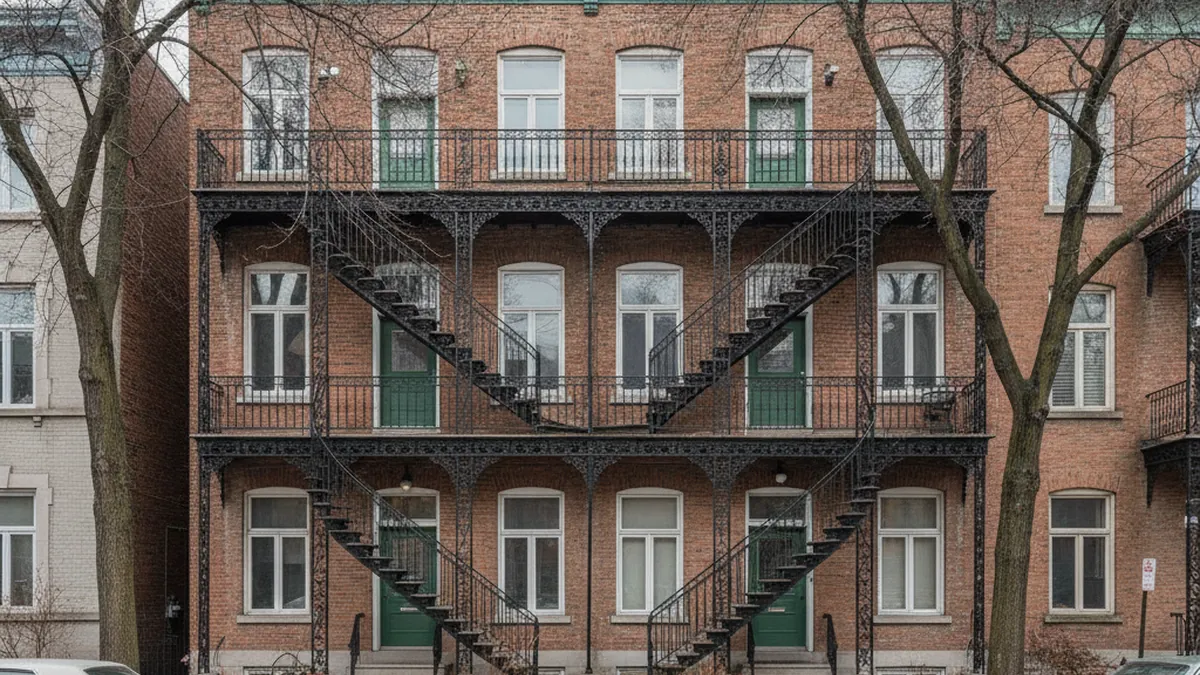
One of the most striking findings in the CORPIQ report concerns the very structure of Quebec's rental housing stock: a feature with no equivalent on the continent.
80% of apartments in 3–5 unit buildings are in Quebec
Quebec is home to 80% of all Canadian rental apartments located in buildings with 3 to 5 units. In other words, the plex — that familiar architectural form with its exterior staircases and brick facades — is almost exclusively Quebec-specific on a Canadian scale.
This concentration is explained by the urban history of Montreal and the cities of the North Shore: a real estate development built on human-scale ownership, where the small landlord living in their own plex while renting the other units became the dominant model. This model has produced a rental stock of remarkable quality and density — more than 38.2% of Quebecers are renters, the highest proportion in Canada.
The flip side of this historical reality: 60.3% of Quebec rental units were built in 1980 or earlier. The housing stock is aging. For owners of plex properties on the North Shore who are considering renovation work, this structural reality argues for acting now rather than waiting — contractors in the region are working at full capacity, and construction costs are not coming down.
What do these numbers mean concretely for your plex on the North Shore?
North Shore cap rates of 4.8%–6.2% beat Montreal Island (3.5%–4.5%). The provincial median plex price is $685,000 (May 2026, +2% YoY). Inventories have dropped ~20% since January 2026 — persistent buyer pressure. These fundamentals confirm the North Shore as one of Quebec's most active and economically grounded multi-unit markets.
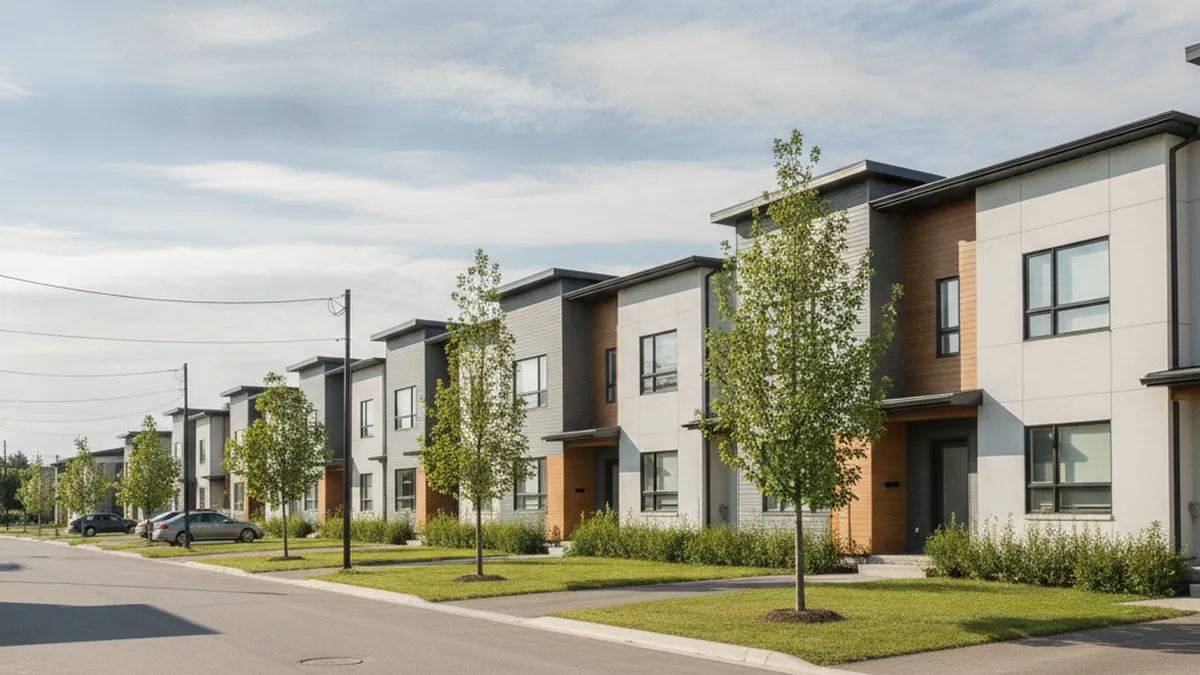
The national data from the CORPIQ report takes on concrete meaning when applied to the Quebec North Shore market. This territory — encompassing Laval, Terrebonne, Repentigny, Mascouche, Blainville, Boisbriand, Mirabel, and Saint-Jérôme — is one of the most active multi-unit markets in the province.
In May 2026, the provincial median price for plex properties stands at $685,000, up 2% year over year according to APCIQ. On the North Shore, per-door data illustrates the diversity of the market — which you can also explore via our plex prices by city (2026 map). And if you want to test your instincts, guess the price of real plex profiles in our interactive game:
| Area (North Shore) | Median price / door | Cap rate 2026 | Median rent 4½ |
|---|---|---|---|
| Laval | $240,000 – $285,000 | 4.9% – 5.6% | $1,350 – $1,550 |
| Blainville | $255,000 – $295,000 | 4.8% – 5.4% | $1,425 – $1,600 |
| Terrebonne / Mascouche | $210,000 – $250,000 | 5.3% – 6.0% | $1,225 – $1,425 |
| Saint-Jérôme | $210,000 – $245,000 | 5.4% – 6.0% | $1,175 – $1,350 |
| Mirabel | $220,000 – $260,000 | 5.2% – 5.8% | $1,250 – $1,425 |
| Saint-Eustache / Deux-Montagnes | $200,000 – $240,000 | 5.2% – 5.8% | $1,175 – $1,375 |
These returns — cap rates of 4.8% to 6.0% — are higher than those seen on the island of Montreal (3.5% to 4.5%). An income property on the North Shore therefore offers better immediate profitability, combined with solid appreciation potential fuelled by the region's demographic demand. Plex inventories on the North Shore have dropped by nearly 20% since the start of the year, signalling persistent buyer pressure.
"What this report demonstrates is that beyond their essential role in housing Quebecers, property owners are an economic engine present in every region."
— Éric Sansoucy, CORPIQ spokesperson, June 2026
How does political pressure compare with the economic reality of the rental market?
The political climate is tense (rent control, Bill 31, TAL delays, vacancy tax discussions) but economic fundamentals remain solid: 88% of Quebec renters report good relations with their landlord, demand is structural, and the CORPIQ report provides hard data to resist panic selling. The right move is choosing the right timing and buyer — not reacting emotionally.
The CORPIQ report arrives in a politically tense environment for owners of plex and income properties in Quebec. Recent years have brought a series of measures: rent control, lease transfer regulations, extended delays at the Administrative Housing Tribunal, discussions on vacant unit taxes.
Faced with this pressure, some multi-unit owners on the North Shore are considering liquidating their real estate holdings. The CORPIQ report gives them a solid economic argument to resist that temptation: your plex generates measurable, documented economic value. The political climate may shift — but the economic fundamentals remain solid.
As the report notes, the Quebec rental housing model is described as a "collective asset" whose preservation is in everyone's interest. The relationship between renters and plex owners is in fact very positive: 88% of Quebec renters report having good relations with their landlord. This figure contradicts the narrative of a structural opposition between the two parties.
For the rational investor on the North Shore, the correct reading of the current context is not "sell in a panic" but "choose the right timing and the right buyer."
What the CORPIQ report actually says about regulation
The report highlights that the regulatory and fiscal environment can slow renovation investments. With 60.3% of Quebec's rental stock built before 1980, plex owners who do not invest in bringing their properties up to standard risk seeing their income property lose value. The window to act at reasonable cost is open — but it won't be forever.
How to maximize your plex's value in the 2026 economic context?
Four levers: (1) document maintenance history and rental income to anchor value; (2) monitor North Shore municipal reassessments and use CORPIQ data in representations; (3) assess MLI Select refinancing eligibility for 5+ unit properties; (4) consider a direct sale — ImmoMulti delivers a written offer within 48 hours, no broker, no commission.

The CORPIQ 2026 report gives Quebec plex owners a precise strategic framework. If you own an income property on the North Shore — whether in Laval, Terrebonne, Repentigny, Blainville, or Saint-Jérôme — here is how to position yourself intelligently.
1. Document the local economic contribution of your plex. If you are considering selling your multi-unit property, a sophisticated buyer values well-documented properties: maintenance expenses, renovations completed, rental history. This documentation is now more important than ever, as it anchors value in verifiable facts — exactly what the CORPIQ report calls for across the sector.
2. Monitor fiscal changes at the municipal level. Several North Shore municipalities are reassessing their property assessment rolls in 2026–2027. The economic value of the plex sector documented by the CORPIQ report can support property owners' representations before local authorities.
3. Assess the refinancing potential. With cap rates of 5.0% to 6.2% on the North Shore, income properties provide a solid basis for structuring a refinancing — notably through CMHC's MLI Select program if your property has five units or more. Our complete guide on MLI Select financing 2026 details the current program conditions.
4. Consider a direct sale if the timing is right. On the North Shore, the traditional selling timeline for a plex is 90 to 180 days through a broker. ImmoMulti buys directly, with no brokerage fees, and a written offer within 48 hours. In a market where inventories are declining, the direct price may be higher than anticipated. To discuss your specific situation, contact our team — no obligation.
The CORPIQ 2026 report does not change the fundamentals of the plex market on the North Shore. It validates and documents them. For owners who already knew their income property was a solid asset, this report is a welcome confirmation.
Informational content only. Does not constitute tax or legal advice. Consult a qualified professional for your personal situation.
Frequently asked questions

