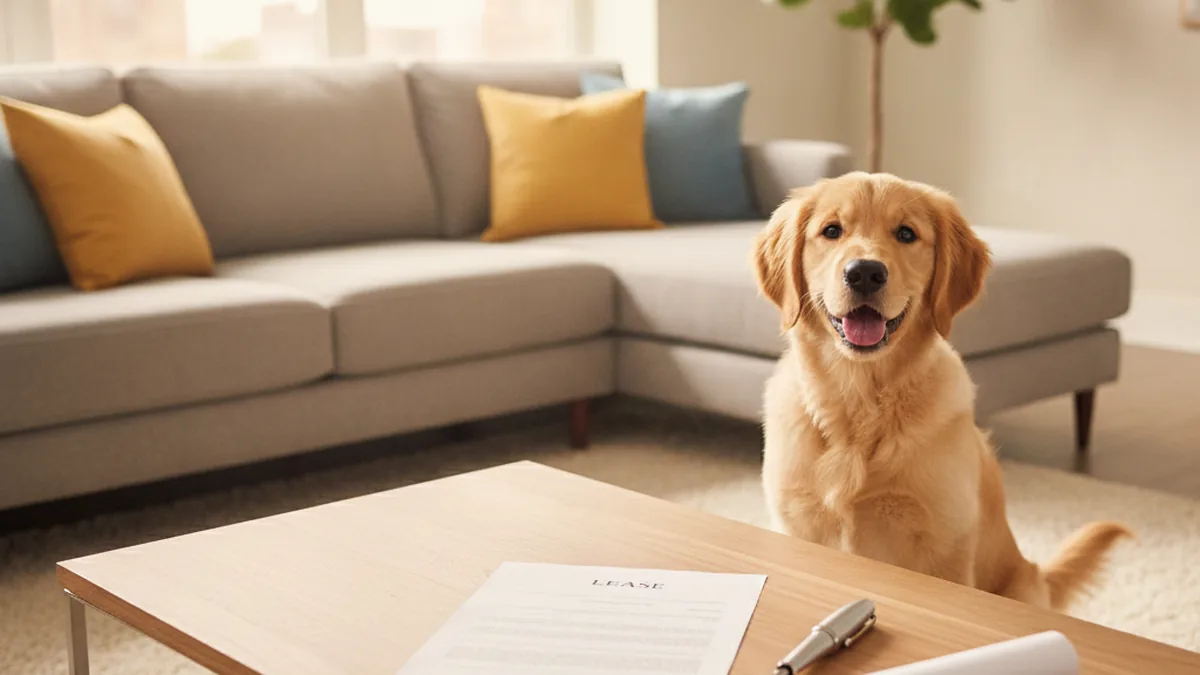
Few lease clauses are as emotional as the famous "no pets." And since a decision from Quebec's Administrative Housing Tribunal (TAT, or TAL in French) struck one down as abusive in March 2026, the question is burning across Quebec real-estate investor groups: should you keep refusing pets in your plex, or open the door? Here is our take, from the perspective of a North Shore plex owner.
Opinion column by the ImmoMulti Team. The facts are sourced; the opinions are our own.
🔥 Our sharp take
Allow pets in your plex — especially cats — and frame them intelligently instead of banning them. We'll say it plainly: in the 2026 market, on the North Shore, a total pet ban is bad business. It cuts you off from a huge slice of the tenant pool, it is aging badly in law, and it doesn't even protect you better than the general legal regime does. A clear, reasonable pet policy beats a rigid ban on almost every front.
Why allowing pets widens your tenant pool
Let's start with the most down-to-earth argument: money. According to a Léger survey conducted for Vivre en Ville, roughly 69% of Quebec tenants are already allowed to keep a pet. In other words, the market norm has already flipped: the landlord posting "no pets" is now swimming against the current and voluntarily shrinking their candidate list.
In a North Shore plex — Terrebonne, Blainville, Saint-Eustache, Mascouche — where every week of vacancy costs hundreds of dollars, refusing pets means refusing solvent tenants. Reported data shows around 70% of landlords accept cats but only 25% accept dogs: there is a real competitive edge in landing on the right side, especially for cats, whose risk is low.
Source: Léger survey for Vivre en Ville, reported by Le Devoir and Les Affaires.
A tenant with a pet also tends to stay longer: finding housing that accepts their dog or cat is hard, so they don't move on a whim. Less turnover means fewer units to refresh, less time spent searching for tenants, and precious income stability for a multi-unit owner.
The no-pets clause is losing ground at the TAT
Here is the second pillar of our position, and the newest. On March 12, 2026, the TAT annulled a lease clause banning pets, ruling it abusive and contrary to the Charter of Rights, in a dispute (Desjardins v. Amilis) where the Montreal SPCA was granted intervener status. The judge notably found that the current legal framework already protects the landlord adequately in cases of damage or disturbance — making a blanket ban disproportionate.
"The judge concluded these clauses are unreasonable, abusive and contrary to several fundamental rights… the current legal framework already adequately protects owners in case of damage or disturbance caused by an animal."
— Summary of the TAT decision of March 12, 2026, as reported by Le Devoir and the Montreal SPCALet's be honest about scope: this decision, in law, applies only to the lease in dispute, and it is under appeal before the Court of Quebec. A "no pets" clause therefore remains, for now, permitted and valid in Quebec. But the judge's reasoning is broad: it opens the door for other tenants to successfully challenge their clause, especially where no nuisance is proven. Staking your management on a legally weakened clause is building on sand.
Sources: Le Devoir — TAT decision on pets; Éducaloi — Pets in Rental Housing; TAT — summaries of pet decisions.
More from our owner-side cluster: TAT delays when a tenant stops paying and the habitability and maintenance burden — two files where, as here, the legal regime already frames your rights and obligations.
Managing risk intelligently: noise, damage, insurance
Allowing pets doesn't mean giving up control. It means replacing the ban with a framework. Here's how a savvy plex owner protects themselves:
- A written pet policy in the lease: number and size of animals, cleanliness obligations, waste management in common areas, zero tolerance for repeated noise.
- Require the tenant to carry liability insurance: damage a pet causes inside the unit is first the tenant's responsibility and their tenant insurance, not your building policy.
- Document the move-in condition (photos, video) to support any future damage claim at the TAT.
- Adapt by unit: a cat upstairs, a large dog rather on the ground floor with outdoor access, depending on your plex's soundproofing.
Warning: no pet deposit in Quebec
Unlike other provinces, a Quebec landlord cannot require any security deposit or rent advance for a pet. Your protection comes from the lease, the tenant's insurance and recourse to the TAT for actual damage — never from money held up front.
🎭 The devil's advocate
Let's be fair to the other side, because it is not without arguments. The landlord who refuses all pets isn't wrong to be wary. A poorly trained dog can wreck a hardwood floor, a cat can leave a unit with stubborn odours that are expensive to neutralize, and a noisy animal can trigger a cascade of neighbour complaints — in a plex, a single problem unit poisons the whole building. And as we saw, you cannot require any deposit: if the tenant leaves behind $4,000 in damage and vanishes, your recourse at the TAT can be slow and uncertain.
What's more, CORPIQ itself defends the landlord's right to decide. Its spokesperson Éric Sansoucy notes that landlords "are not there to break relationships" between people and their animals, while firmly opposing any law that would forbid refusing a pet: per CORPIQ, the owner must keep their decision-making power. An owner of a small, freshly renovated plex, who lives in one of the units, can legitimately want to protect their investment and their peace. That's not malice — it's prudence.
Source: CORPIQ's position and survey reported by Les Affaires.
The verdict
After weighing both camps, our position holds: the total ban is a relic. Frame instead of forbid. Say yes to cats almost systematically — the risk is low and the pool is huge. Assess dogs case by case: size, breed, unit, soundproofing. And armour yourself through the lease (written policy, required liability insurance, documented move-in condition) rather than through a "no pets" clause the TAT increasingly views sideways.
The 2026 context is clear: the blanket clause costs you tenants, ages badly in law, and doesn't protect you more. A North Shore plex owner who plays the pet card wisely rents faster, keeps tenants longer and lands on the right side of case law. If, at the end of this reflection, property management wears on you anyway, know that a direct sale remains an option — and for that too, better to decide before fatigue decides for you.
ImmoMulti: direct buyer of multi-unit buildings on the North Shore
Tired of management — pets, the TAT, upkeep? ImmoMulti buys plexes and multi-unit buildings across the North Shore, no broker, no commission, with an offer in 48 hours. Get a confidential proposal. See also our off-market deals.