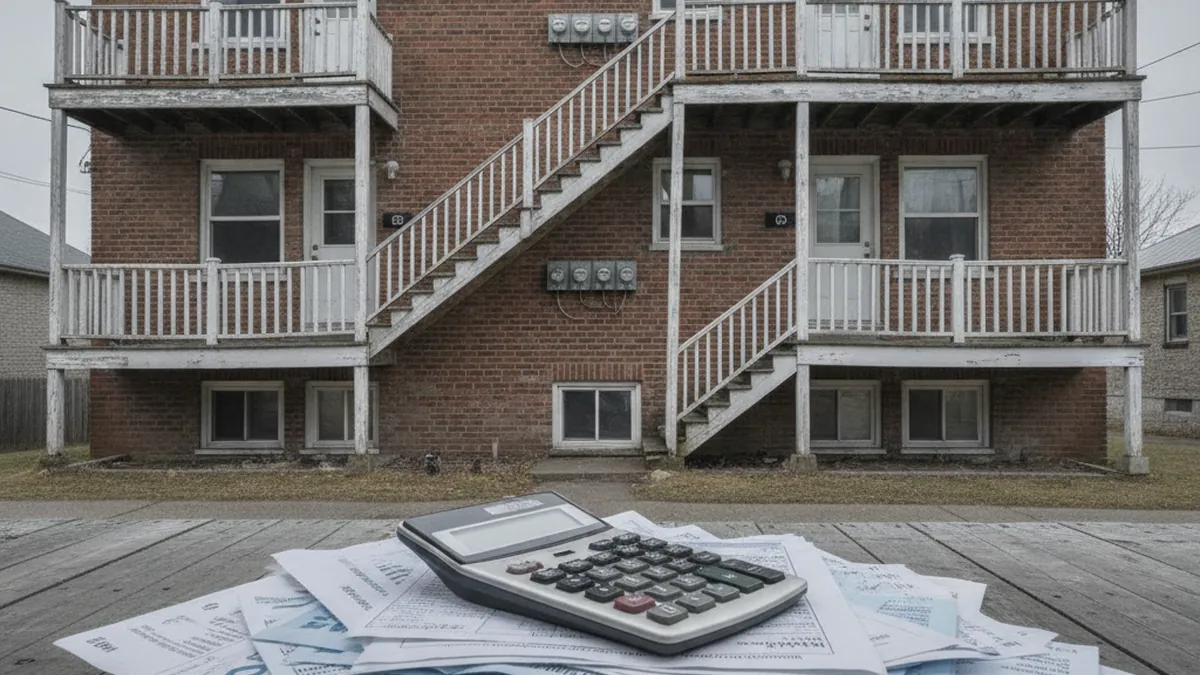
A CORPIQ/Aviseo study reported in La Presse on June 17, 2026 is clear: 1 in 4 small rental properties in Quebec is now operating at a deficit. Ownership costs have risen +49% since 2019. Renovation financing is up +186%. The Rental Housing Tribunal (TAL) rate increases? 3.1% per year on average. The scissors are wide open — and the small North Shore plex owner is caught in the blades.
Opinion column by the ImmoMulti Team. Statistics are sourced; interpretations are our own. The opposing view is presented in the "Devil's advocate" section below.
🔥 Our sharp take
Here is our thesis: Quebec housing policy was designed to protect tenants — a legitimate goal — but it has been applied without any mechanism to balance the equation for small landlords. The result is a structural imbalance that gradually makes plex ownership untenable, particularly for the individual owner who lives in their building or who bought it as a retirement investment. We do not say this to defend speculators or neglectful landlords. We say it because the numbers say so — and because the political discourse remains largely silent on this side of the story.
ImmoMulti is a direct buyer of multiplex income properties on the North Shore. Every week, we speak with owners who have reached the point of no return: a property that is technically worth something, but that generates a monthly cash-flow deficit they can no longer absorb. This column is for them.
Capped revenues, uncapped costs

The heart of the problem is simple to state, even if its consequences are complex. The TAL system — the Rental Housing Tribunal — is supposed to set a "fair" annual increase for rents. In theory, it takes into account changes in municipal taxes, energy costs, insurance and maintenance. In practice, the increases authorized since 2019 have averaged 3.1% per year, while general inflation has reached +17% over the same period and ownership costs have exploded by +49%.
The owner who bought a North Shore triplex in 2019 with regulated leases now finds themselves in a vice: revenues are rising at the pace of a TAL calculation that does not reflect reality, while their costs — insurance, property taxes (inflated by the exploding assessment roll), financing, renovation — are following a completely different curve. It is not mismanagement. It is a structural equation that no longer holds.
The scissors effect in clear numbers
- +49% — increase in plex ownership costs since 2019 (CORPIQ/Aviseo)
- +186% — increase in renovation financing costs since 2019
- +17% — general inflation (CPI) since 2019
- 3.1%/year — average TAL increase rate in recent years
"I bought my duplex to ensure my retirement. Today I'm losing money every month. I can't refinance to do the work because the building is already at its lending limit. And I can't raise the rent more than the TAL allows, even though my insurance doubled in two years."— Alicia Gravel, owner of 2 small buildings in Montreal (La Presse, June 17, 2026)
A regulation that no longer makes sense
Beyond the numbers, the regulatory framework itself has become absurd for the small owner. Some examples:
- Eviction for major repairs (renovation/repossession): a legitimate owner who wants to renovate a unit to keep it inhabitable must navigate a process at the TAL that can take months, with the constant risk of a lawsuit for "bad faith" eviction. The financial and administrative deterrent discourages maintenance.
- Habitability: the owner must maintain the building at an ever-higher standard — under penalty of fines, as our column on habitability explains — but their revenues are capped. It is an obligation without the means to meet it.
- CCQ on small buildings: certain construction standards normally reserved for large commercial buildings apply to renovations on 5-unit plexes. The cost of a properly performed renovation — mandatory CCQ workers, insurance, permits — can be two or three times higher than an equivalent project in single-family housing.
Each of these regulations has a justification in isolation. Together, they form a trap for the small owner who is not a fund, does not have a legal team, and cannot absorb the cumulative costs.
Deal Analyzer: is my plex still worth holding?Calculate cap rate, DCR and NOI to decide: keep, renovate or sell. →Assistance programs that miss the mark
Yes, programs exist: RénoLogis, Rénoclimat, TECQ, various municipal programs. On paper, they address the renovation cost problem. In practice, the feedback from small owners is consistent:
- Administrative complexity that requires a consultant to navigate — a cost in itself.
- Processing times of 6 to 18 months, during which work cannot begin or projects stall.
- Subsidy amounts that cover 15 to 30% of actual costs, requiring the owner to find the rest.
- Eligibility conditions that exclude many buildings (age, type of work, income of occupants).
The result: the owners who most need them — small owners in deficit — are often the least able to navigate the system. A large real estate company has a team for this. The retired owner-occupant of a Terrebonne triplex does not.
What the government could do tomorrow morning
- Reform the TAL's rent calculation method to reflect actual ownership cost increases, not just a few standard items
- Exempt small buildings (4 units and fewer) from certain CCQ requirements to halve renovation costs
- Simplify RénoLogis and other programs into a single window with a 90-day decision commitment
- Reduce TAL processing times for evictions for major repairs to remove the financial deterrent
🎭 Devil's advocate
Let's be honest: the other side has solid arguments.
First, tenants are also suffering from a housing crisis. Rents have soared in open-market units. Many tenants — especially in major cities — spend 40 to 50% of their income on housing. Freezing or capping rents protects the most vulnerable. Loosening the system more aggressively could accelerate gentrification.
Second, not all owners are in deficit. Many small plex owners bought decades ago at prices incomparable to today's. Their financing costs are low, their equity is massive. Complaining that their 2019-acquired building is less profitable than expected is legitimate, but it does not necessarily mean the system is broken — it may mean that some acquisitions were made with overly optimistic assumptions.
Third, the renoviction risk is real. Without strong TAL protections, some owners would use "renovation" as a pretext for evicting long-term tenants to re-let at a much higher market price. The process, even if slow, protects against abuse. And the housing shortage means that the costs of a poorly managed exit can be catastrophic for a family. The balance between protection and flexibility is genuinely difficult to find.
Finally, assistance programs exist — and while imperfect, they are available to those who take the time to navigate them. Dismissing them entirely because they are complex is partly a question of will and preparation.
The verdict
After weighing both sides: the system is not evil — it is out of alignment. Tenant protection is a legitimate social objective. But a protection system that drives small individual owners toward the exit does not protect tenants in the long run: it concentrates the housing stock in the hands of funds and large operators who have no incentive to keep rents reasonable.
The small North Shore plex owner is not the problem. They are often the solution — a local owner, vested in their community, who maintains their building and deals directly with their tenants. When the equation becomes untenable, they sell. And it is rarely another small owner who buys. It is a fund, a flipper, or an operator who sees in the deficit a restructuring opportunity.
If you are a small owner on the North Shore and your plex is generating a cash-flow deficit, you have three main options: fight to refinance while the credit window is still open, wait for a regulatory change that may be slow to come, or sell at the right time — before the deficit forces a distress sale. ImmoMulti buys directly, without broker, without commission, without the usual conditions. An offer within 48 h.
Sell your North Shore plex, on your timelineDirect offer within 48 h, no broker, no commission. Even a property operating at a deficit. →