
Quick answer
Quebec income-property insurance premiums have risen +9% per year on average over the past five years — doubling in 8 years, quadrupling in 15. Insurers are simultaneously raising deductibles and cutting coverage. The upside: documented premium increases can justify rent increases above the TAL's 3.1% base rate. If costs are eroding profitability, ImmoMulti buys multiplexes directly — no broker, offer in 48 h.
ImmoMulti buys plexes directly on the North Shore, and in every property file reviewed in 2026, insurance premiums have become a line item that jumps out: +9% per year on average in Quebec over the past five years, according to La Presse (June 16, 2026). At that pace, a premium doubles in 8 years and quadruples in 15 years — a $3,000 premium on a quadruplex today could reach $6,000 by 2034. For a duplex, triplex, or quadruplex owner on the North Shore whose rents are governed by the TAL (Quebec's rental tribunal), this runaway expense is eating directly into net income. But the premium hike is only half the problem: insurers are also cutting coverage, excluding risks, and raising deductibles. Here is what that concretely changes for your income property on the North Shore — and the often-overlooked link between your premiums and the rent increase you can justify before the TAL.
By how much have insurance premiums risen — and why isn't it slowing down?
+9% per year on average over the past five years in Quebec (La Presse, June 16, 2026). The average Quebec home insurance premium reached $1,103 in 2024; rental building policies run higher. At 9%/year, a premium doubles in 8 years and quadruples in 15 — a $3,000 quadruplex policy today could reach $12,000 by 2041.
The picture is clear and well documented. According to La Presse, which devoted a full feature to home insurance on June 16, 2026, premiums have risen by an average of 9% per year over the past five years, with some years seeing double-digit increases. At that pace, the math is unforgiving: a premium doubles in 8 years and quadruples in 15 years.
To put that in perspective, the average home insurance premium in Quebec reached $1,103 in 2024. That figure applies to a personal residence — but an income property is insured differently, as a rental building, with a premium that is generally higher and subject to the same upward slope. For the owner of a plex on the North Shore, building insurance typically runs into the thousands of dollars per year — and climbs at every renewal.
Source: La Presse — "Tout savoir sur l'assurance habitation" (June 16, 2026)
Why are insurers raising premiums AND cutting coverage at the same time?
Climate change is driving record insured losses — $8.5B+ in weather-related damages in Canada in 2024. To limit exposure, insurers raise premiums while also excluding risks (sewer backup, flooding), raising deductibles, and withdrawing from high-risk zones. Plex owners pay more for coverage that is sometimes thinner than before.
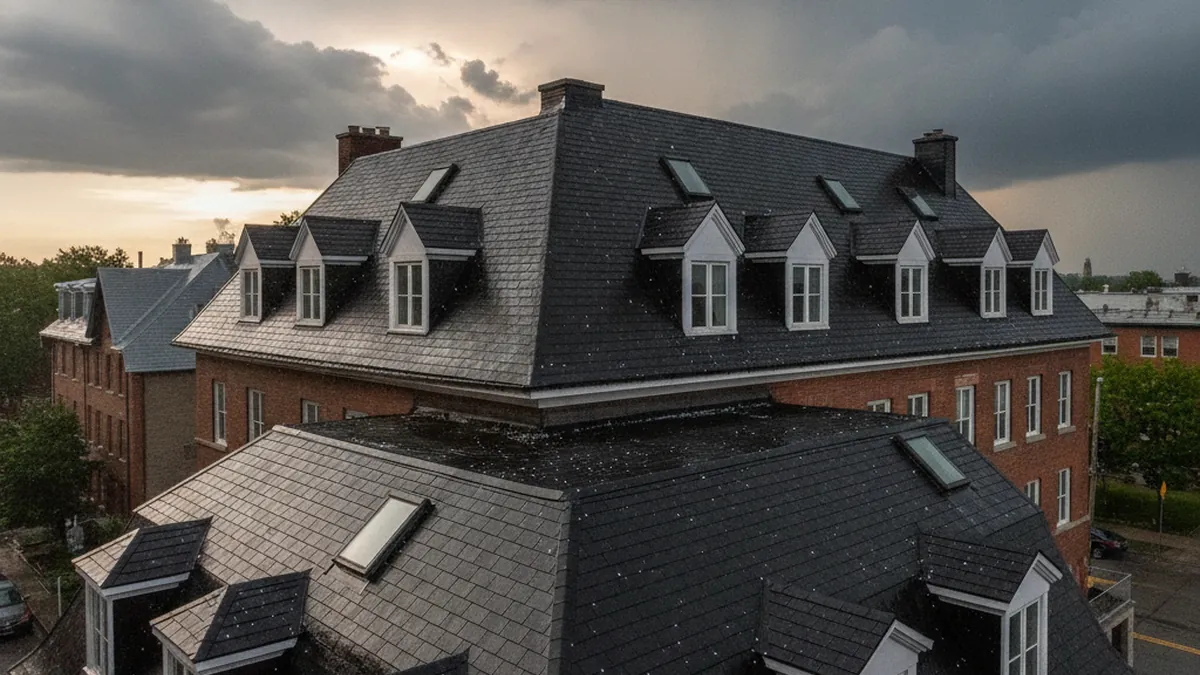
What is behind this acceleration? The answer lies largely in climate. Climate change is driving a surge in extreme weather events: wildfires, hail storms, floods, and torrential rain. According to Radio-Canada and Le Devoir, insured weather-related damages in Canada exceeded $8.5 billion in 2024 (and over $9 billion in total insured losses) — a record that weighs directly on pricing across the entire market.
Faced with this pressure, insurers are not simply raising premiums. They are actively reducing their exposure: increasingly excluding certain risks, raising deductibles, and outright withdrawing from areas they deem too risky. For the owner of a multiplex, this means paying more for coverage that is sometimes thinner than it used to be.
Warning: less coverage for a higher price
The premium hike is only half the problem. Insurers are increasingly excluding certain risks (sewer backup, repeat water damage, flooding in sensitive zones), raising deductibles, and pulling back from high-risk areas. Before renewing your North Shore plex policy, read the exclusions carefully: a stable premium can mask gutted coverage.
Sources: Radio-Canada — home insurance, rates and coverage (2026) and Le Devoir — "Les assureurs en habitation augmentent leurs tarifs et réduisent leur couverture" (2026)
What will your insurance premiums cost in 2034 and 2041 if the trend holds?
At 9%/year compound growth: a $3,000 premium in 2026 becomes ~$6,000 in 2034 (8 years) and ~$12,000 in 2041 (15 years). For a North Shore quadruplex held long-term, insurance will approach the same budget weight as municipal taxes — a structural NOI erosion that must be factored into valuation.
The 9%-per-year trend is not an abstraction: it has a formidable compounding effect on an income property's budget. Below is a projection of a rental building insurance premium at the observed average rate, for a typical North Shore quadruplex.
| Year | Estimated annual premium (base $3,000) | Market benchmark |
|---|---|---|
| 2026 (today) | $3,000 | Starting point |
| 2034 (≈ 8 years) | ≈ $6,000 | Premium doubled |
| 2041 (≈ 15 years) | ≈ $12,000 | Premium quadrupled |
The projection is intentionally illustrative — your actual premium will depend on the building's age, location, claims history, and existing protections. But the mechanics are universal: at 9% per year, the premium doubles in 8 years and quadruples in 15 years. For the owner of a plex or multiplex who holds the property for a decade or more, insurance moves from a secondary expense to a major budget line — on par with municipal taxes.
"At 9% per year, premiums double in 8 years and quadruple in 15 years."
— La Presse, "Tout savoir sur l'assurance habitation," June 16, 2026What is the real impact of rising insurance costs on your North Shore plex's profitability?
Insurance (+9%/yr), municipal taxes (rising after 2024–2026 reassessments), and maintenance costs are all moving up simultaneously while TAL-capped rents limit income growth. When three major expense lines rise together without a corresponding revenue lever, NOI compresses — and with it the property's cap-rate-derived resale value.

On the North Shore of Montreal — Terrebonne, Mascouche, Blainville, Boisbriand, Saint-Jérôme, Saint-Eustache, Deux-Montagnes — the surge in insurance premiums does not arrive in isolation. It is compounding the effect of significant property reassessments in recent years that have driven municipal taxes sharply higher, along with a general rise in maintenance and renovation costs. Three expense lines moving up simultaneously, while rental income remains capped.
Insurance occupies a place that is often underestimated within the net operating income (NOI) of a multiplex. Here is how it compares with the main operating expenses of a typical North Shore plex:
| Expense line | 2026 trend | Owner's control |
|---|---|---|
| Building insurance | +9%/yr on average | Low — shopping around and deductible adjustments only |
| Municipal taxes | Rising (2024–2026 reassessments) | Very low |
| Maintenance & renovations | Rising sharply | Medium — planning possible |
| Mortgage interest | Variable at renewal | Medium — refinancing |
The problem is structural: on these expense lines, the plex owner has very little room to manoeuvre, while rental income is capped by the TAL's methodology. When insurance premiums double over eight years without a corresponding rent increase, the NOI is squeezed — and with it the resale value of the property, which is calculated from that net income.
Can a rise in your insurance justify a rent increase above the TAL base rate?
Yes. The TAL's 2026 base rate is 3.1%, to which documented increases in the landlord's insurance premiums and municipal taxes are added on top. Keep every annual renewal notice: the dollar increase in your premium is a justifiable addition to your rent increase calculation — separate from the 3.1% reference rate.
Here is the angle that too many multiplex owners overlook: the increase in your insurance premiums is not just bad news. Before the TAL (Quebec's rental tribunal), the landlord's insurance is a justifiable expense that can support a rent increase above the base rate.
For 2026, the TAL recommends a base rate of 3.1%, to which amounts are added to offset increases in municipal taxes and the landlord's insurance premiums, as well as the cost of major work. In other words: if your building insurance premium has actually gone up, that documented increase can justify a rent increase beyond the reference rate — provided you keep your renewal notices and include it in your calculation.
We will not walk through the full TAL formula here — it is covered in detail in our guide to the new rent calculation method at the TAL for 2026. The key takeaway: a rising insurance premium is a piece of data you can and should use to align your rents with the reality of your costs.
Document your insurance for the TAL
- Keep every annual renewal notice for your rental building policy
- Note the premium amount for the previous year and the current year
- The actual increase (in dollars) is added on top of the 3.1% base rate in the TAL calculation
- Combine it with tax increases and the cost of major work to justify the total rent increase
Source: Le Devoir — "Les loyers devraient augmenter de moins de 3,1 % en 2026, selon le TAL"
How to respond concretely to rising insurance premiums on your multiplex?
Four levers: (1) shop through a P&C broker at renewal — price gaps between insurers are significant; (2) raise your deductible to lower the annual premium; (3) update high-risk systems (roof, plumbing, electrical) to reduce exclusions; (4) require tenant liability insurance in all leases. If cumulative costs make the property unprofitable, a direct sale to ImmoMulti recovers capital without waiting for the next premium shock.

You cannot control the underlying direction of the insurance market, but you do have concrete levers to protect the profitability of your North Shore plex.
Optimize your building insurance policy
- Shop through a property and casualty insurance broker: comparing multiple insurers at renewal can reveal significant price gaps from one company to the next.
- Adjust your deductible: a higher deductible lowers the annual premium. Weigh that saving against your actual exposure in the event of a claim.
- Update high-risk systems: a roof, plumbing, electrical panel, and heating system that are up to date can lower the premium and limit exclusions on your multiplex.
- Require proof of tenants' insurance for their personal property — separate from your building coverage.
Reassess the overall profitability of your income property
When insurance, taxes, and maintenance all rise together, it becomes essential to recalculate where your property stands. Our guide to calculating multiplex returns explains how NOI, the GRM, and the cap rate translate these expenses into real value. And if your numbers confirm that profitability is deteriorating despite your adjustments, it is worth reading our analysis of unprofitable plexes in Quebec in 2026: more than one in four is already operating at a loss.
Consider selling before the pressure gets worse
For some multiplex owners on the North Shore, the accumulation of increases — insurance, taxes, major repairs — tips a formerly profitable property into the red. In that case, selling before the NOI (and therefore the value) deteriorates further is a legitimate strategy. If you own a property in an area such as Terrebonne or elsewhere on the North Shore, a direct sale lets you recover your capital without waiting for the next premium shock.
ImmoMulti: direct buyer of multiplexes on the North Shore
If rising insurance premiums, taxes, and maintenance costs are making your plex less profitable than expected, we can submit a direct offer — no commission, fully confidential. No public listing, no broker, no obligation. Receive a proposal within 48 hours.


