
Quick answer
In Quebec, you cannot evict an occupant without a lease on your own — changing the locks or cutting services is illegal. The only lawful path is a ruling from the Rental Housing Tribunal (TAL) or, for a true squatter, the Court of Quebec/Superior Court. Eviction is then carried out by a bailiff, not the landlord. The full process can take several months.
A unit in your plex on the North Shore is occupied by someone who never signed a valid lease — or who refuses to leave after an agreement ended. Can you change the locks or cut the heat? No: in Quebec, any eviction carried out without a court order — most often from the Rental Housing Tribunal (TAL), sometimes from the Court of Quebec or the Superior Court for a true squatter — constitutes an unlawful act that can be turned against you. ImmoMulti, a direct buyer of multi-unit buildings on the North Shore, sees this regularly: a unit blocked by an occupant without rights can tie up your rental income for several months while you wait for a ruling and engage a bailiff. When rent has gone unpaid for more than 3 weeks, the TAL can order lease termination and eviction — but only upon the landlord's application. This guide explains the complete legal sequence, realistic timelines, and the options available to a multi-unit property owner who wants to recover their unit as quickly and safely as possible.
What is the crucial difference between an occupant without rights and a tenant with a lease?
A tenant with a lease has full Civil Code and TAL protections — automatic renewal, rent control, protection against eviction without prescribed legal grounds. An occupant without rights has never signed a valid lease (moved in uninvited, stayed after agreement ended, housed guest who refuses to leave). They have no tenant rights, but you still cannot remove them yourself — a court order is always required.

Before taking any action, you must properly characterize the situation, because the legal basis differs depending on the status of the person in your plex. Too many landlords confuse an occupant without rights with a tenant holding a lease — these are not the same rules.
A tenant with a lease is bound to you by a rental agreement. They benefit from the full protection of the Civil Code of Quebec and the TAL: automatic lease renewal, rent increase controls, and protection against eviction for owner occupancy and termination. You cannot simply remove them because you want to; a legally prescribed ground is required, and in many cases, a court ruling.
An occupant without rights, on the other hand, has never signed a valid lease. They may be someone who moved into a vacant unit, a former occupant who remained after an arrangement ended, or a housed guest who now refuses to leave. This person does not have a tenant's rights — but that does not give you the right to evict them yourself.
Never take the law into your own hands
Changing the locks, removing doors, cutting electricity or heat, or moving an occupant's belongings: all of these actions are prohibited, even when someone is occupying your unit with absolutely no legal right. They constitute unlawful acts that can expose you to legal recourse and undermine your own case. The only lawful exit runs through the courts.
Why is a TAL ruling the only legal path to eviction?
Quebec law prohibits any landlord from personally evicting an occupant — even one with zero legal right to be there. The TAL has jurisdiction when the occupant stems from a rental relationship. For a true squatter (no prior lease or rental link), the Court of Quebec or Superior Court applies. In both cases, a court order is mandatory before any eviction can proceed.

The rule is clear: to remove someone from your property, you need a court order — acting on your own is never an option. In the majority of cases — an occupant who stems from a rental relationship (former tenant who stayed, housed guest, verbal agreement) — the Rental Housing Tribunal (TAL) has jurisdiction and makes the ruling. No multi-unit property owner, however legitimate their situation, can bypass this step.
Important caveat: for a true squatter who never had a lease or any rental relationship with you (for example, someone who broke into a vacant unit), the TAL may not have jurisdiction. In that case, the recourse goes through the Court of Quebec or the Superior Court (action en réintégrande or action to evict an occupant without right or title). The principle remains the same — never act on your own — but the correct court depends on the occupant's exact status, which is why legal advice is valuable.
In practical terms, you must file an application with the TAL setting out the facts and requesting an eviction order (and, where applicable, payment of amounts owed). The tribunal convenes the parties, hears the evidence, and renders a decision. If that decision is in your favour, it is the legal instrument that will allow the eviction to proceed if needed.
The most common scenario in an income property is unpaid rent. When rent is more than three weeks overdue, the tenant risks lease termination and eviction, provided the landlord applies to the TAL. Once again, it is the tribunal that decides to terminate the lease and order eviction: the three-week threshold gives you no power to act unilaterally.
Authoritative source: Rental Housing Tribunal (TAL) — tal.gouv.qc.ca
What are the actual steps and timelines for evicting an occupant from your plex?
Five steps: (1) characterize the situation, (2) file a TAL application, (3) attend the TAL hearing, (4) receive the ruling, (5) a bailiff enforces it if the occupant doesn't leave voluntarily. There is no fixed total timeline — the process typically stretches several months, during which the unit generates no rent.

The process follows a specific sequence. Here are the main steps, from the initial finding to enforcement, along with the factors that affect timelines for a plex owner.
| Step | What it involves | Expected timeline |
|---|---|---|
| 1. Characterize the situation | Determine whether the person is an occupant without rights or a tenant with a lease, and gather evidence. | Variable — act without delay |
| 2. File an application with the TAL | Submit the eviction application (and claim for amounts owed if applicable) to the tribunal. | Depends on the tribunal |
| 3. TAL hearing | Parties present evidence; the tribunal hears the case. | Depends on the hearing schedule |
| 4. TAL ruling | The tribunal issues an order; it may be contested, extending the timeline. | After the hearing |
| 5. Enforcement by bailiff | If the occupant does not leave, a bailiff carries out the eviction. | Subject to availability + 5-day notice |
There is no single fixed timeline: everything depends on how long it takes to obtain a hearing, the complexity of the case, any potential contest, and the availability of a bailiff. In practice, for the owner of a small multi-unit building, the entire process can stretch over several months — that many months during which the unit generates no income while costs continue to accrue.
Who can actually carry out an eviction, and when can a bailiff intervene?
Only a licensed bailiff/process server can physically enforce an eviction order — the landlord can never act personally, even with a ruling in hand. The bailiff must serve a 5-day execution notice. There is no Quebec "winter moratorium": the only restricted period is December 24 to January 2 plus statutory holidays (Code of Civil Procedure, s. 692).

Obtaining a favourable TAL ruling does not mean the occupant will disappear overnight. If they refuse to leave voluntarily, a bailiff / process server must carry out the eviction by enforcing the ruling. The plex owner can never substitute for them, even armed with the order.
An important point that is often overlooked: contrary to a widespread belief, Quebec has no winter moratorium and no ban on evictions on July 1st (the "winter truce" is a French concept, not a Quebec one). Under section 692 of the Code of Civil Procedure, the only period during which a bailiff cannot execute an eviction is from December 24 to January 2 (as well as statutory holidays). The bailiff must also serve an execution notice at least 5 days before proceeding. If your ruling comes close to the holiday season, you should plan for an additional delay.
Sources: Rental Housing Tribunal — Enforcing a Decision; Code of Civil Procedure, s. 692.
"As long as the bailiff has not enforced the ruling, the occupant remains on the premises — and a landlord who tries to speed things up on their own is exposed to far greater trouble than the delay they were trying to avoid."
— General principle of Quebec rental law; to be verified with legal counselIn other words, patience and procedural rigour are your best allies. Every shortcut attempted outside the legal framework risks backfiring.
Does Bill 31 change the eviction rules for an occupant without a lease in your plex?
Not directly. Bill 31 targets evictions of lease-holding tenants: it shifts the burden of proof onto landlords, removes deemed acceptance of eviction notices, and requires compensation of 1 month's rent per year of occupancy (min. 3, max. 24 months). An occupant without a valid lease is NOT entitled to Bill 31 eviction compensation — but Bill 31 does make evicting actual tenants considerably heavier.
Bill 31 on housing, adopted in Quebec, amended several rules governing tenant evictions. It is essential to understand its scope clearly, because it targets tenants with leases, not occupants without rights.
Among its effects on the eviction of lease-holding tenants:
- It shifts the burden of proof in evictions onto the landlord.
- When a tenant does not respond to an eviction notice, that silence is no longer treated as default acceptance.
- A landlord who carries out an eviction must compensate the tenant by one month's rent per year of continuous occupancy (minimum 3 months, maximum 24 months).
A distinction not to confuse
The compensation provisions under Bill 31 apply to evictions of tenants with leases, not to occupants without rights. A person occupying your unit without a valid lease is not entitled to the eviction compensation under Bill 31. This law therefore creates no new compensation obligation toward an occupant without rights — but it does, in parallel, make the eviction process heavier for your actual tenants. Bill 31 also introduces a major change regarding lease assignment: a landlord can now refuse an assignment without giving a reason, which releases the outgoing tenant and allows re-renting at market price.
This distinction is critical: a multi-unit property owner who wants to recover a unit from a tenant in good standing (through eviction for owner occupancy or lease termination) follows a completely different path — and faces very different financial obligations — than one who needs to remove an occupant without rights.
Sources: Radio-Canada — "Bill 31 on housing is finally adopted"; Le Devoir — "What will be the consequences of adopting Bill 31"
What are your concrete options as a plex owner on the North Shore facing this situation?
Three options: (1) initiate TAL proceedings immediately with legal counsel and follow the process rigorously; (2) document everything — agreements, non-payment, condition reports — to build a strong TAL file; or (3) sell your plex as-is to ImmoMulti — we buy multi-unit buildings on the North Shore including those with complex tenancy situations, offer within 48 hours, $0 commission.
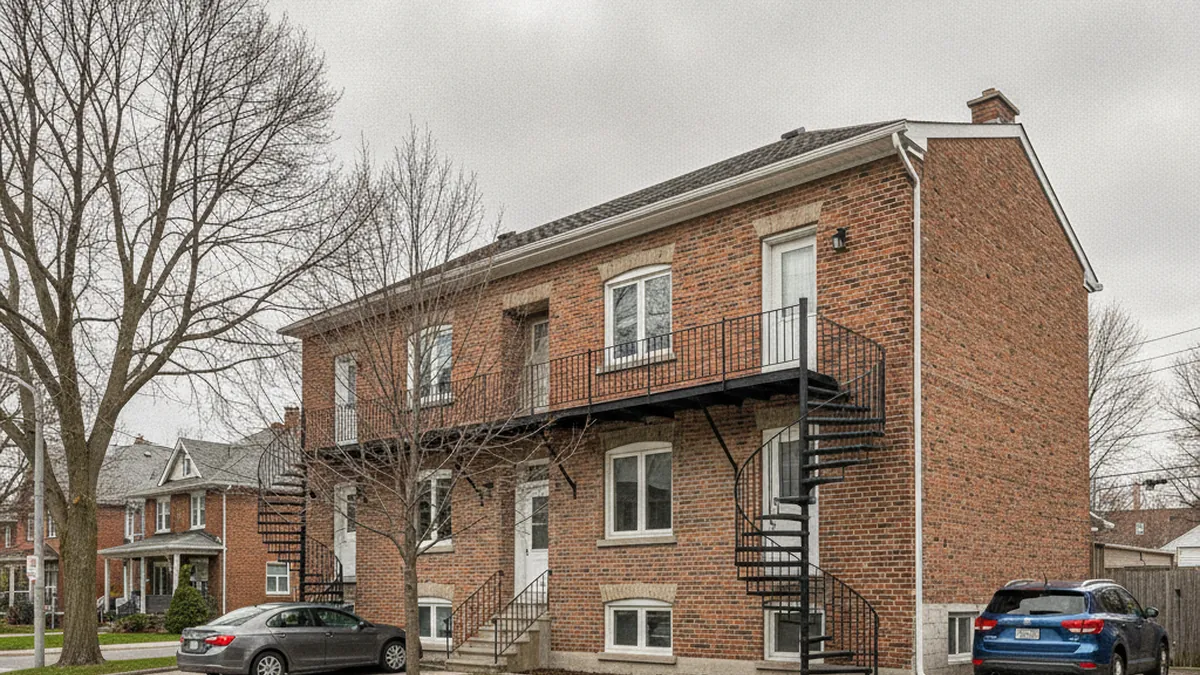
An occupant without a lease in a duplex, triplex or fourplex on the North Shore of Montreal — Terrebonne, Mascouche, Blainville, Boisbriand, Saint-Jérôme, Saint-Eustache, Deux-Montagnes — is not just a legal headache. It is a direct financial burden: a blocked unit, absent rental income, and costs that keep running.
Engage the process and follow the legal framework
The first option, and often the right one, is to initiate the TAL proceedings without delay, ideally with the guidance of legal counsel. The longer you wait to characterize the situation and file your application, the longer the overall timeline grows. Throughout the process, strict adherence to the legal framework protects your rights as a multi-unit property owner.
Document and preserve your remedies
Keep all useful evidence: agreements, communications, proof of non-payment, condition reports. This solid file is what will make the difference before the TAL, whether the person is an occupant without rights or a tenant whose lease you are seeking to terminate for unpaid rent.
Sell your property as-is, without waiting for the outcome
Some owners have neither the time nor the energy to carry an eviction proceeding through several months. On the traditional market, a unit occupied without rights drives away buyers and complicates financing. This is precisely the type of situation where a direct sale makes the most sense: ImmoMulti buys plex and multi-unit buildings on the North Shore as-is — including with a complex tenancy situation — with no broker, no commission, and an offer within 48 hours.
ImmoMulti: direct buyer of multi-unit buildings on the North Shore
An occupant without a lease, a tenant who has stopped paying, an active TAL file? We can submit a direct offer on your income property, with no commission and in full confidentiality. No public listing, no broker, no obligation. Receive a proposal within 48 hours.
If your situation revolves more around unpaid rent, our guide unpaid rent: sell your plex or wait? details the profitability calculation in that context. And if you are looking to recover a unit from a lease-holding tenant, eviction for owner occupancy on the North Shore follows very different rules from evicting an occupant without rights — in some cases, negotiating a cash-for-keys buyout to have the tenant vacate voluntarily can be faster than a months-long tribunal process. Whatever your situation, you can also choose to sell your income property quickly rather than absorbing months of uncertainty.


