
In the Laurentides, the welcome tax uses the same provincial scale everywhere up to $500,000 (0.5% / 1% / 1.5%), but several municipalities — including Mirabel, Deux-Montagnes and Saint-Eustache — apply a municipal rate of 3% on the excess. On a $2,000,000 income property, this gap represents more than $22,000 more depending on the city chosen. Property taxes also vary from one municipality to another and are part of the annual operating expenses to integrate in any yield analysis. This guide first presents the provincial scale common to all Laurentides cities, then details how upper brackets diverge city by city, with a worked example on a $2,000,000 property in two scenarios. All rates are provided as an indication (2026): always verify exact figures with the relevant municipality before signing.
Important notice
The rates and brackets cited here are provided as an indication (2026). The base land transfer tax scale is provincial, but each city sets its own property tax rates and may increase the upper brackets of the welcome tax. Always verify exact figures with the relevant municipality before any decision. This guide is informational and does not replace advice from a notary or tax accountant.
What is the welcome tax and how does it work in the Laurentides?
The "welcome tax" is the popular nickname for land transfer tax. It is a municipal tax required each time a property changes hands in Quebec. Despite its name, it has nothing to do with any former minister named Bienvenue: it is simply a source of revenue for cities, charged to the buyer.
Two key points for an income property:
- The buyer pays, never the seller. When the property is acquired by multiple persons, they are jointly responsible.
- The tax base is the highest of the price paid and the standardized value of the property in the assessment roll. For a multiplex sold above its municipal assessment, it is generally the sale price that serves as the base.
The bill typically arrives within weeks or months of the transfer, and the tax is payable within 30 days. Some Laurentides cities now allow instalment payments (two or four payments depending on the municipality).
What is the base Quebec welcome tax scale?
The Act Respecting Duties on Transfers of Immovables sets a base scale that applies throughout Quebec, therefore in all Laurentides cities. The thresholds are indexed annually; here are the brackets in effect as an indication for 2026:
| Tax base bracket | Rate |
|---|---|
| $0 to $62,900 | 0.5% |
| $62,900 to $315,000 | 1.0% |
| Above $315,000 | 1.5% (provincial ceiling rate) |
Source: brackets set by the Act Respecting Duties on Transfers of Immovables (CQLR c D-15.1) and the respective municipal by-laws of Laurentides cities.
The calculation is progressive by bracket: each portion of the price is taxed at its own rate, like income tax. The crucial nuance for an income property, often of high value: 1.5% is the provincial ceiling, but above $500,000 a municipality may set a higher rate, up to 3%. This is where the Laurentides ceases to be uniform — and several cities in the region do apply that 3%.
How does the welcome tax vary from city to city in the Laurentides?
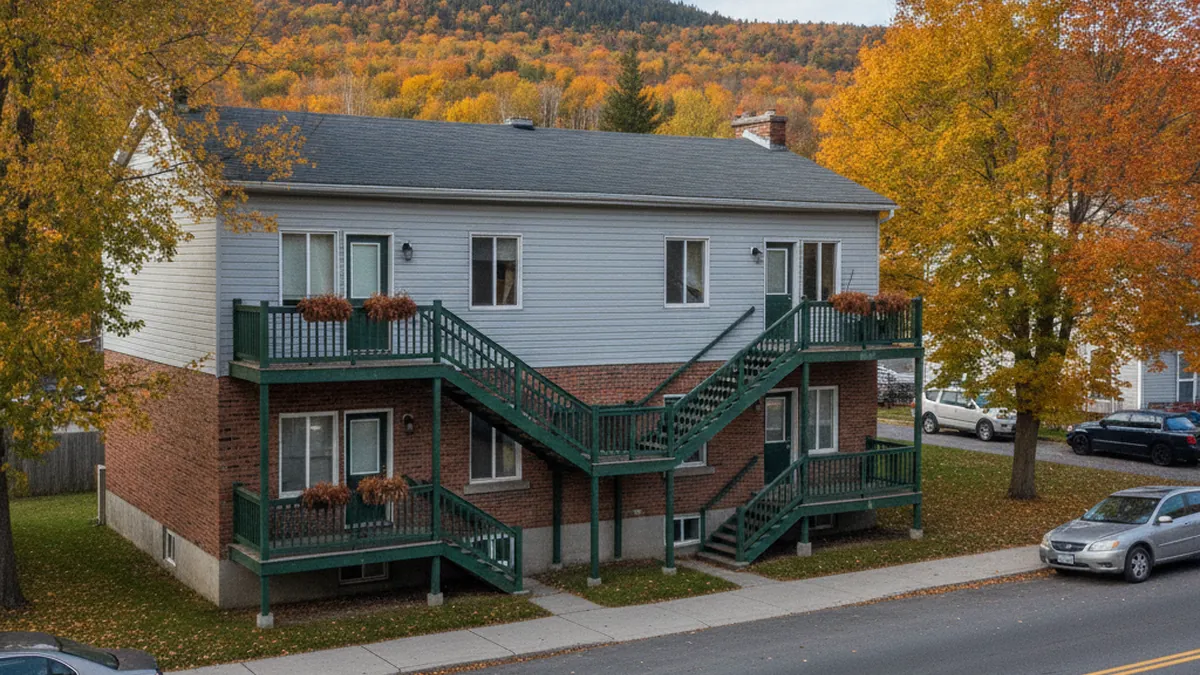
All Laurentides cities apply the three base brackets above up to $500,000. What differs is the portion above $500,000, where the law allows a higher rate (up to 3%). Several cities in the region have adopted this maximum of 3%; others have opted for intermediate tiers (2% or 2.5% between $500,000 and $750,000, then 3% beyond). Here is an indicative comparison (2026) based on published municipal scales; always confirm the exact figure with the targeted city.
| City (Laurentides) | $500,000 to $750,000 | Above $750,000 |
|---|---|---|
| Mirabel | 3.0% | 3.0% |
| Saint-Eustache | 3.0% | 3.0% |
| Deux-Montagnes | 3.0% | 3.0% |
| Rosemère | 3.0% | 3.0% |
| Sainte-Thérèse | 3.0% | 3.0% |
| Blainville | 1.5% | 3.0% |
| Mont-Tremblant | 2.0% | 3.0% |
| Saint-Sauveur | 2.0% (to confirm) | 3.0% (to confirm) |
| Saint-Jérôme, Sainte-Adèle | To confirm with the city | |
The lesson: for the 'base' portion up to $500,000, the welcome tax is identical everywhere in the Laurentides (0.5% / 1% / 1.5%). It is only on the portion above that cities diverge — and the gap is significant: at 3% rather than 1.5%, every $100,000 above $500,000 costs $1,500 more. Before finalizing a purchase budget, request the land transfer tax by-law in effect from the relevant municipality. As an example, Saint-Jérôme has allowed since 2026 payment of the bill in two instalments (30 and 90 days).
How much does the welcome tax cost on a $2,000,000 property in the Laurentides?
Take an income property sold for $2,000,000 and compare two scenarios.
Case A — city at base scale only (1.5% above $315,000):
- 0.5% on first bracket ($0 to $62,900) = $314.50
- 1.0% on second bracket ($62,900 to $315,000) = $2,521.00
- 1.5% on the rest ($315,000 to $2,000,000, i.e. $1,685,000) = $25,275.00
- Total ≈ $28,110
Case B — city applying 3% above $500,000 (Mirabel, Saint-Eustache, Deux-Montagnes, Rosemère, Sainte-Thérèse…):
- 0.5% ($0 to $62,900) = $314.50
- 1.0% ($62,900 to $315,000) = $2,521.00
- 1.5% ($315,000 to $500,000, i.e. $185,000) = $2,775.00
- 3.0% ($500,000 to $2,000,000, i.e. $1,500,000) = $45,000.00
- Total ≈ $50,610
The gap is more than $22,000 on the same property, depending on the city. This is exactly why you must check the brackets in effect in the relevant municipality rather than assuming a single rate. These amounts are indicative (2026); confirm the tax base and scale with the city and assessment roll.
Key takeaway
For the seller of a property in the Laurentides, this expense is not theirs: it is the buyer who bears it. But it weighs on the buyer's total budget, and therefore indirectly on the price they can offer. Knowing the local scale helps both parties negotiate realistically.
What property taxes apply to income properties in the Laurentides?
Not to be confused with the welcome tax (paid once at purchase), property taxes are annual and recurring. Each municipality sets a rate per $100 of assessed value, and several apply a distinct rate to buildings with 6 or more units or to non-residential categories.
Two factors make the bill vary from city to city in the Laurentides:
- The rate itself. In Blainville, for example, the residential rate (1 to 5 units) went from approximately $0.450 per $100 of assessed value in 2025 to approximately $0.466 in 2026, as an indication. Other cities have different rates.
- A new assessment roll being filed. Property value increases have been significant recently in the region — for example an average value increase of more than 27% in Saint-Jérôme and more than 50% in Blainville at the last roll. Cities then adjust their rate downward, but the net bill varies for each property.
For an income property, property taxes are a major operating expense that directly affects net income — and therefore value. Measuring this impact is exactly what tools like the cap rate calculator and the GRM calculator do.
What land transfer tax exemptions exist in the Laurentides?
The Act Respecting Duties on Transfers of Immovables provides several cases of exemption from land transfer tax, valid throughout Quebec, therefore in the Laurentides:
- Transfer between spouses who are married, in a civil union, or common-law partners (after at least 12 consecutive months of cohabitation).
- Direct-line transfer ascending or descending (parent-child, grandparent-grandchild). Note: a transfer between siblings does not qualify.
- Transfer between a person and a corporation they control (generally more than 90% of voting rights), under conditions.
These exemptions are useful in the context of transmitting or reorganizing a real estate portfolio — a subject covered in our guide on real estate inheritance. Eligibility must always be validated by a notary, as the conditions are strict.
What is the impact for sellers and buyers of income properties in the Laurentides?
For a seller: the welcome tax is not your expense, but it forms part of the total cost your buyer must absorb. Your own sale costs are primarily fiscal — capital gains tax and CCA recapture. If you are considering selling an income property in the Laurentides, these are the elements to quantify first.
For a buyer: land transfer tax and property taxes are two lines to integrate from the start in your plan. A city with higher brackets or a high property tax rate reduces net yield, at the same purchase price. Hence the value of comparing cities — for example Saint-Jérôme, Mirabel or Blainville — and modelling the offer accordingly.
In both cases, the same best practice applies: start from real numbers, integrate local taxes, then validate with a purchase offer calculator before committing. And for the provincial detail on land transfer tax, see our dedicated article on the welcome tax in Quebec.
In summary
The base welcome tax scale is provincial and identical in the Laurentides up to $500,000 (0.5% / 1% / 1.5%). Above that, cities diverge: several — Mirabel, Saint-Eustache, Deux-Montagnes, Rosemère, Sainte-Thérèse — apply the maximum of 3%, while Blainville (1.5% up to $750,000) or Mont-Tremblant (2% from $500,000 to $750,000) have intermediate tiers. On a $2M property, the gap exceeds $22,000. Always check current rates with the municipality, and reason from net income rather than listed price.


